THREE STRANGE HUMANOID FIGURES CAPTURED BESIDE A FENCE — ALIENS OR AN OPTICAL ILLUSION?
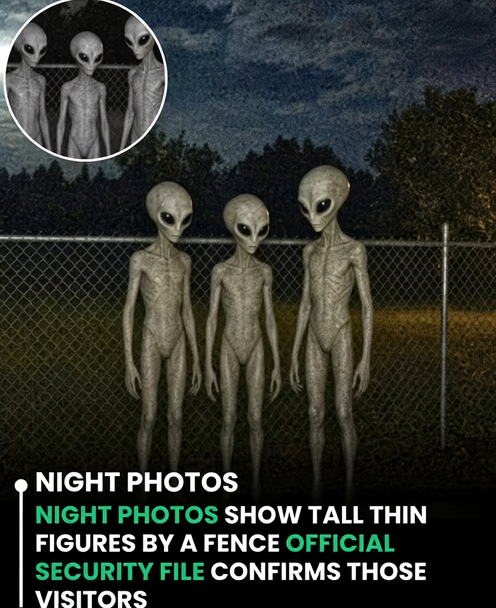
Three tall, extremely thin humanoid figures appear to be standing together beside a chain-link fence in the darkness of night.
Their silhouettes are immediately striking.
They appear unusually slender, with narrow bodies, elongated arms, and oversized heads. Their faces seem dominated by large, dark eyes, creating an appearance remarkably similar to the classic “Grey” beings described in countless UFO encounter stories.
At first glance, the image can be deeply unsettling.
The figures appear almost human—but not quite.
Their proportions seem unusual.
Their heads appear disproportionately large.
Their arms appear extremely long.
And their dark, featureless eyes create the impression that something unfamiliar may be standing just beyond the fence.
But what exactly are we looking at?
Is this genuinely unusual footage?
Could the figures represent something that has not yet been identified?
Or could the strange appearance be the result of darkness, distance, camera limitations, and the way modern night-vision systems process images?
That question is at the center of the mystery.
Nighttime cameras can produce some of the most visually confusing images imaginable.
When there is very little visible light, cameras often rely on infrared illumination or highly sensitive image sensors to capture details that the human eye would struggle to see.
The resulting footage can look dramatically different from what a person would see in normal daylight.
Fine details disappear.
Edges become blurred.
Colors may vanish entirely.
Background objects can merge together.
And human figures viewed from a distance can appear distorted.
A person standing near a fence may look unusually thin if their clothing blends into the darkness around them.
A head partially illuminated by infrared light can appear much larger or more rounded than it really is.
Eyes can become especially strange in low-light footage because reflective surfaces may react strongly to infrared illumination.
The result can be a face that appears almost completely dark, with bright or exaggerated eye regions—or, depending on the camera, a silhouette in which facial details disappear entirely.
Then there is compression.
Digital surveillance cameras frequently compress video in order to save storage space.
When an image contains mostly darkness, fine details can be lost even further.
Small movements become difficult to interpret.
Thin limbs may blend into shadows.
Edges can become blocky or smeared.
And when the original footage is later copied, uploaded, downloaded, edited, or reposted on social media, additional compression can reduce the available information even more.
This is particularly important when examining an extraordinary claim from a single image.
A still frame provides only a tiny portion of the information contained in a video.
It tells us what the scene looked like at one specific moment.
It does not necessarily tell us how the objects arrived there.
It does not reveal how they moved.
It may not establish their true size.
And it cannot always show whether an apparently unusual feature is actually part of the subject or simply an artifact of lighting and image processing.
That is why investigators examining unusual UAP footage generally need much more than a single dramatic frame.
The original recording is extremely important.
So are timestamps.
Camera settings.
Sensor information.
The exact location of the camera.
The distance between the camera and the apparent objects.
Weather conditions.
Lighting conditions.
Nearby structures.
And the frames immediately before and after the unusual image.
All of these details can potentially change the interpretation.
For example, suppose the figures appear to be seven or eight feet tall.
That impression could be completely different if the camera was actually positioned much farther away than initially ᴀssumed.
Perspective can dramatically alter the apparent size of objects.
A person standing close to a camera may appear enormous compared with another person several dozen meters away.
Likewise, someone standing behind a fence may appear unusually thin depending on the angle, lighting, and position of the fence itself.
Without reliable reference points, determining scale from an isolated nighttime image can be extremely difficult.
The chain-link fence visible in the scene could potentially provide useful information.
If investigators know the dimensions of the fence, its distance from the camera, and the exact position of the figures relative to it, they may be able to estimate the apparent height and proportions of the subjects.
But even then, perspective must be carefully considered.
This is why longer footage could be so important.
If the three figures remained in the area for several seconds or minutes, investigators could examine how they moved.
Do they walk normally?
Do their arms swing naturally?
Do their bodies maintain human-like proportions when viewed from different angles?
Do they interact with the fence?
Do they cast shadows?
Do they become clearer as they approach the camera?
Do their apparent proportions change when they move?
These details could help distinguish between a genuinely unusual object and a visual illusion.
Movement is particularly valuable because it provides information that a still pH๏τograph cannot.
A strange silhouette can look almost anything like a creature when frozen in one frame.
But when the same figure moves naturally, the illusion may disappear.
Alternatively, if a figure continues to display highly unusual proportions and behavior across multiple frames and viewing angles, the footage becomes more interesting and potentially more difficult to explain.
This is one reason official UAP investigations place significant importance on original data and context.
The U.S. government’s All-domain Anomaly Resolution Office, or AARO, has published cases involving unusual imagery where investigators were unable to determine exactly what had been captured because the available information was limited.
Importantly, an unresolved case does not automatically mean extraterrestrial.
“Unidentified” simply means that the available evidence is insufficient to establish a definitive explanation.
That distinction is essential when discussing mysterious footage.
A video can remain unexplained without proving that aliens are present.
Likewise, an object or figure can look remarkably strange without necessarily being something unknown.
There are countless examples of ordinary objects appearing extraordinary under unusual pH๏τographic conditions.
People wearing dark clothing can become almost featureless silhouettes.
Animals can look strangely shaped when partially obscured.
Branches and vegetation can resemble limbs.
Reflective surfaces can create apparently glowing eyes.
And digital artifacts can introduce shapes or patterns that were never physically present in the original scene.
The human brain also plays an important role.
When we see an ambiguous shape, our brains naturally try to recognize familiar patterns.
If we already expect to see a humanoid figure, an unclear silhouette may quickly be interpreted as a person.
If the image is presented as evidence of extraterrestrials, viewers may naturally compare the figures to familiar descriptions of Grey aliens.
That does not mean viewers are imagining everything.
It means perception is influenced by context.
And when the available visual information is incomplete, different people can look at the same image and reach very different conclusions.
The three figures beside the fence therefore remain an intriguing visual mystery.
Their appearance is certainly unusual.
Their tall, narrow forms and oversized heads strongly resemble the stereotypical Grey alien described in many UFO encounter accounts.
But appearance alone cannot establish what they are.
To move from speculation toward evidence, investigators would need the original recording and as much surrounding information as possible.
Where exactly was the camera?
What type of camera recorded the footage?
Was infrared illumination being used?
How far away were the figures?
How high was the fence?
How long were they visible?
Were there other people or animals nearby?
Did anyone witness the figures directly rather than through the camera?
And, perhaps most importantly, what do the frames immediately before and after the apparent encounter show?
Those questions could dramatically change the story.
If a longer recording showed three ordinary people walking into the area, the mystery might quickly disappear.
If the footage revealed animals, shadows, or objects creating the unusual silhouettes, another explanation could emerge.
But if the original high-quality recording showed the figures moving in ways that could not easily be explained by perspective, lighting, or ordinary human activity, investigators would have much more material to examine.
For now, the safest conclusion is also the most intriguing one:
We do not know exactly what these figures are.
They may represent an unusual visual effect.
They may be ordinary people or animals distorted by nighttime imaging.
They may be artifacts created by compression or infrared illumination.
Or they could remain genuinely unidentified.
What the image does not currently provide is confirmed evidence that extraterrestrial beings were standing beside that fence.
That possibility remains speculation.
And perhaps that uncertainty is exactly what makes the footage so fascinating.
Three mysterious silhouettes.
A dark night.
A chain-link fence.
And a camera capturing something that, at first glance, looks remarkably unlike anything ordinary.
Until the original footage, complete metadata, location information, and surrounding frames can be independently examined, the mystery remains open.
Aliens—or an extraordinary illusion created by an ordinary scene?
That is the question the footage leaves behind.
💔 STELLA PARTON BREAKS HER SILENCE — What She Said About Dolly’s Health Has Fans Looking Back
Dolly Parton’s Sister Breaks Silence What Really Happened - GMT - G1
Stella Parton was born May 4, 1949, the sixth of twelve children raised by Robert Lee and Avie Lee Parton in Sevierville, Tennessee — a household defined by noise, limited money, and almost no privacy, the kind of environment that produced strong, determined personalities.
Stella was one of them.
By seven, she was appearing alongside her older sister Dolly on a Knoxville television program; by her teens, she was writing her own songs, though marriage and motherhood pulled music to the margins of her life for a stretch.
The dream never fully disappeared.

In 1967, she recorded a gospel album with her mother and sisters, and later worked clubs in Washington, D.C., before founding her own record label in 1975 and releasing “I Want to Hold You in My Dreams Tonight,” which climbed to number nine on the country charts.
Long before any of that commercial success, Stella had already shown a willingness to take positions others avoided.
At 26, amid backlash against Australian singer Olivia Newton-John for winning recognition in country music, Stella recorded “Ode to Olivia” in her defense — a stand that offered her no career benefit and real risk of criticism, but one she took anyway simply because she believed staying silent was the wrong choice.
That instinct defined the rest of her career: hits like “The Danger of a Stranger” and “Steady as the Rain” (written by Dolly) built a genuine, independent following, including in the U.K., while Stella also worked in New York theater and spoke openly, often controversially, about poverty, domestic violence, and the treatment of women in the music industry.
She was named the Christian Country Music Association’s Female Vocalist of the Year in 2004.
Through all of it, she remained defined publicly, more often than not, as simply “Dolly’s little sister” — a label she spent five decades quietly proving didn’t tell the full story.
That same directness is why her comments in the fall of 2025 carried real weight.
Stella had never positioned herself as the family’s image manager or spokesperson; she was, by reputation, someone who believed difficult truths shouldn’t stay hidden indefinitely.
What she described wasn’t dramatic or accusatory — it was a portrait of a woman who had spent years prioritizing everyone else’s needs over her own.
The context mattered.
Carl Dean, Dolly’s husband of nearly sixty years, died in March 2025 at 82, after a long illness during which Dolly had devoted herself almost entirely to his care.
She later acknowledged that in the process, she’d neglected her own health significantly.
The loss reverberated through the whole extended family — the Partons had lost three brothers in the years surrounding this period, compounding grief that, for a family that had once crowded twelve children into a single small home, meant losing pieces of a shared childhood one after another.
Stella herself went seven years without releasing new music during this stretch, later describing the period simply as one shaped by sorrow, while still speaking about the importance of finding moments of laughter within it.
Looking back, one moment reads very differently in hindsight than it did at the time: in late September 2025, Dolly postponed her planned Las Vegas residency, citing health challenges — a rare cancellation for a performer whose six-decade career had included very few of them.
At the time, most fans treated it as a minor, temporary setback.
Stella’s later reflections suggested the signs had actually been building for some time, visible to family in ways the public smile made easy to miss.
That concern crystallized publicly not long after, when Dolly’s younger sister Frieda posted a simple request on Facebook asking fans to pray for Dolly.
What looked at first like an ordinary, well-meaning gesture spread rapidly, sparking widespread speculation about how serious Dolly’s condition actually was.
Dolly herself responded directly within days, appearing in a video from a Grand Ole Opry commercial shoot, insisting with her familiar humor that she wasn’t finished yet — the now widely remembered “I ain’t dead yet” moment that briefly quieted public concern.
In the months that followed, the pattern repeated: reassuring updates about kidney stones, dehydration, and treatment, paired with continued work on new projects, right up until Dolly Parton’s death on August 25, 2026, at 80.
Looking back across that full timeline — the postponed residency, the family’s public worry, Stella’s own account of a sister who consistently deprioritized her own wellbeing — it becomes easier to see what the people closest to Dolly understood well before the rest of the world did: that the warmth and resilience the public saw every time she appeared on camera came at a real, largely invisible cost.