The monumental rock relief of Shapur I at Naqsh-e Rostam stands as one of the most magnificent and enduring testaments to Sasanian political and military dominance in the ancient world. Chronologically dated to the 3rd century CE—specifically carved following the historic Sasanian victory over the Roman Empire around 260 CE—this archaeological masterwork visually encapsulates a pivotal shift in the geopolitical balance of power between Persia and Rome. Located on a sheer cliff face just a few kilometers north of Persepolis in modern-day Iran, the site was already steeped in sacred royal history, situated directly beneath the cliff-cut rock tombs of earlier Achaemenid kings. By selecting this venerable backdrop, the Sasanian monarchs deliberately anchored their imperial legitimacy in the deep historical and cultural continuum of ancient Persian civilization.
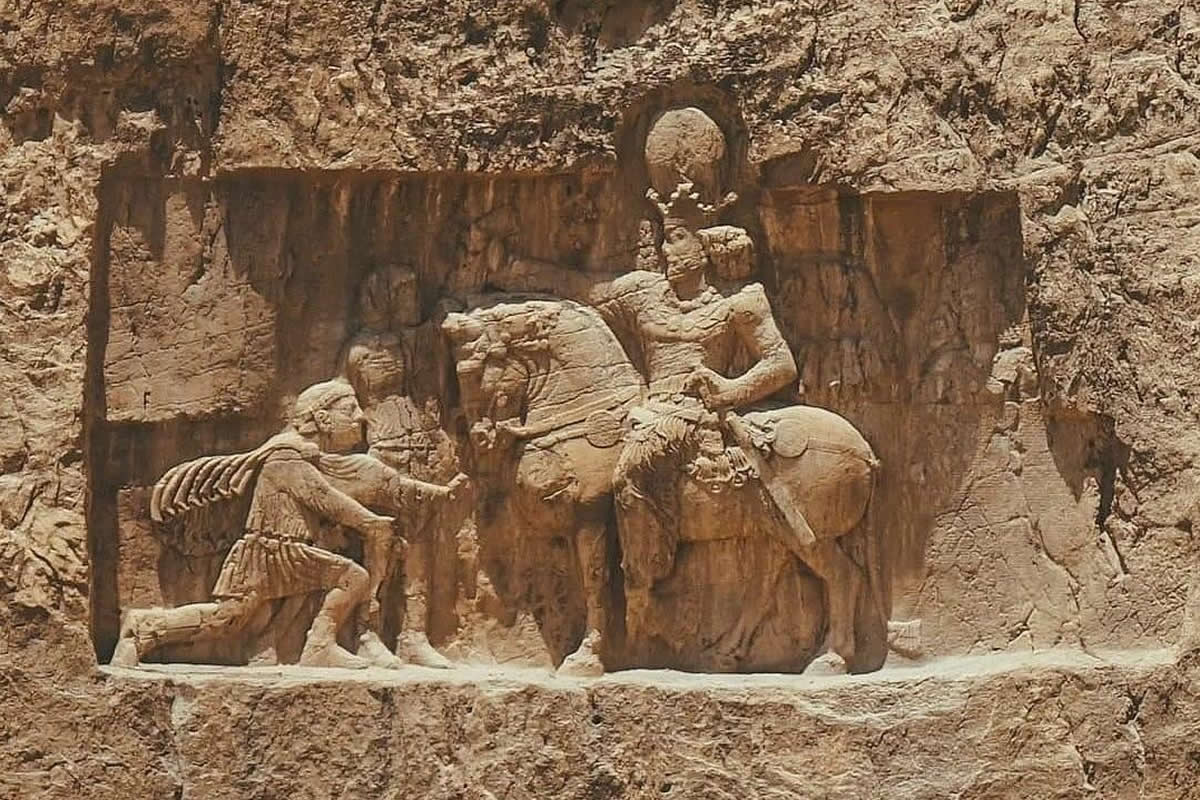
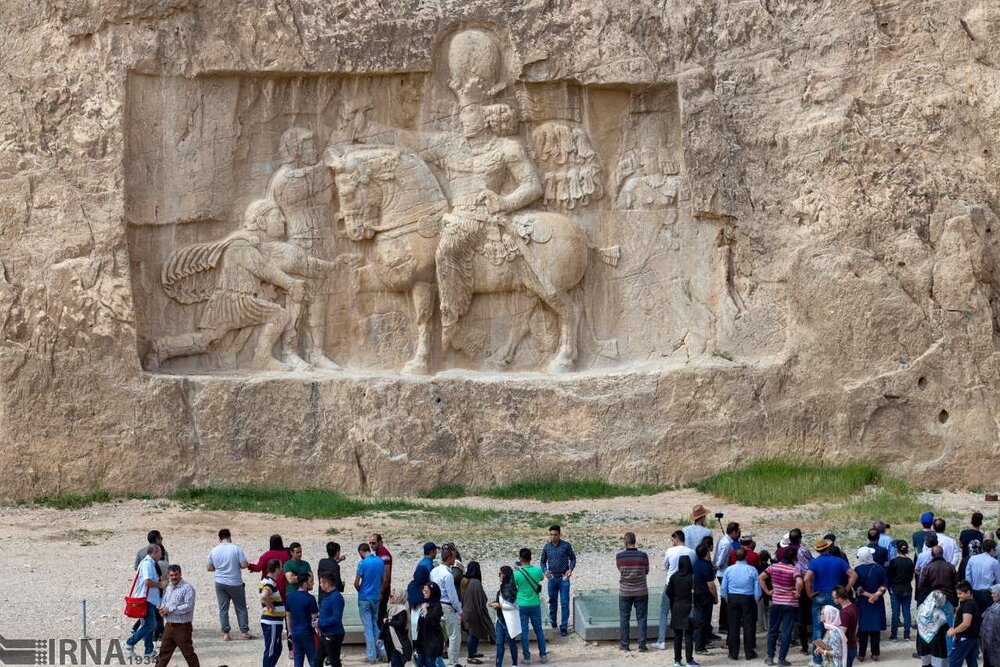
From an archaeological and material perspective, the monument is a rock-cut bas-relief carved directly into the living limestone of the Zagros Mountains. Spanning approximately 11 meters in width and 5 meters in height, the composition is executed in high relief, creating a dramatic sense of depth, volume, and realistic texture that reflects a sophisticated synthesis of native Persian traditions and Hellenistic artistic influences. The intricate details of the scene are meticulously chiseled: King Shapur I is depicted mounted upon a robust, elaborately caparisoned royal steed with ornate floral saddlecloths, a knotted tail adorned with pleated ribbons, and a carefully arranged mane. The sculptors paid exceptional attention to textile rendering, displaying the rippling folds of the king’s billowing cloak, his pleated tunic, the Roman togas of the captive figures, and the finely detailed imperial crowns and weaponry.
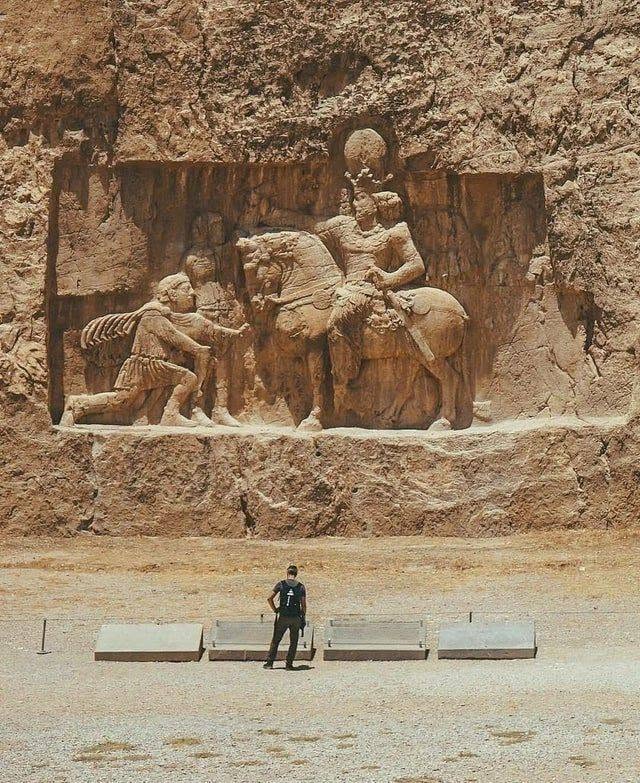
The iconographic narrative of the relief portrays a triple encounter between the Sasanian sovereign and three Roman emperors, immortalizing a level of humiliation unprecedented in Roman history. King Shapur I sits upright with supreme royal composure, his right hand firmly grasping the wrist of the standing Roman Emperor Valerian—who was captured alive at the historic Battle of Edessa—while another Roman emperor, traditionally identified as Philip the Arab, kneels in supplication before the horse’s legs, and a third, Gordian III, lies vanquished beneath the mount. The primary function of this grand artistic program was political propaganda and ideological reinforcement. It served to project the divine mandate of the Sasanian king, validating his supreme authority through the Zoroastrian concept of korymbos and royal glory, while simultaneously broadcasting to both domestic subjects and foreign rivals that the Persian Empire stood as the unrivaled master of the Near East.

Unlike portable artifacts recovered through subterranean excavation, this immovable rock-cut monument was created through a public commission directed by the royal court of the Sasanian Empire under the personal oversight of King Shapur I (reigned 240–272 CE). Skilled imperial lapidary artisans and master stone-carvers executed the monumental relief, later accompanied by trilingual inscriptions in Middle Persian, Parthian, and Greek, as well as an adjacent rock carving added around 280 CE by the influential Zoroastrian high priest Kartir. Because the relief is exposed to the open air on a permanent cliff face, it was never “discovered” or excavated in the traditional archaeological sense, but rather has remained continuously visible and documented by travelers, epigraphers, and modern archaeological expeditions studying the legacy of ancient Near Eastern civilizations.
Today, the Naqsh-e Rostam relief remains an irreplaceable anchor for historical and archaeological research into Late Antiquity, offering scholars direct insight into Sasanian military organization, royal ideology, costume history, and imperial art. It preserves invaluable primary epigraphic evidence that corroborates and expands upon royal archives, shedding light on how ancient states utilized monumental public art to immortalize their triumphs over geopolitical rivals. Protected as a crucial part of the cultural heritage of the Persepolis region, the site continues to draw researchers and historians globally, ensuring that the visual legacy of Shapur I’s historic triumph endures as a defining monument of ancient human achievement.
💔 STELLA PARTON BREAKS HER SILENCE — What She Said About Dolly’s Health Has Fans Looking Back
Dolly Parton’s Sister Breaks Silence What Really Happened - GMT - G1
Stella Parton was born May 4, 1949, the sixth of twelve children raised by Robert Lee and Avie Lee Parton in Sevierville, Tennessee — a household defined by noise, limited money, and almost no privacy, the kind of environment that produced strong, determined personalities.
Stella was one of them.
By seven, she was appearing alongside her older sister Dolly on a Knoxville television program; by her teens, she was writing her own songs, though marriage and motherhood pulled music to the margins of her life for a stretch.
The dream never fully disappeared.

In 1967, she recorded a gospel album with her mother and sisters, and later worked clubs in Washington, D.C., before founding her own record label in 1975 and releasing “I Want to Hold You in My Dreams Tonight,” which climbed to number nine on the country charts.
Long before any of that commercial success, Stella had already shown a willingness to take positions others avoided.
At 26, amid backlash against Australian singer Olivia Newton-John for winning recognition in country music, Stella recorded “Ode to Olivia” in her defense — a stand that offered her no career benefit and real risk of criticism, but one she took anyway simply because she believed staying silent was the wrong choice.
That instinct defined the rest of her career: hits like “The Danger of a Stranger” and “Steady as the Rain” (written by Dolly) built a genuine, independent following, including in the U.K., while Stella also worked in New York theater and spoke openly, often controversially, about poverty, domestic violence, and the treatment of women in the music industry.
She was named the Christian Country Music Association’s Female Vocalist of the Year in 2004.
Through all of it, she remained defined publicly, more often than not, as simply “Dolly’s little sister” — a label she spent five decades quietly proving didn’t tell the full story.
That same directness is why her comments in the fall of 2025 carried real weight.
Stella had never positioned herself as the family’s image manager or spokesperson; she was, by reputation, someone who believed difficult truths shouldn’t stay hidden indefinitely.
What she described wasn’t dramatic or accusatory — it was a portrait of a woman who had spent years prioritizing everyone else’s needs over her own.
The context mattered.
Carl Dean, Dolly’s husband of nearly sixty years, died in March 2025 at 82, after a long illness during which Dolly had devoted herself almost entirely to his care.
She later acknowledged that in the process, she’d neglected her own health significantly.
The loss reverberated through the whole extended family — the Partons had lost three brothers in the years surrounding this period, compounding grief that, for a family that had once crowded twelve children into a single small home, meant losing pieces of a shared childhood one after another.
Stella herself went seven years without releasing new music during this stretch, later describing the period simply as one shaped by sorrow, while still speaking about the importance of finding moments of laughter within it.
Looking back, one moment reads very differently in hindsight than it did at the time: in late September 2025, Dolly postponed her planned Las Vegas residency, citing health challenges — a rare cancellation for a performer whose six-decade career had included very few of them.
At the time, most fans treated it as a minor, temporary setback.
Stella’s later reflections suggested the signs had actually been building for some time, visible to family in ways the public smile made easy to miss.
That concern crystallized publicly not long after, when Dolly’s younger sister Frieda posted a simple request on Facebook asking fans to pray for Dolly.
What looked at first like an ordinary, well-meaning gesture spread rapidly, sparking widespread speculation about how serious Dolly’s condition actually was.
Dolly herself responded directly within days, appearing in a video from a Grand Ole Opry commercial shoot, insisting with her familiar humor that she wasn’t finished yet — the now widely remembered “I ain’t dead yet” moment that briefly quieted public concern.
In the months that followed, the pattern repeated: reassuring updates about kidney stones, dehydration, and treatment, paired with continued work on new projects, right up until Dolly Parton’s death on August 25, 2026, at 80.
Looking back across that full timeline — the postponed residency, the family’s public worry, Stella’s own account of a sister who consistently deprioritized her own wellbeing — it becomes easier to see what the people closest to Dolly understood well before the rest of the world did: that the warmth and resilience the public saw every time she appeared on camera came at a real, largely invisible cost.