The monumental ruins of Roman aqueducts stand as some of the most extraordinary and enduring achievements of imperial engineering in the ancient world. Chronologically dated to the classical period of the Roman Empire—spanning primarily from the late 1st century BCE through the 2nd century CE—these expansive water-supply networks symbolize a golden age of structural innovation, municipal expansion, and centralized state organization. Located across vast territories throughout the Mediterranean basin, Europe, and the Near East—including iconic surviving segments in Italy, Spain, and France—these grand architectural frameworks were strategically positioned to traverse complex natural topographies, linking distant mountain springs directly to thriving urban centers.
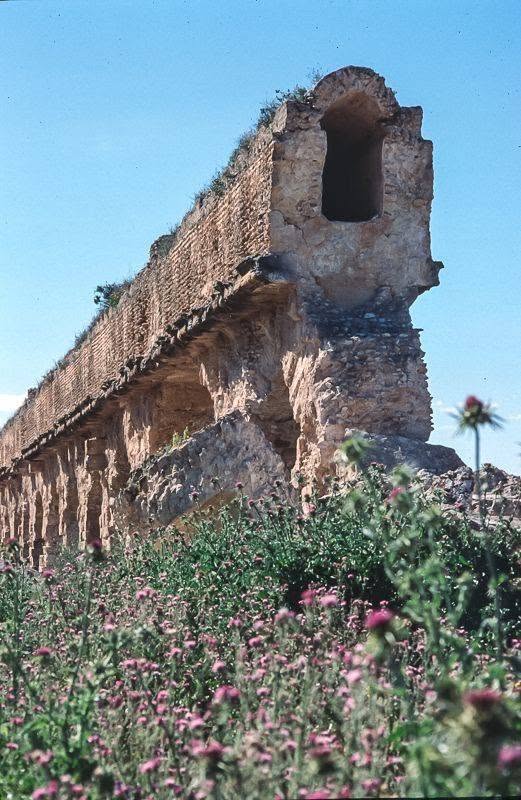
From an archaeological and material perspective, these towering arcades were constructed using a combination of locally sourced stone blocks, durable bricks, and specialized Roman concrete (opus caementicium) bound by strong lime mortar. The structural details showcase advanced masonry techniques, featuring precision-cut voussoirs that formed semi-circular arches designed to evenly distribute mᴀssive weight loads across sturdy structural piers. At the topmost section of the structure, archaeologists encounter the enclosed water channel (specus), which was frequently lined with waterproof hydraulic mortar containing crushed pottery to prevent leakage, while wooden scaffolding and temporary centering frameworks were systematically employed by ancient builders during the construction phase.

The primary function of these mᴀssive structures was to harness the force of gravity to transport millions of gallons of fresh, clean water continuously over dozens or even hundreds of miles without the aid of mechanical pumps. While the vast majority of the aqueduct systems ran safely underground to protect the water supply from contamination and temperature extremes, these monumental arched bridges were strictly engineered to carry the water channels smoothly across lowlands, valleys, and deep river gorges. Inside urban environments, this steady influx of water served vital civic purposes, supplying public baths, ornamental fountains, latrines, and private households, thereby establishing water access as a cornerstone of Roman civilization and public health.
Unlike portable artifacts recovered through traditional subterranean excavation, these monumental architectural complexes are permanent elements of the landscape that have remained visible above ground for millennia, continuously studied through architectural archaeology and epigraphic analysis. They were originally commissioned, financed, and directed by powerful Roman magistrates, censors, and emperors—such as Appius Claudius Caecus, Augustus, and Claudius—and executed by thousands of military engineers, skilled craftsmen, and laborers. Modern archaeological investigations, mapping projects, and structural conservation efforts led by international insтιтutions continue to document these ruins, shedding light on the socio-economic organization, labor management, and advanced hydraulic knowledge of the Roman state.
Today, these aqueduct remnants serve as invaluable historical archives that allow modern researchers to reconstruct the environmental impact, urban planning strategies, and technological sophistication of antiquity. They remain powerful visual reminders of how ancient societies successfully manipulated their natural surroundings to sustain mᴀssive urban populations, leaving an architectural heritage that still influences modern civil engineering and water management principles. Protected globally as vital cultural landmarks, these structures ensure that the monumental legacy of Roman ingenuity continues to inspire awe and scholarly inquiry across generations.
💔 STELLA PARTON BREAKS HER SILENCE — What She Said About Dolly’s Health Has Fans Looking Back
Dolly Parton’s Sister Breaks Silence What Really Happened - GMT - G1
Stella Parton was born May 4, 1949, the sixth of twelve children raised by Robert Lee and Avie Lee Parton in Sevierville, Tennessee — a household defined by noise, limited money, and almost no privacy, the kind of environment that produced strong, determined personalities.
Stella was one of them.
By seven, she was appearing alongside her older sister Dolly on a Knoxville television program; by her teens, she was writing her own songs, though marriage and motherhood pulled music to the margins of her life for a stretch.
The dream never fully disappeared.

In 1967, she recorded a gospel album with her mother and sisters, and later worked clubs in Washington, D.C., before founding her own record label in 1975 and releasing “I Want to Hold You in My Dreams Tonight,” which climbed to number nine on the country charts.
Long before any of that commercial success, Stella had already shown a willingness to take positions others avoided.
At 26, amid backlash against Australian singer Olivia Newton-John for winning recognition in country music, Stella recorded “Ode to Olivia” in her defense — a stand that offered her no career benefit and real risk of criticism, but one she took anyway simply because she believed staying silent was the wrong choice.
That instinct defined the rest of her career: hits like “The Danger of a Stranger” and “Steady as the Rain” (written by Dolly) built a genuine, independent following, including in the U.K., while Stella also worked in New York theater and spoke openly, often controversially, about poverty, domestic violence, and the treatment of women in the music industry.
She was named the Christian Country Music Association’s Female Vocalist of the Year in 2004.
Through all of it, she remained defined publicly, more often than not, as simply “Dolly’s little sister” — a label she spent five decades quietly proving didn’t tell the full story.
That same directness is why her comments in the fall of 2025 carried real weight.
Stella had never positioned herself as the family’s image manager or spokesperson; she was, by reputation, someone who believed difficult truths shouldn’t stay hidden indefinitely.
What she described wasn’t dramatic or accusatory — it was a portrait of a woman who had spent years prioritizing everyone else’s needs over her own.
The context mattered.
Carl Dean, Dolly’s husband of nearly sixty years, died in March 2025 at 82, after a long illness during which Dolly had devoted herself almost entirely to his care.
She later acknowledged that in the process, she’d neglected her own health significantly.
The loss reverberated through the whole extended family — the Partons had lost three brothers in the years surrounding this period, compounding grief that, for a family that had once crowded twelve children into a single small home, meant losing pieces of a shared childhood one after another.
Stella herself went seven years without releasing new music during this stretch, later describing the period simply as one shaped by sorrow, while still speaking about the importance of finding moments of laughter within it.
Looking back, one moment reads very differently in hindsight than it did at the time: in late September 2025, Dolly postponed her planned Las Vegas residency, citing health challenges — a rare cancellation for a performer whose six-decade career had included very few of them.
At the time, most fans treated it as a minor, temporary setback.
Stella’s later reflections suggested the signs had actually been building for some time, visible to family in ways the public smile made easy to miss.
That concern crystallized publicly not long after, when Dolly’s younger sister Frieda posted a simple request on Facebook asking fans to pray for Dolly.
What looked at first like an ordinary, well-meaning gesture spread rapidly, sparking widespread speculation about how serious Dolly’s condition actually was.
Dolly herself responded directly within days, appearing in a video from a Grand Ole Opry commercial shoot, insisting with her familiar humor that she wasn’t finished yet — the now widely remembered “I ain’t dead yet” moment that briefly quieted public concern.
In the months that followed, the pattern repeated: reassuring updates about kidney stones, dehydration, and treatment, paired with continued work on new projects, right up until Dolly Parton’s death on August 25, 2026, at 80.
Looking back across that full timeline — the postponed residency, the family’s public worry, Stella’s own account of a sister who consistently deprioritized her own wellbeing — it becomes easier to see what the people closest to Dolly understood well before the rest of the world did: that the warmth and resilience the public saw every time she appeared on camera came at a real, largely invisible cost.