The discovery of the monumental epigraphic boulder, widely recognized as a classic example of ancient Egyptian desert stelae, represents a fascinating intersection of natural geology and royal propaganda. Dating primarily to the Ptolemaic Period (circa 332–31 BCE) with historical foundations tracing back to earlier dynastic traditions, this remarkable artifact is carved directly into the face of a freestanding granite monolith. From an archaeological perspective, such rock-cut stelae provide invaluable insights into how ancient states claimed sovereign ownership over remote frontiers, trade routes, and sacred landscapes. The choice of a prominent, weather-worn natural boulder rather than a quarried slab demonstrates a sophisticated pragmatic approach to monumental architecture in the arid desert environment of Upper Egypt.

The primary site of discovery is Sehel Island, situated along the Nile River just upstream from the First Cataract near the modern city of Aswan. Historically functioning as a vital granite quarry and a strategic gateway to Nubia, Sehel Island was a sacred landscape heavily saturated with thousands of petroglyphs, votive inscriptions, and royal decrees left by pilgrims, merchants, and pharaonic officials over millennia. The specific geological context—comprising dense, dark igneous rock weathered by centuries of desert sun and wind—provided an exceptionally stable canvas for long-term preservation. Within this dramatic landscape, the monolithic boulder was selected not only for its prominent visibility along ancient desert tracks but also for its symbolic proximity to the divine boundary waters of the Nile cataracts.
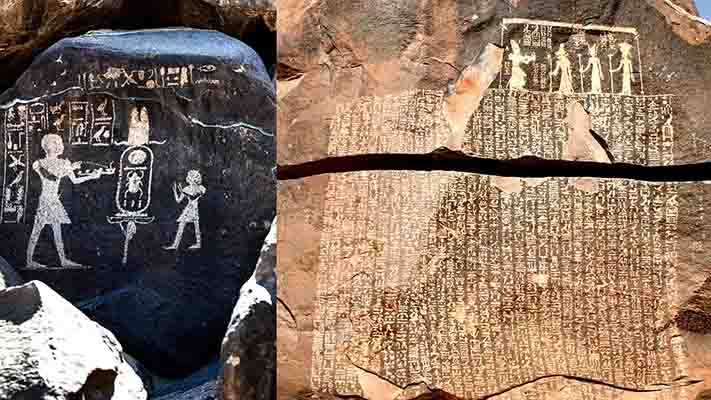
In terms of material composition and manufacturing details, the artifact is a masterclass in ancient stone-cutting technology executed directly on coarse-grained natural granite. The craftsmanship involved meticulously smoothing a rectangular field onto the uneven face of the boulder, followed by deep incision of precise Egyptian hieroglyphic columns and intricate relief carvings at the top. The upper register typically depicts the reigning monarch making ritual offerings to regional deities such as Khnum, Satis, and Anuket, framed within a traditional architectural naos. Despite a pronounced natural horizontal fissure splitting the boulder—a geological fracture that existed before the carvers began their work—the ancient scribes and artisans skillfully integrated the flaw into the layout of the text, ensuring structural continuity and legibility across the broken stone matrix.
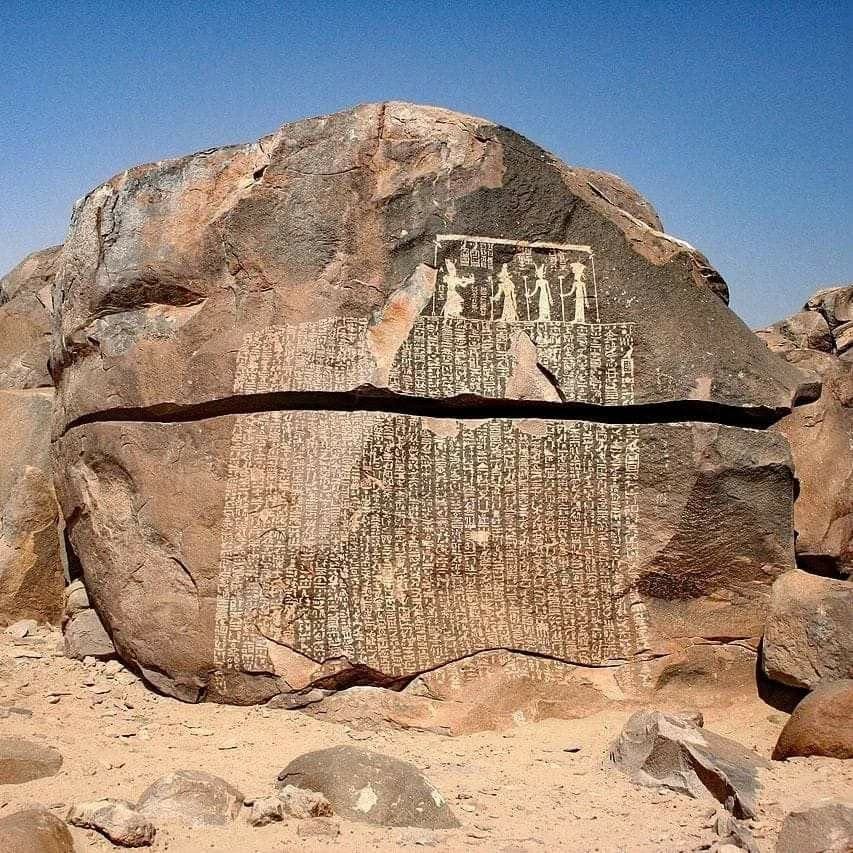
The functional utility and cultural significance of this monumental rock stela extend far beyond simple artistic expression, serving profound socio-religious and political purposes. Historically, inscriptions of this nature—such as the famous Famine Stela found on the same island—were utilized to legitimize royal authority, commemorate divine interventions, or record state-sanctioned decrees regarding land grants, temple taxes, and water management during times of environmental crisis. For travelers, sailors, and caravaneers navigating the treacherous rapids of the First Cataract, encountering such divine pronouncements carved into monumental stone reinforced the absolute power of the pharaoh and the protective grace of local gods. Thus, the boulder functioned simultaneously as an eternal royal proclamation, a sacred boundary marker, and a permanent plea for cosmic equilibrium.
The systematic documentation, study, and conservation of these rock-cut monuments have been spearheaded by generations of international Egyptologists and archaeological missions, building upon early pioneering surveys conducted by the Egyptian Antiquities Service in the late nineteenth and early twentieth centuries. Modern epigraphic teams utilize advanced digital pH๏τogrammetry, laser scanning, and raking-light pH๏τography to record eroded hieroglyphic columns that are otherwise invisible to the naked eye. Through meticulous cataloging by organizations such as the Supreme Council of Antiquities and various academic insтιтutions, these desert inscriptions are preserved against modern environmental degradation and tourist impact. Today, the Sehel rock stelae stand as immortal testaments to the collaborative genius of ancient scribes, stonecutters, and modern archaeological preservationists alike.
💔 STELLA PARTON BREAKS HER SILENCE — What She Said About Dolly’s Health Has Fans Looking Back
Dolly Parton’s Sister Breaks Silence What Really Happened - GMT - G1
Stella Parton was born May 4, 1949, the sixth of twelve children raised by Robert Lee and Avie Lee Parton in Sevierville, Tennessee — a household defined by noise, limited money, and almost no privacy, the kind of environment that produced strong, determined personalities.
Stella was one of them.
By seven, she was appearing alongside her older sister Dolly on a Knoxville television program; by her teens, she was writing her own songs, though marriage and motherhood pulled music to the margins of her life for a stretch.
The dream never fully disappeared.

In 1967, she recorded a gospel album with her mother and sisters, and later worked clubs in Washington, D.C., before founding her own record label in 1975 and releasing “I Want to Hold You in My Dreams Tonight,” which climbed to number nine on the country charts.
Long before any of that commercial success, Stella had already shown a willingness to take positions others avoided.
At 26, amid backlash against Australian singer Olivia Newton-John for winning recognition in country music, Stella recorded “Ode to Olivia” in her defense — a stand that offered her no career benefit and real risk of criticism, but one she took anyway simply because she believed staying silent was the wrong choice.
That instinct defined the rest of her career: hits like “The Danger of a Stranger” and “Steady as the Rain” (written by Dolly) built a genuine, independent following, including in the U.K., while Stella also worked in New York theater and spoke openly, often controversially, about poverty, domestic violence, and the treatment of women in the music industry.
She was named the Christian Country Music Association’s Female Vocalist of the Year in 2004.
Through all of it, she remained defined publicly, more often than not, as simply “Dolly’s little sister” — a label she spent five decades quietly proving didn’t tell the full story.
That same directness is why her comments in the fall of 2025 carried real weight.
Stella had never positioned herself as the family’s image manager or spokesperson; she was, by reputation, someone who believed difficult truths shouldn’t stay hidden indefinitely.
What she described wasn’t dramatic or accusatory — it was a portrait of a woman who had spent years prioritizing everyone else’s needs over her own.
The context mattered.
Carl Dean, Dolly’s husband of nearly sixty years, died in March 2025 at 82, after a long illness during which Dolly had devoted herself almost entirely to his care.
She later acknowledged that in the process, she’d neglected her own health significantly.
The loss reverberated through the whole extended family — the Partons had lost three brothers in the years surrounding this period, compounding grief that, for a family that had once crowded twelve children into a single small home, meant losing pieces of a shared childhood one after another.
Stella herself went seven years without releasing new music during this stretch, later describing the period simply as one shaped by sorrow, while still speaking about the importance of finding moments of laughter within it.
Looking back, one moment reads very differently in hindsight than it did at the time: in late September 2025, Dolly postponed her planned Las Vegas residency, citing health challenges — a rare cancellation for a performer whose six-decade career had included very few of them.
At the time, most fans treated it as a minor, temporary setback.
Stella’s later reflections suggested the signs had actually been building for some time, visible to family in ways the public smile made easy to miss.
That concern crystallized publicly not long after, when Dolly’s younger sister Frieda posted a simple request on Facebook asking fans to pray for Dolly.
What looked at first like an ordinary, well-meaning gesture spread rapidly, sparking widespread speculation about how serious Dolly’s condition actually was.
Dolly herself responded directly within days, appearing in a video from a Grand Ole Opry commercial shoot, insisting with her familiar humor that she wasn’t finished yet — the now widely remembered “I ain’t dead yet” moment that briefly quieted public concern.
In the months that followed, the pattern repeated: reassuring updates about kidney stones, dehydration, and treatment, paired with continued work on new projects, right up until Dolly Parton’s death on August 25, 2026, at 80.
Looking back across that full timeline — the postponed residency, the family’s public worry, Stella’s own account of a sister who consistently deprioritized her own wellbeing — it becomes easier to see what the people closest to Dolly understood well before the rest of the world did: that the warmth and resilience the public saw every time she appeared on camera came at a real, largely invisible cost.

:max_bytes(150000):strip_icc():focal(749x0:751x2):format(webp)/christa-pike-093026-8626d70f4a344768827ba5a8f02adee2.jpg "Christa Pike Remains ‘Alive and Snoring’ After 2 Lethal Injections, Her Lawyer Says")