THE DOVER DEMON — THREE NIGHTS, FOUR WITNESSES, AND ONE OF THE STRANGEST CREATURE REPORTS IN AMERICAN HISTORY
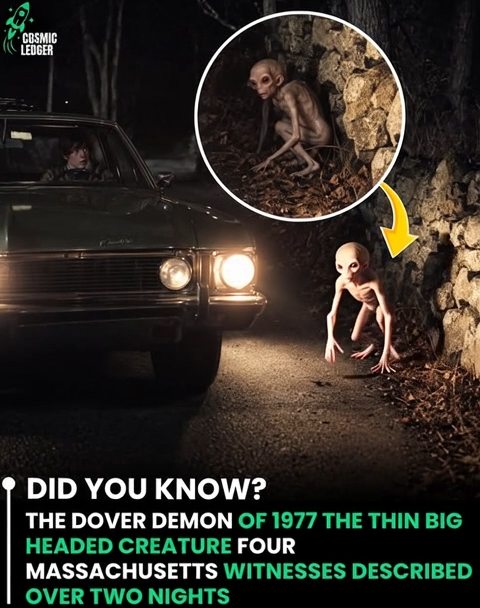
Late at night on April 21, 1977, a 17-year-old Mᴀssachusetts teenager named Bill Bartlett was driving through the quiet roads of Dover.
It was the kind of night when darkness seemed to swallow everything beyond the reach of the headlights.
Then Bartlett saw something moving.
At first, it appeared to be an animal crawling along a low stone wall beside the road.
But as his headlights illuminated the figure, Bartlett realized that whatever he was looking at did not resemble any animal he recognized.
According to his account, the creature was small and extremely thin, with unusually long limbs, pale skin, and an enormous head.
The head, he later said, was shaped almost like a watermelon.
The encounter lasted only moments.
But those moments would eventually become one of the most famous unexplained creature cases in American folklore.
The creature would later be known as the Dover Demon.
And what made the story especially strange was that Bartlett was not the only person who claimed to see it.
A STRANGE FIGURE IN THE HEADLIGHTS
Bartlett’s reported encounter happened shortly before midnight.
As he drove through Dover, Mᴀssachusetts, his headlights illuminated the unusual figure near a stone wall.
The creature was described as having a disproportionately large head compared with its thin body.
Its limbs appeared long and slender, giving it an unusual silhouette.
Its skin was reportedly pale, adding to the eerie appearance created by the darkness and headlights.
But perhaps the most memorable feature was the head.
Rather than having the proportions of a normal human being or animal, it appeared enormous and rounded.
Bartlett reportedly became convinced that he was looking at something he had never encountered before.
He later created a sketch of what he said he had seen.
That drawing would become central to the mystery.
It was not a detailed scientific illustration.
It was the attempt of a teenager to put an extraordinary experience onto paper.
Yet the image was unsettling precisely because of its simplicity: a thin, humanoid figure with elongated arms and legs and an enormous head.
The sketch would eventually become one of the defining images ᴀssociated with the Dover Demon legend.
THEN ANOTHER SIGHTING
If Bartlett’s story had ended there, it might have remained an unusual personal encounter.
But later that same night, another teenager reportedly encountered a strange figure in the area.
The description was said to resemble Bartlett’s account.
This was significant because the second report appeared to involve a similar-looking creature in roughly the same region.
Then, on the following evening, two more young people reportedly described seeing something that matched the unusual description.
Suddenly, the story was no longer based on a single witness.
Several young people had reportedly encountered a strange figure over a short period of time.
The sightings became connected.
And that connection transformed an obscure local story into a paranormal mystery.
FOUR WITNESSES — ONE STRANGE DESCRIPTION
The reports became particularly intriguing because of the similarities between the descriptions.
The witnesses reportedly described a figure with an unusually large head, a thin body, long limbs, and pale coloration.
Those characteristics became the foundation of what people would later recognize as the Dover Demon.
But there was an important limitation.
There was no captured creature.
There was no physical specimen.
There were no verified pH๏τographs showing the being.
There was no biological evidence demonstrating that an unknown species had been present.
The entire mystery rested primarily on eyewitness testimony and the drawings ᴀssociated with the reports.
That distinction matters.
An unexplained sighting can be genuinely mysterious without automatically proving that a supernatural or extraterrestrial creature exists.
Eyewitnesses can sincerely describe what they believe they saw, while darkness, distance, unusual animals, lighting conditions, expectation, and memory can all influence perception.
And in the Dover case, those questions remain part of the mystery.
ENTER LOREN COLEMAN
The reports eventually attracted the attention of researcher Loren Coleman, who investigated the accounts and helped bring the case into the wider world of cryptozoology and paranormal research.
Coleman gave the reported creature a name:
The Dover Demon.
The name helped transform a series of strange local sightings into a recognizable piece of American monster folklore.
Unlike legendary creatures with centuries of reported history, the Dover Demon was ᴀssociated with a very specific time and place.
Three nights.
Several young witnesses.
One unusual description.
And a drawing that would become inseparable from the story.
That specificity is one reason the case continues to attract attention decades later.
WHAT COULD THE WITNESSES HAVE SEEN?
Theories about the Dover Demon have ranged widely.
Some explanations are entirely ordinary.
A person seeing an unfamiliar animal at night could misinterpret its shape, especially if the animal were partially hidden behind a wall or vegetation.
The position of the creature could also dramatically alter its apparent proportions.
An animal viewed from an unusual angle could appear to have longer limbs or a larger head than it actually possessed.
Darkness can make identification even more difficult.
When the human brain encounters an unfamiliar shape, it attempts to interpret the available visual information.
A brief glimpse illuminated by headlights may provide only fragments of information.
The brain fills in the gaps.
That does not mean a witness is lying.
It means perception itself can be complicated.
Another possibility is that the reports influenced one another.
Once one unusual creature description becomes known within a small group, later witnesses may unconsciously incorporate elements of that description into their own memories.
However, the reported timing of the sightings is also part of what makes the case interesting.
The witnesses were young, the encounters were reportedly brief, and the events occurred within a narrow geographic and temporal window.
Those details have helped preserve the mystery.
THE DRAWING THAT REFUSED TO DISAPPEAR
More than the descriptions, perhaps the most enduring element of the story is Bartlett’s sketch.
It remains striking because it does not look like a conventional monster.
There are no horns.
No claws.
No enormous teeth.
Instead, the figure is unsettling because it looks vaguely humanoid while being profoundly unfamiliar.
Its proportions are wrong.
The head is far too large.
The body appears thin.
The limbs seem unusually elongated.
The result is an image that feels almost like something remembered from a dream.
That quality has helped the drawing survive as one of the most recognizable images ᴀssociated with the case.
For paranormal enthusiasts, it represents a possible encounter with an unknown being.
For skeptics, it represents an example of how a strange nighttime observation can become a powerful legend.
For researchers, it remains an intriguing case study in eyewitness testimony and folklore.
DECADES LATER, THE QUESTION REMAINS
No verified creature matching the Dover Demon description has been identified.
No biological classification has been established.
No physical evidence has confirmed that the witnesses encountered an unknown species.
And there have been no widely accepted repeat sightings establishing a continuing population of such creatures.
Yet the story has never completely disappeared.
The reason may be simple.
The Dover Demon occupies an unusual space between folklore and eyewitness mystery.
It is not an ancient legend pᴀssed down for centuries.
It is a modern story tied to named witnesses, a specific location, a specific period, and a famous drawing.
And that makes it feel strangely close to us.
Imagine driving alone on a dark Mᴀssachusetts road.
Your headlights sweep across a stone wall.
For a fraction of a second, something pale moves through the darkness.
You slow down.
You look again.
And whatever you saw is gone.
Was it an animal?
A person?
A trick of light and shadow?
A momentary misinterpretation?
Or something that has never been properly identified?
There is no confirmed answer.
That uncertainty is precisely what keeps the Dover Demon alive.
Nearly half a century after those reported sightings, the creature remains a strange footnote in American paranormal history — remembered not because anyone proved what it was, but because no one ever conclusively determined what those teenagers actually saw.
And perhaps that is the most haunting part of the story.
Three nights. Several witnesses. One unforgettable sketch.
And a creature that, after all these years, still has no confirmed explanation.
💔 STELLA PARTON BREAKS HER SILENCE — What She Said About Dolly’s Health Has Fans Looking Back
Dolly Parton’s Sister Breaks Silence What Really Happened - GMT - G1
Stella Parton was born May 4, 1949, the sixth of twelve children raised by Robert Lee and Avie Lee Parton in Sevierville, Tennessee — a household defined by noise, limited money, and almost no privacy, the kind of environment that produced strong, determined personalities.
Stella was one of them.
By seven, she was appearing alongside her older sister Dolly on a Knoxville television program; by her teens, she was writing her own songs, though marriage and motherhood pulled music to the margins of her life for a stretch.
The dream never fully disappeared.

In 1967, she recorded a gospel album with her mother and sisters, and later worked clubs in Washington, D.C., before founding her own record label in 1975 and releasing “I Want to Hold You in My Dreams Tonight,” which climbed to number nine on the country charts.
Long before any of that commercial success, Stella had already shown a willingness to take positions others avoided.
At 26, amid backlash against Australian singer Olivia Newton-John for winning recognition in country music, Stella recorded “Ode to Olivia” in her defense — a stand that offered her no career benefit and real risk of criticism, but one she took anyway simply because she believed staying silent was the wrong choice.
That instinct defined the rest of her career: hits like “The Danger of a Stranger” and “Steady as the Rain” (written by Dolly) built a genuine, independent following, including in the U.K., while Stella also worked in New York theater and spoke openly, often controversially, about poverty, domestic violence, and the treatment of women in the music industry.
She was named the Christian Country Music Association’s Female Vocalist of the Year in 2004.
Through all of it, she remained defined publicly, more often than not, as simply “Dolly’s little sister” — a label she spent five decades quietly proving didn’t tell the full story.
That same directness is why her comments in the fall of 2025 carried real weight.
Stella had never positioned herself as the family’s image manager or spokesperson; she was, by reputation, someone who believed difficult truths shouldn’t stay hidden indefinitely.
What she described wasn’t dramatic or accusatory — it was a portrait of a woman who had spent years prioritizing everyone else’s needs over her own.
The context mattered.
Carl Dean, Dolly’s husband of nearly sixty years, died in March 2025 at 82, after a long illness during which Dolly had devoted herself almost entirely to his care.
She later acknowledged that in the process, she’d neglected her own health significantly.
The loss reverberated through the whole extended family — the Partons had lost three brothers in the years surrounding this period, compounding grief that, for a family that had once crowded twelve children into a single small home, meant losing pieces of a shared childhood one after another.
Stella herself went seven years without releasing new music during this stretch, later describing the period simply as one shaped by sorrow, while still speaking about the importance of finding moments of laughter within it.
Looking back, one moment reads very differently in hindsight than it did at the time: in late September 2025, Dolly postponed her planned Las Vegas residency, citing health challenges — a rare cancellation for a performer whose six-decade career had included very few of them.
At the time, most fans treated it as a minor, temporary setback.
Stella’s later reflections suggested the signs had actually been building for some time, visible to family in ways the public smile made easy to miss.
That concern crystallized publicly not long after, when Dolly’s younger sister Frieda posted a simple request on Facebook asking fans to pray for Dolly.
What looked at first like an ordinary, well-meaning gesture spread rapidly, sparking widespread speculation about how serious Dolly’s condition actually was.
Dolly herself responded directly within days, appearing in a video from a Grand Ole Opry commercial shoot, insisting with her familiar humor that she wasn’t finished yet — the now widely remembered “I ain’t dead yet” moment that briefly quieted public concern.
In the months that followed, the pattern repeated: reassuring updates about kidney stones, dehydration, and treatment, paired with continued work on new projects, right up until Dolly Parton’s death on August 25, 2026, at 80.
Looking back across that full timeline — the postponed residency, the family’s public worry, Stella’s own account of a sister who consistently deprioritized her own wellbeing — it becomes easier to see what the people closest to Dolly understood well before the rest of the world did: that the warmth and resilience the public saw every time she appeared on camera came at a real, largely invisible cost.