The Great Ziggurat of Ur, located near modern Nasiriyah in the Dhi Qar Governorate of Iraq, stands as one of the most magnificent and well-preserved architectural marvels of ancient Mesopotamia. Situated within the vast archaeological remains of the ancient Sumerian city-state of Ur (known historically as Tell el-Muqayyar), this colossal stepped pyramid dominates the surrounding desert landscape. As the focal point of the city’s main temple complex, the ziggurat represents the pinnacle of early urban planning, religious architecture, and imperial centralization, offering modern researchers an unparalleled window into the monumental building capabilities of the ancient Near East.
Chronologically, the construction of the Great Ziggurat began during the Early Bronze Age in the 21st century BCE, specifically around 2100 BCE under the reign of King Ur-Nammu, the founder of the Third Dynasty of Ur (Ur III), and was later completed by his son, King Shulgi. Over the succeeding centuries, the structure suffered partial degradation and underwent significant restorations, most notably during the Neo-Babylonian period in the 6th century BCE by King Nabonidus, who rebuilt its upper tiers. This multi-phase chronology places the monument at the intersection of the Neo-Sumerian cultural zenith and later Mesopotamian revivals, preserving architectural modifications from distinct historical epochs.
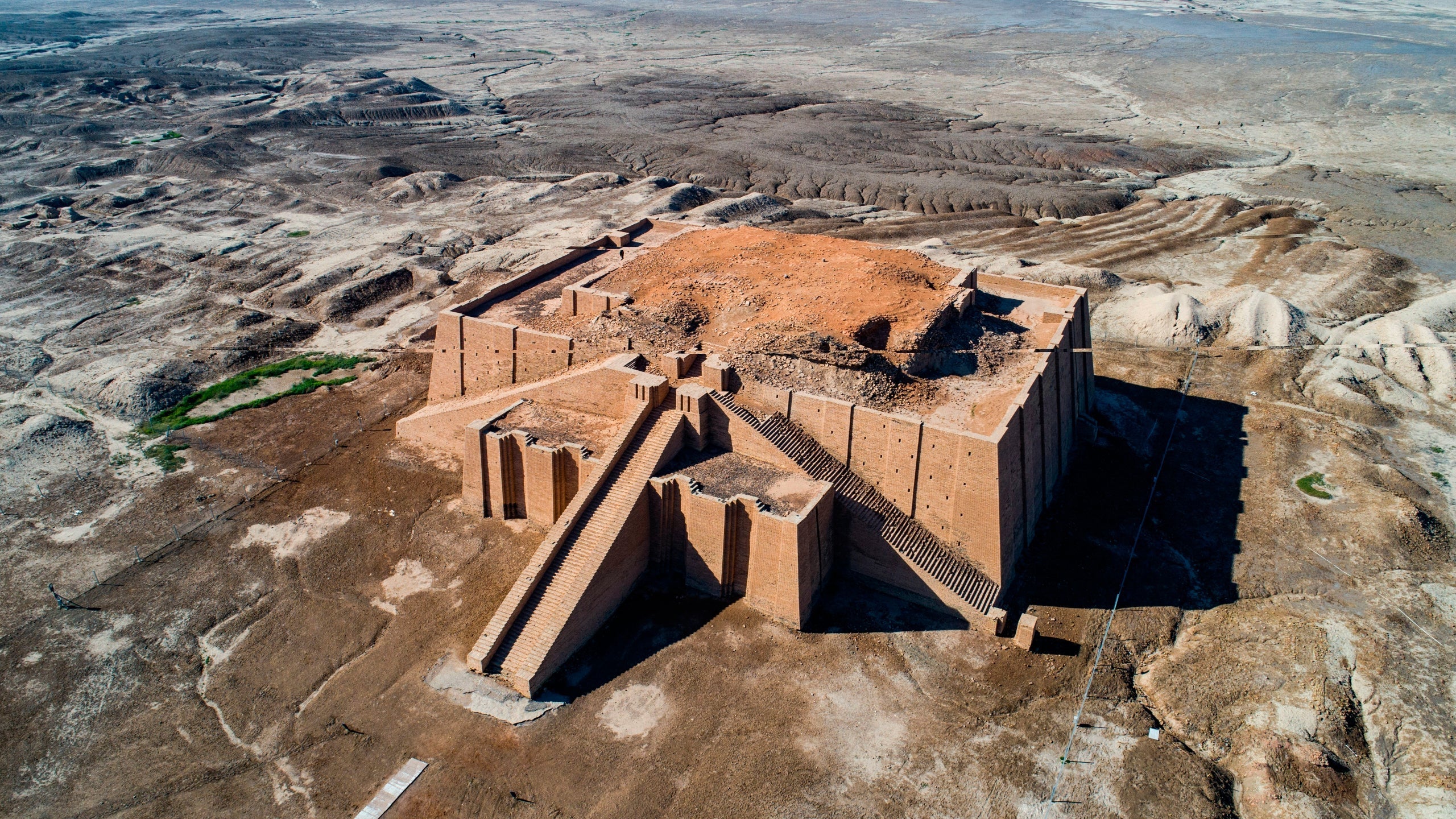
The engineering and material composition of the ziggurat demonstrate sophisticated adaptation to environmental constraints and resource availability in the alluvial plains of southern Iraq. The mᴀssive core of the structure was constructed using millions of sun-dried mud bricks, which provided structural mᴀss, while the exterior was heavily armored with a thick outer layer of kiln-baked bricks set in bitumen mortar to protect the vulnerable core from weathering and seasonal rains. Furthermore, builders incorporated intricate systems of weep holes and drainage channels through the baked brick exterior to reduce internal moisture and prevent structural fracturing. The lower terrace alone utilized an estimated 720,000 baked bricks, reflecting an immense mobilization of labor and material resources.

Functionally, the Great Ziggurat served as a sacred cosmic bridge—a monumental stepped platform designed to elevate a temple high above the mundane earth to bring mortals closer to the divine realm. The structure was dedicated to Nanna (also known as Sin), the patron moon god and principal deity of Ur, who held immense religious and political sway over the city-state. Beyond its primary religious function as a shrine and sanctuary, the surrounding temple complex acted as the administrative, economic, and redistribution heart of the kingdom, where citizens brought agricultural offerings, taxes, and trade goods managed by temple bureaucracy.
Modern archaeological exploration of this historic landmark was pioneered in the 1920s and 1930s by joint expeditions led by the renowned British archaeologist Sir Leonard Woolley, representing the British Museum and the University of Pennsylvania Museum. Woolley’s systematic excavations cleared away centuries of accumulated debris, mapped the complex layout, and uncovered the intricate relationship between the ziggurat and the surrounding royal cemeteries and administrative buildings. Later, in the late 20th century, partial restorations of the lower facade and monumental staircases were undertaken, ensuring that this priceless testament to human civilization continues to inspire archaeological inquiry and historical preservation today.
💔 STELLA PARTON BREAKS HER SILENCE — What She Said About Dolly’s Health Has Fans Looking Back
Dolly Parton’s Sister Breaks Silence What Really Happened - GMT - G1
Stella Parton was born May 4, 1949, the sixth of twelve children raised by Robert Lee and Avie Lee Parton in Sevierville, Tennessee — a household defined by noise, limited money, and almost no privacy, the kind of environment that produced strong, determined personalities.
Stella was one of them.
By seven, she was appearing alongside her older sister Dolly on a Knoxville television program; by her teens, she was writing her own songs, though marriage and motherhood pulled music to the margins of her life for a stretch.
The dream never fully disappeared.

In 1967, she recorded a gospel album with her mother and sisters, and later worked clubs in Washington, D.C., before founding her own record label in 1975 and releasing “I Want to Hold You in My Dreams Tonight,” which climbed to number nine on the country charts.
Long before any of that commercial success, Stella had already shown a willingness to take positions others avoided.
At 26, amid backlash against Australian singer Olivia Newton-John for winning recognition in country music, Stella recorded “Ode to Olivia” in her defense — a stand that offered her no career benefit and real risk of criticism, but one she took anyway simply because she believed staying silent was the wrong choice.
That instinct defined the rest of her career: hits like “The Danger of a Stranger” and “Steady as the Rain” (written by Dolly) built a genuine, independent following, including in the U.K., while Stella also worked in New York theater and spoke openly, often controversially, about poverty, domestic violence, and the treatment of women in the music industry.
She was named the Christian Country Music Association’s Female Vocalist of the Year in 2004.
Through all of it, she remained defined publicly, more often than not, as simply “Dolly’s little sister” — a label she spent five decades quietly proving didn’t tell the full story.
That same directness is why her comments in the fall of 2025 carried real weight.
Stella had never positioned herself as the family’s image manager or spokesperson; she was, by reputation, someone who believed difficult truths shouldn’t stay hidden indefinitely.
What she described wasn’t dramatic or accusatory — it was a portrait of a woman who had spent years prioritizing everyone else’s needs over her own.
The context mattered.
Carl Dean, Dolly’s husband of nearly sixty years, died in March 2025 at 82, after a long illness during which Dolly had devoted herself almost entirely to his care.
She later acknowledged that in the process, she’d neglected her own health significantly.
The loss reverberated through the whole extended family — the Partons had lost three brothers in the years surrounding this period, compounding grief that, for a family that had once crowded twelve children into a single small home, meant losing pieces of a shared childhood one after another.
Stella herself went seven years without releasing new music during this stretch, later describing the period simply as one shaped by sorrow, while still speaking about the importance of finding moments of laughter within it.
Looking back, one moment reads very differently in hindsight than it did at the time: in late September 2025, Dolly postponed her planned Las Vegas residency, citing health challenges — a rare cancellation for a performer whose six-decade career had included very few of them.
At the time, most fans treated it as a minor, temporary setback.
Stella’s later reflections suggested the signs had actually been building for some time, visible to family in ways the public smile made easy to miss.
That concern crystallized publicly not long after, when Dolly’s younger sister Frieda posted a simple request on Facebook asking fans to pray for Dolly.
What looked at first like an ordinary, well-meaning gesture spread rapidly, sparking widespread speculation about how serious Dolly’s condition actually was.
Dolly herself responded directly within days, appearing in a video from a Grand Ole Opry commercial shoot, insisting with her familiar humor that she wasn’t finished yet — the now widely remembered “I ain’t dead yet” moment that briefly quieted public concern.
In the months that followed, the pattern repeated: reassuring updates about kidney stones, dehydration, and treatment, paired with continued work on new projects, right up until Dolly Parton’s death on August 25, 2026, at 80.
Looking back across that full timeline — the postponed residency, the family’s public worry, Stella’s own account of a sister who consistently deprioritized her own wellbeing — it becomes easier to see what the people closest to Dolly understood well before the rest of the world did: that the warmth and resilience the public saw every time she appeared on camera came at a real, largely invisible cost.

:max_bytes(150000):strip_icc():focal(749x0:751x2):format(webp)/christa-pike-093026-8626d70f4a344768827ba5a8f02adee2.jpg "Christa Pike Remains ‘Alive and Snoring’ After 2 Lethal Injections, Her Lawyer Says")