Jennifer Aniston REVEALS The Dolly Parton Advice She’ll Never Forget
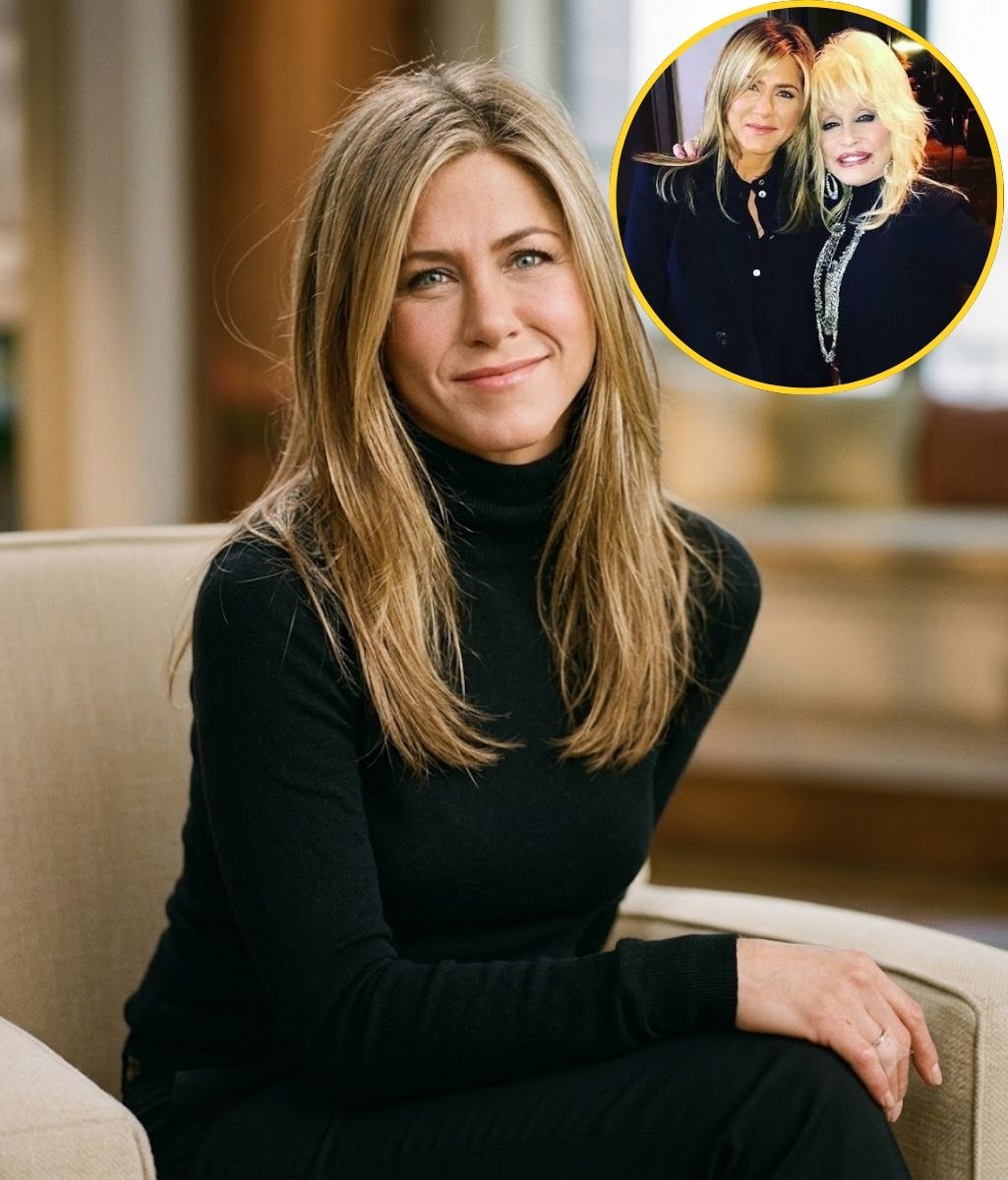
Just days after Dolly Parton’s death, Jennifer Aniston found herself answering a simple question about life advice. She could have drawn from more than three decades in Hollywood, from the enormous success of Friends, from heartbreak, fame, reinvention, or the hard lessons that come with living under constant public attention. Instead, Jennifer immediately thought of Dolly.
Speaking at the 92nd Street Y in New York City on September 2, 2026, Jennifer referred to Dolly as a “dear friend” and shared one of the sayings that had stayed with her. Dolly used to say that she had “chased a few rainbows” and managed to catch some of them. Jennifer then turned that memory into advice of her own, encouraging people to chase their dreams and go after their own rainbows.
On the surface, it sounds like classic Dolly Parton: colorful, optimistic, and just whimsical enough to make people smile. But the line carries more weight when you consider the life behind it. Dolly had spent decades chasing dreams that would once have seemed almost impossible for a girl raised in poverty in the mountains of East Tennessee. Music, Hollywood, business, philanthropy, and international fame all began with the belief that something bigger might exist beyond the life she could already see.
Jennifer understood that message personally because she had worked with Dolly on Dumplin’, the 2018 Netflix film starring Danielle Macdonald and Aniston. Dolly contributed heavily to the soundtrack, including new material created with Linda Perry, while the story itself revolved around a teenage girl inspired in part by Dolly’s music and larger-than-life confidence. Their collaboration allowed Jennifer to experience Dolly not simply as an icon, but as a creative partner whose humor and optimism were rooted in something very real.
That connection continued beyond the film. Jennifer has also been developing a new take on 9 to 5, the 1980 comedy that starred Dolly alongside Jane Fonda and Lily Tomlin. Before her death, Dolly had spoken positively about the project, saying she thought the script offered a fresh approach that could bring the office story into a modern world. Her encouragement gave Jennifer another reason to see Dolly not only as a legendary performer but as someone still interested in helping other women carry ideas forward.
That is why the “rainbows” advice feels especially meaningful now.
Dolly never built her career by pretending that dreams were easy to reach. She knew poverty, rejection, criticism, long hours, and the constant risk that success could disappear as quickly as it arrived. Her optimism was not based on ignorance of struggle. It came from believing that struggle did not have to prevent someone from continuing toward something better.
Jennifer’s decision to repeat that message so soon after Dolly’s death suggests how deeply it stayed with her.
She was not quoting a famous line simply because it sounded nice.
She was remembering the philosophy of someone she admired.
Dolly had always had a gift for turning complicated ideas into simple language. She could make ambition sound playful rather than frightening and make perseverance feel less like a burden. A “rainbow” was not simply luck. It represented the thing a person was willing to keep moving toward, even when reaching it seemed uncertain.
That philosophy was visible throughout Dolly’s life. She left East Tennessee for Nashville with little guarantee that anything would work out. She fought to become a songwriter before she became a star, left a successful partnership with Porter Wagoner because she believed she needed to grow on her own, and later expanded far beyond music into film, television, business, and philanthropy.
Not every dream worked.
But enough of them did.
That may be what Dolly meant when she said she had caught a few rainbows rather than claiming she had caught them all.
There is humility in that difference.
It acknowledges that a meaningful life is not one in which every ambition becomes reality. Sometimes the point is simply continuing to chase what matters, knowing that a few dreams may eventually become real.
For Jennifer, that idea now carries the weight of loss.
Dolly is no longer here to repeat the advice herself, but the words remain. They survive through the people who heard them, the people who worked beside her, and the people who continue telling the stories she left behind.
That may be why Jennifer’s answer resonated so strongly.
She was asked for her own wisdom.
Instead, she gave the room Dolly’s.
The woman who had spent decades becoming one of the most recognizable entertainers in the world had reduced an enormous philosophy of ambition, resilience, and hope to one simple image: keep chasing rainbows.
Jennifer Aniston has lived through enough success and disappointment to offer countless lessons of her own.
But when the moment came to choose one worth pᴀssing forward, she chose Dolly Parton’s.
And perhaps that says more about Dolly’s influence than any award ever could.
Because the people who knew her are not only remembering her songs.
They are still living by the things she taught them.
Video
💔 STELLA PARTON BREAKS HER SILENCE — What She Said About Dolly’s Health Has Fans Looking Back
Dolly Parton’s Sister Breaks Silence What Really Happened - GMT - G1
Stella Parton was born May 4, 1949, the sixth of twelve children raised by Robert Lee and Avie Lee Parton in Sevierville, Tennessee — a household defined by noise, limited money, and almost no privacy, the kind of environment that produced strong, determined personalities.
Stella was one of them.
By seven, she was appearing alongside her older sister Dolly on a Knoxville television program; by her teens, she was writing her own songs, though marriage and motherhood pulled music to the margins of her life for a stretch.
The dream never fully disappeared.

In 1967, she recorded a gospel album with her mother and sisters, and later worked clubs in Washington, D.C., before founding her own record label in 1975 and releasing “I Want to Hold You in My Dreams Tonight,” which climbed to number nine on the country charts.
Long before any of that commercial success, Stella had already shown a willingness to take positions others avoided.
At 26, amid backlash against Australian singer Olivia Newton-John for winning recognition in country music, Stella recorded “Ode to Olivia” in her defense — a stand that offered her no career benefit and real risk of criticism, but one she took anyway simply because she believed staying silent was the wrong choice.
That instinct defined the rest of her career: hits like “The Danger of a Stranger” and “Steady as the Rain” (written by Dolly) built a genuine, independent following, including in the U.K., while Stella also worked in New York theater and spoke openly, often controversially, about poverty, domestic violence, and the treatment of women in the music industry.
She was named the Christian Country Music Association’s Female Vocalist of the Year in 2004.
Through all of it, she remained defined publicly, more often than not, as simply “Dolly’s little sister” — a label she spent five decades quietly proving didn’t tell the full story.
That same directness is why her comments in the fall of 2025 carried real weight.
Stella had never positioned herself as the family’s image manager or spokesperson; she was, by reputation, someone who believed difficult truths shouldn’t stay hidden indefinitely.
What she described wasn’t dramatic or accusatory — it was a portrait of a woman who had spent years prioritizing everyone else’s needs over her own.
The context mattered.
Carl Dean, Dolly’s husband of nearly sixty years, died in March 2025 at 82, after a long illness during which Dolly had devoted herself almost entirely to his care.
She later acknowledged that in the process, she’d neglected her own health significantly.
The loss reverberated through the whole extended family — the Partons had lost three brothers in the years surrounding this period, compounding grief that, for a family that had once crowded twelve children into a single small home, meant losing pieces of a shared childhood one after another.
Stella herself went seven years without releasing new music during this stretch, later describing the period simply as one shaped by sorrow, while still speaking about the importance of finding moments of laughter within it.
Looking back, one moment reads very differently in hindsight than it did at the time: in late September 2025, Dolly postponed her planned Las Vegas residency, citing health challenges — a rare cancellation for a performer whose six-decade career had included very few of them.
At the time, most fans treated it as a minor, temporary setback.
Stella’s later reflections suggested the signs had actually been building for some time, visible to family in ways the public smile made easy to miss.
That concern crystallized publicly not long after, when Dolly’s younger sister Frieda posted a simple request on Facebook asking fans to pray for Dolly.
What looked at first like an ordinary, well-meaning gesture spread rapidly, sparking widespread speculation about how serious Dolly’s condition actually was.
Dolly herself responded directly within days, appearing in a video from a Grand Ole Opry commercial shoot, insisting with her familiar humor that she wasn’t finished yet — the now widely remembered “I ain’t dead yet” moment that briefly quieted public concern.
In the months that followed, the pattern repeated: reassuring updates about kidney stones, dehydration, and treatment, paired with continued work on new projects, right up until Dolly Parton’s death on August 25, 2026, at 80.
Looking back across that full timeline — the postponed residency, the family’s public worry, Stella’s own account of a sister who consistently deprioritized her own wellbeing — it becomes easier to see what the people closest to Dolly understood well before the rest of the world did: that the warmth and resilience the public saw every time she appeared on camera came at a real, largely invisible cost.