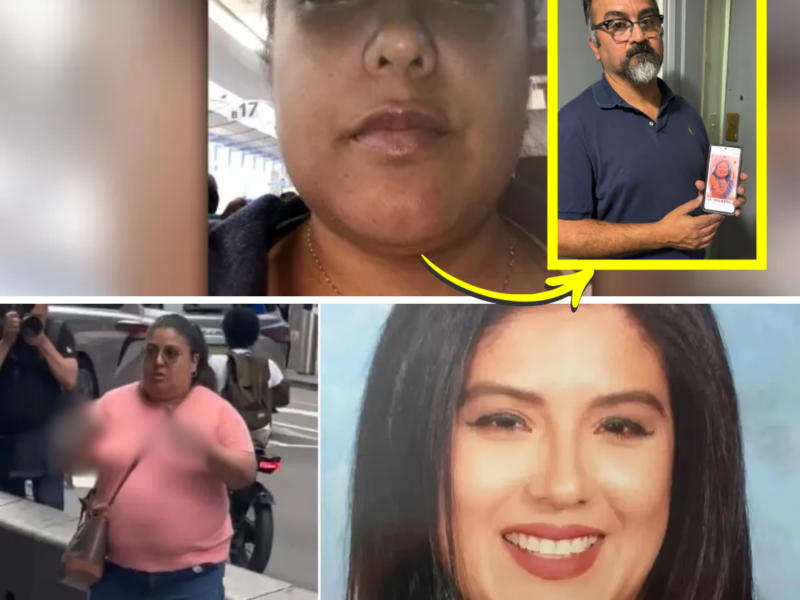
“I can’t understand what happened to my sister.” Pamela Cisneros’s family said this after the woman they had known for years appeared in Times Square. For Pamela was not always the person the public saw on August 31. Her family knew a woman who had once struggled with mental health issues but had enjoyed years of greater stability. They knew a mother of three. Someone who held a master’s degree in psychology. Someone trying to find work and rebuild her life after her marriage fell apart. They also knew a Pamela who lived a quiet life in Queens. No one knows which version of her changed first. But as the family looks back on those final weeks, one detail keeps coming up: after her divorce, Pamela made a specific declaration.
**“I Can’t Understand What Happened to My Sister”**
That is what members of Pamela Cisneros’s family said after the woman they had known for years appeared in Times Square on August 31, 2026. The statement was not rhetorical. It was an admission of genuine incomprehension. The person captured on bystander video—advancing on officers with a knife in each hand after the Tasers failed—did not match any of the versions of Pamela they carried in their minds.

For the family, Pamela had never been only the figure the public saw that afternoon. They knew a woman who had once struggled severely with mental-health issues yet had enjoyed years of greater stability on monthly psychiatric injections. They knew a mother of three. Someone who held a master’s degree in psychology. Someone who, after a six-year divorce process, was trying to find work and rebuild a quieter life. They also knew a Pamela who lived alone in a modest apartment in Queens, paid her rent on time, and still made efforts to stay connected to the people who had supported her through earlier crises.
No one in the family claims to know which of those versions began to change first. But as they look back on the final weeks, one detail keeps returning: after the marriage was legally ended, Pamela made a specific declaration about how she intended to manage her own treatment and independence.
### The Versions the Family Held
Patrick Peralta, her brother, has repeated variations of the same sentence since the attack: he does not know what happened. He has described a sister who never showed aggression toward others, who appeared stable for the better part of six years while receiving the injections, and who still seemed “fine” when he last saw her in early August and when their mother spoke with her by phone days before the stabbings. He has also acknowledged the longer fractures—the protracted divorce, the practical separation from two of her daughters who lived in Florida with their father, and the gradual thinning of regular contact after 2025.
Mario Cisneros, her father, has spoken in similar terms. He knew a daughter who had been noble and polite, a Christian, someone he had driven to appointments for years because the structure helped keep her on track. He believed the years of relative calm had allowed her to reclaim a measure of ordinary life. When she told him in April 2026 that she no longer needed the ride to the clinic, he took the statement as evidence of progress rather than risk.
These were not naïve portraits. The family had lived through the documented crises of 2018 and 2019, the hospitalizations, the suicide attempt on the subway tracks, and the long uncertainty that followed. They had watched the medication produce years of stability. They had seen her visit her autistic daughter, help with family gatherings, and attempt intermittent work. The versions they held were grounded in that lived experience. The woman who appeared in Times Square simply did not fit inside any of them.
### The Declaration After the Divorce
The detail that keeps surfacing in the family’s retrospective accounts is a shift that became more pronounced after the divorce was finalized in 2025. Pamela began to ᴀssert a stronger desire to manage her treatment and daily life without the same level of external involvement. She told her father she did not want to remain dependent on medication in the way she had been. She declined the accompaniment to appointments that had once been routine, insisting she could handle the process herself. The language was consistent with a wish for autonomy after years of being defined by illness and by a marriage that had consumed so much time and energy.
At the time the declarations sounded reasonable. A woman who had stabilized, who held an advanced degree, and who was living independently might be expected to want greater control over her own care. The family interpreted the statements as signs that the long period of support had worked. Only later did those same statements begin to look like the point at which the last reliable external checks began to loosen.
The change in contact followed a similar pattern. After the legal end of the marriage, the people who had once seen her regularly saw her less often. Visits became less predictable. In the final week before the attack she had largely stopped appearing at the usual family gatherings. When relatives called, the answers remained the familiar ones: she was fine. The absence did not trigger alarm because absences had already become more common. Only in hindsight did the combination—the declaration of independence from structured support, the thinning of contact, and the continued surface reᴀssurances—acquire its full weight.
### Which Version Changed First
The family cannot settle the question of sequence. Did the quiet life in the Queens apartment after the divorce create the conditions in which an older vulnerability returned? Did the decision to manage treatment more independently mark the beginning of a private drift that no one else could see? Or did the decisive shift occur later, in the largely unobserved stretch of weeks when the ordinary routines that had reᴀssured neighbors, the building manager, and the family itself began to erode without a clear external signal?
What they can say is that the versions they knew—the stabilized patient, the mother still trying to stay connected to her children, the woman with a master’s degree attempting to rebuild, the quiet tenant—remained credible to them until the images from Times Square made those versions feel suddenly incomplete. The neighbor who had known her since childhood and the building manager who never had a complaint about her supply the same ordinary surface from outside the family. Together the testimonies form a portrait of continuity that held until it did not.
The family’s repeated statement—“I can’t understand what happened to my sister”—is not an evasion. It is the most honest summary they can offer. They knew a woman who had struggled, stabilized, and appeared to be managing. They also know that the person who carried knives into a crowded midtown afternoon does not fit inside that knowledge. Between those two realities lies the quiet apartment, the post-divorce declaration of independence, the thinning of contact, and a final stretch of time that no one was watching closely enough to interrupt. The gap remains open.
Summary of the Pamela Cisneros case:
On the afternoon of August 31, 2026, around 4:24–4:30 p.m., 49-year-old Pamela Cisneros (a Queens resident of Ecuadorian origin and mother of three) carried out a random, unprovoked knife attack in Times Square, Midtown Manhattan.
She pulled two kitchen knives from a red Target bag and first stabbed Tak Kam, a 68-year-old man from Kingston, Rhode Island (who was visiting his son), in the abdomen near West 41st Street and Seventh Avenue. He survived and was reported in stable condition.
About 20 seconds later, she walked roughly one block to West 42nd Street and fatally stabbed Erin Piacenti, a 32-year-old Bank of America vice president from Chester, New Jersey, who was heading home from work. Piacenti died from her injuries.
Police confronted Cisneros near an NYPD substation by West 43rd Street. Officers ordered her to drop the knives; she refused and advanced toward them while swinging the knives and reportedly saying she would rather kill them. Three officers fired Tasers, which had no effect. Two officers then sH๏τ her. She was taken to Bellevue Hospital and pronounced ᴅᴇᴀᴅ.
Cisneros had a long history of serious mental illness (described by family as bipolar disorder and postpartum depression after the birth of one of her daughters more than 20 years earlier). She had multiple hospitalizations, a 2018 police encounter involving aggressive/intoxicated behavior, and a 2019 suicide attempt in which she jumped onto subway tracks in Queens. She had been receiving monthly injectable medication and showed some stability in recent years, with family members saying she reported feeling “fine” days before the attack and had never previously been violent toward others. She held a master’s degree in psychology and had worked intermittently (including with an immigration attorney).
The New York Attorney General’s office (under Leтιтia James) opened an investigation into the police shooting, as required for civilian deaths involving law enforcement. Policing experts generally viewed the shooting as justified given the immediate threat, though some questioned certain tactics (such as area control and the presence of bystanders).
Family members expressed shock. Her brother said she had never shown aggression, and her mother questioned why officers did not simply restrain her instead of using lethal force. A social media post from late 2025 in which Cisneros discussed “end times” and people “stabbing others for no reason” later drew attention.
The attack was described by police as random and unprovoked, with no known connection between Cisneros and the victims.