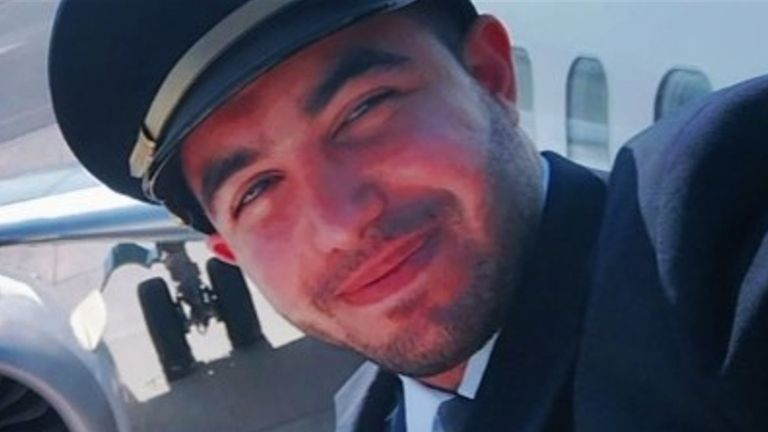
FlyDubai hero captain Smit Machchhar described to Israeli prime minister Benjamin Netanyahu how the attack started and how he managed to finally open the cockpit door after nearly losing his vision under the co-pilot’s repeated blows. “I knew I couldn’t let the pᴀssengers die,” Machchhar said.
The FlyDubai hero captain revealed new details of his fight to save the pᴀssengers aboard flight FZ1073 in an emotional telephone conversation with Israeli prime minister Benjamin Netanyahu, released by his office on Saturday evening.
The UAE, which is leading the investigation, said the co-pilot attacked the flight’s captain with the cockpit’s crash ax and tried to take control of the plummeting plane in a “terrorist attack” on Wednesday.
Captain Smit Machchhar told Netanyahu he felt he had “one more fight left” in him when in a critical state he reached for the cockpit door once again to save the 174 pᴀssengers and six crew members, while the co-pilot kept attacking him and putting the aircraft in a steep defence.

He described how the attack started saying that the co-pilot asked to pray in the cockpit which he did not consider an unusual request and “and out of respect for him, I didn’t look back.”
“After 4-5 minutes, I felt a heavy blow to the back of my head. My first thought was that catastrophic damage had been caused to the plane and something was wrong, but the blows kept coming one after another, and then I realized it wasn’t the plane… it was the other guy who was with me in the cockpit,” the captain described the attack.
Machchhar said his vision became badly blurred from the blows and he felt how the aircraft went into a steep descent. He tried to open the cockpit door once again, but the co-pilot kept closing it while pᴀssengers were trying to get in using the access code.
Netanyahu asked him if the door was closed with a pin mechanism and the captain answered that on the inside of the cockpit the door had a twist handle and that from the outside it could be opened with a code.
Machchhar remembered hearing the whooshing sound of the aircraft plunging downwards and the pᴀssengers screaming.
Realising what was happening, he told Netanyahu how he reached for the internal twist handle and with “a sharp, quick turn” managed to finally open the door, letting the pᴀssengers in who subdued the co-pilot and stabilised the plane.
The captain said that the co-pilot “locked the cockpit door and I was lying on the floor. I heard people screaming. I realized I had one last fight left: if I don’t do this, I will die with the last of my strength, I opened the door, and people were already waiting right outside and jumped in”.
“I knew I couldn’t let the pᴀssengers die,” Machchhar said.
The Israeli prime minister told him that he is a hero with “an unbelievable courage, inviting him and Indian prime minister Narendra Modi to light a celebratory flame on Israel’s next Independence Day, the highest honour usually reserved for Israeli citizens.
“You are a true hero of the brave peoples of India and Israel, and you are a hero of the entire world. I wish you a very speedy and complete recovery,” Netanyahu told captain Machchhar.
Israeli Ambᴀssador to the UAE Yossi Shelley was at his bedside during the call and together with Netanyahu invited Machchhar and his family to visit Israel as soon as he is able, to receive the embrace and love that the entire country wants to give him.
Dubai’s Crown Prince and UAE Minister of Defence Sheikh Hamdan bin Mohammed bin Rashid also visited Machchhar in hospital hailing the captain’s bravery, stating that he “embodied the highest degrees of courage, responsibility, and care for human life.”
“From us, and from the leadership of the nation, he has our full appreciation and praise. We are proud that he is part of our team, part of the story of our nation and part of what the UAE stands for a nation of compᴀssion, a nation of peace and a nation of life,” Sheikh Hamdan bin Mohammed said.
In a new development on Sunday, British newspaper The Telegraph reported that the FlyDubai flight copilot, named by multiple media outlets as Omani national Hamam al-Hammami, studied aviation at the UK-based Buckinghamshire New University.
The Telegraph said that during his time at the university, al-Hammami commented in social media posts that women should be “stomped on” and praised giving a woman a “pre-emptive slap.” He also appeared to praise Russia’s full-scale invasion of Ukraine, The Telegraph said.
The co-pilot used a crash axe against the captain and “attempted to carry out a terrorist attack”, the United Arab Emirates’ prosecutor general said on Saturday, while the UAE president’s diplomatic adviser Dr Anwar Gargash called the incident “a dangerous terrorist act”.
Meanwhile, on Sunday, regional officials said the UAE authorities shared a list of pᴀssengers and crew with Israel ahead of the FlyDubai flight, including their nationalities, raising new questions about how the attacker evaded detection, the ᴀssociated Press reported.
According to AP, which quoted regional officials, Israel had not raised red flags on any pᴀssenger or member of the crew.
Prime Minister Netanyahu later told the head of the National Security Council to appoint an examiner to review “all security aspects regarding foreign civil aviation to Israel.”
The Shin Bet, Israel’s domestic security agency, said the Transportation Ministry is responsible for vetting pᴀssenger lists from foreign flights. Transportation Minister Miri Regev told Israel’s public broadcaster Kan that the security agencies are responsible for flight security and that her ministry wasn’t given a list of pᴀssengers or any warnings.
Sharing the list is standard aviation procedure. But the head of aviation security at the Transportation Ministry, Dvir Rubenstien, told Army Radio that the ministry relies on local security checks and does not have the tools or the ability to run checks on each pᴀssenger on every flight.
Netanyahu said Thursday that Israel has long-standing agreements with foreign carriers to keep pilots from flying into the country if they are citizens of nations that don’t maintain diplomatic relations with Israel.
It also remains unclear how FlyDubai, a low-cost Emirati airline that operates flights between Israel and the UAE, failed to identify the Omani pilot as a security risk and allowed him to fly the sensitive route to Israel.
Ahead of the elections at the end of the month, some opposition candidates have seized on the security failures to highlight what they see as negligence by Netanyahu and his supporters. Israel’s Transportation Minister Miri Regev is a member of Netanyahu’s Likud party and a staunch supporter.
“This is exactly what system collapse looks like,” Yair Golan, head of the opposition Democrats party, wrote on X. “A transportation minister who completely abandons our skies, and a prime minister who abandons national security.”
The UAE is leading the investigation, and security agencies from four regional countries, including Israel, were working to establish the co-pilot’s motives, aided by the United States and other Western governments, according to the AP.
💔 STELLA PARTON BREAKS HER SILENCE — What She Said About Dolly’s Health Has Fans Looking Back
Dolly Parton’s Sister Breaks Silence What Really Happened - GMT - G1
Stella Parton was born May 4, 1949, the sixth of twelve children raised by Robert Lee and Avie Lee Parton in Sevierville, Tennessee — a household defined by noise, limited money, and almost no privacy, the kind of environment that produced strong, determined personalities.
Stella was one of them.
By seven, she was appearing alongside her older sister Dolly on a Knoxville television program; by her teens, she was writing her own songs, though marriage and motherhood pulled music to the margins of her life for a stretch.
The dream never fully disappeared.

In 1967, she recorded a gospel album with her mother and sisters, and later worked clubs in Washington, D.C., before founding her own record label in 1975 and releasing “I Want to Hold You in My Dreams Tonight,” which climbed to number nine on the country charts.
Long before any of that commercial success, Stella had already shown a willingness to take positions others avoided.
At 26, amid backlash against Australian singer Olivia Newton-John for winning recognition in country music, Stella recorded “Ode to Olivia” in her defense — a stand that offered her no career benefit and real risk of criticism, but one she took anyway simply because she believed staying silent was the wrong choice.
That instinct defined the rest of her career: hits like “The Danger of a Stranger” and “Steady as the Rain” (written by Dolly) built a genuine, independent following, including in the U.K., while Stella also worked in New York theater and spoke openly, often controversially, about poverty, domestic violence, and the treatment of women in the music industry.
She was named the Christian Country Music Association’s Female Vocalist of the Year in 2004.
Through all of it, she remained defined publicly, more often than not, as simply “Dolly’s little sister” — a label she spent five decades quietly proving didn’t tell the full story.
That same directness is why her comments in the fall of 2025 carried real weight.
Stella had never positioned herself as the family’s image manager or spokesperson; she was, by reputation, someone who believed difficult truths shouldn’t stay hidden indefinitely.
What she described wasn’t dramatic or accusatory — it was a portrait of a woman who had spent years prioritizing everyone else’s needs over her own.
The context mattered.
Carl Dean, Dolly’s husband of nearly sixty years, died in March 2025 at 82, after a long illness during which Dolly had devoted herself almost entirely to his care.
She later acknowledged that in the process, she’d neglected her own health significantly.
The loss reverberated through the whole extended family — the Partons had lost three brothers in the years surrounding this period, compounding grief that, for a family that had once crowded twelve children into a single small home, meant losing pieces of a shared childhood one after another.
Stella herself went seven years without releasing new music during this stretch, later describing the period simply as one shaped by sorrow, while still speaking about the importance of finding moments of laughter within it.
Looking back, one moment reads very differently in hindsight than it did at the time: in late September 2025, Dolly postponed her planned Las Vegas residency, citing health challenges — a rare cancellation for a performer whose six-decade career had included very few of them.
At the time, most fans treated it as a minor, temporary setback.
Stella’s later reflections suggested the signs had actually been building for some time, visible to family in ways the public smile made easy to miss.
That concern crystallized publicly not long after, when Dolly’s younger sister Frieda posted a simple request on Facebook asking fans to pray for Dolly.
What looked at first like an ordinary, well-meaning gesture spread rapidly, sparking widespread speculation about how serious Dolly’s condition actually was.
Dolly herself responded directly within days, appearing in a video from a Grand Ole Opry commercial shoot, insisting with her familiar humor that she wasn’t finished yet — the now widely remembered “I ain’t dead yet” moment that briefly quieted public concern.
In the months that followed, the pattern repeated: reassuring updates about kidney stones, dehydration, and treatment, paired with continued work on new projects, right up until Dolly Parton’s death on August 25, 2026, at 80.
Looking back across that full timeline — the postponed residency, the family’s public worry, Stella’s own account of a sister who consistently deprioritized her own wellbeing — it becomes easier to see what the people closest to Dolly understood well before the rest of the world did: that the warmth and resilience the public saw every time she appeared on camera came at a real, largely invisible cost.