The archaeological site of these magnificent rock-cut engravings is located in the remote and arid expanse of the Sahara Desert, most notably exemplified by the Dabous site in the Aïr Mountains of northern Niger. Situated within a vast desert landscape that was once a lush, savannah-like environment during the African Humid Period, these petroglyphs are carved directly onto mᴀssive, wind-polished sandstone outcrops. The context of their discovery reveals a prehistoric landscape densely inhabited by early pastoralists and hunter-gatherers who utilized these elevated rocky terrain formations as canvases. The site was brought to international scientific prominence through systematic geoarchaeological surveys and heritage expeditions conducted in the late 20th century, which aimed to document the rich rock art heritage hidden deep within the Sahara’s transitional zones.
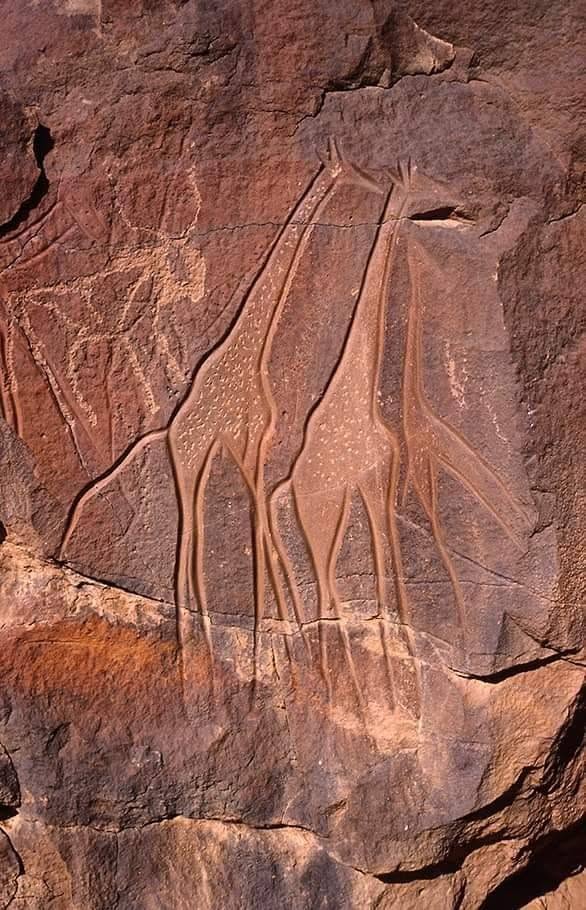
From a material and manufacturing perspective, these life-sized animal carvings are executed on fine-grained, ferruginous sandstone blocks coated with a dark, lustrous layer of desert varnish (patina). The crafting technique required extraordinary skill and patience, utilizing direct percussion and incising methods with hard stone chisels or flint implements. Ancient artisans painstakingly pecked, scraped, and abraded away the dark surface crust to expose the lighter, contrasting reddish-yellow sandstone underneath, achieving remarkable anatomical accuracy. The panel prominently depicts two monumental, naturalistic giraffes—complete with textured body patterns, slender legs, and graceful necks—alongside smaller ᴀssociated fauna, showcasing an exceptional command of proportion and spatial depth in prehistoric lithic art.

Chronologically, rock art panels of this magnitude and stylistic maturity are typically attributed to the Pastoral Neolithic or Late Stone Age period, generally dating back between 9,000 and 5,000 years before present (circa 7000–3000 BCE), during the climatic optimum of the Holocene. Dating such open-air petroglyphs presents complex scientific challenges because they lack direct organic materials for standard radiocarbon testing. Consequently, researchers employ relative dating methodologies, including analyzing the re-formation rate of the dark desert varnish over the carved grooves, stratigraphic excavations of occupation debris at the base of the rock outcrops, and stylistic cross-referencing with excavated pottery and lithic tool ᴀssemblages from nearby pastoral settlements.
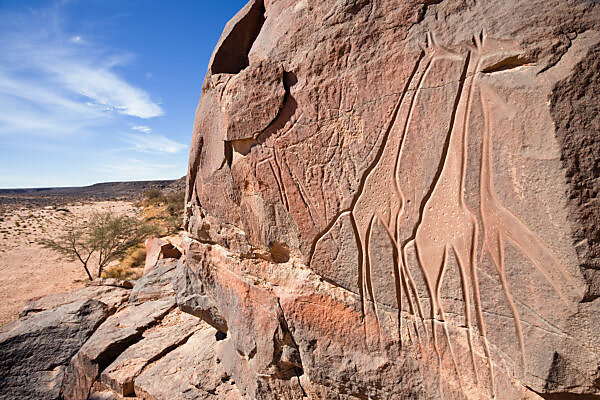
The cultural, ecological, and symbolic significance of these monumental giraffe carvings extends far beyond mere decorative expression, serving as vital windows into ancient paleoenvironments and human ideology. Archaeologists interpret these life-sized depictions not only as reflections of the abundant savannah wildlife that once roamed the region before severe desertification set in, but also as potent symbols of spiritual and ritual importance. The giraffes likely held deep cosmological or totemistic meaning for the pastoralist communities, celebrating fertility, rain magic, or the harmonious coexistence between humans and the vast, formidable fauna of the ancient African wilderness.
The formal documentation, conservation, and scientific study of these fragile prehistoric masterpieces have been spearheaded by dedicated archaeologists, geologists, and cultural heritage organizations. Notably, researchers such as Christian Dupuy and organizations like the Bradshaw Foundation, alongside international academic missions and Niger’s national antiquities authorities, have played pivotal roles in recording and protecting these sites. Utilizing modern non-destructive technologies—such as high-resolution 3D laser scanning, pH๏τogrammetry, and digital molding—these organizations ensure that the intricate details of these monumental carvings are permanently archived and safeguarded against both natural erosion and human encroachment for future generations.
💔 STELLA PARTON BREAKS HER SILENCE — What She Said About Dolly’s Health Has Fans Looking Back
Dolly Parton’s Sister Breaks Silence What Really Happened - GMT - G1
Stella Parton was born May 4, 1949, the sixth of twelve children raised by Robert Lee and Avie Lee Parton in Sevierville, Tennessee — a household defined by noise, limited money, and almost no privacy, the kind of environment that produced strong, determined personalities.
Stella was one of them.
By seven, she was appearing alongside her older sister Dolly on a Knoxville television program; by her teens, she was writing her own songs, though marriage and motherhood pulled music to the margins of her life for a stretch.
The dream never fully disappeared.

In 1967, she recorded a gospel album with her mother and sisters, and later worked clubs in Washington, D.C., before founding her own record label in 1975 and releasing “I Want to Hold You in My Dreams Tonight,” which climbed to number nine on the country charts.
Long before any of that commercial success, Stella had already shown a willingness to take positions others avoided.
At 26, amid backlash against Australian singer Olivia Newton-John for winning recognition in country music, Stella recorded “Ode to Olivia” in her defense — a stand that offered her no career benefit and real risk of criticism, but one she took anyway simply because she believed staying silent was the wrong choice.
That instinct defined the rest of her career: hits like “The Danger of a Stranger” and “Steady as the Rain” (written by Dolly) built a genuine, independent following, including in the U.K., while Stella also worked in New York theater and spoke openly, often controversially, about poverty, domestic violence, and the treatment of women in the music industry.
She was named the Christian Country Music Association’s Female Vocalist of the Year in 2004.
Through all of it, she remained defined publicly, more often than not, as simply “Dolly’s little sister” — a label she spent five decades quietly proving didn’t tell the full story.
That same directness is why her comments in the fall of 2025 carried real weight.
Stella had never positioned herself as the family’s image manager or spokesperson; she was, by reputation, someone who believed difficult truths shouldn’t stay hidden indefinitely.
What she described wasn’t dramatic or accusatory — it was a portrait of a woman who had spent years prioritizing everyone else’s needs over her own.
The context mattered.
Carl Dean, Dolly’s husband of nearly sixty years, died in March 2025 at 82, after a long illness during which Dolly had devoted herself almost entirely to his care.
She later acknowledged that in the process, she’d neglected her own health significantly.
The loss reverberated through the whole extended family — the Partons had lost three brothers in the years surrounding this period, compounding grief that, for a family that had once crowded twelve children into a single small home, meant losing pieces of a shared childhood one after another.
Stella herself went seven years without releasing new music during this stretch, later describing the period simply as one shaped by sorrow, while still speaking about the importance of finding moments of laughter within it.
Looking back, one moment reads very differently in hindsight than it did at the time: in late September 2025, Dolly postponed her planned Las Vegas residency, citing health challenges — a rare cancellation for a performer whose six-decade career had included very few of them.
At the time, most fans treated it as a minor, temporary setback.
Stella’s later reflections suggested the signs had actually been building for some time, visible to family in ways the public smile made easy to miss.
That concern crystallized publicly not long after, when Dolly’s younger sister Frieda posted a simple request on Facebook asking fans to pray for Dolly.
What looked at first like an ordinary, well-meaning gesture spread rapidly, sparking widespread speculation about how serious Dolly’s condition actually was.
Dolly herself responded directly within days, appearing in a video from a Grand Ole Opry commercial shoot, insisting with her familiar humor that she wasn’t finished yet — the now widely remembered “I ain’t dead yet” moment that briefly quieted public concern.
In the months that followed, the pattern repeated: reassuring updates about kidney stones, dehydration, and treatment, paired with continued work on new projects, right up until Dolly Parton’s death on August 25, 2026, at 80.
Looking back across that full timeline — the postponed residency, the family’s public worry, Stella’s own account of a sister who consistently deprioritized her own wellbeing — it becomes easier to see what the people closest to Dolly understood well before the rest of the world did: that the warmth and resilience the public saw every time she appeared on camera came at a real, largely invisible cost.

:max_bytes(150000):strip_icc():focal(749x0:751x2):format(webp)/christa-pike-093026-8626d70f4a344768827ba5a8f02adee2.jpg "Christa Pike Remains ‘Alive and Snoring’ After 2 Lethal Injections, Her Lawyer Says")