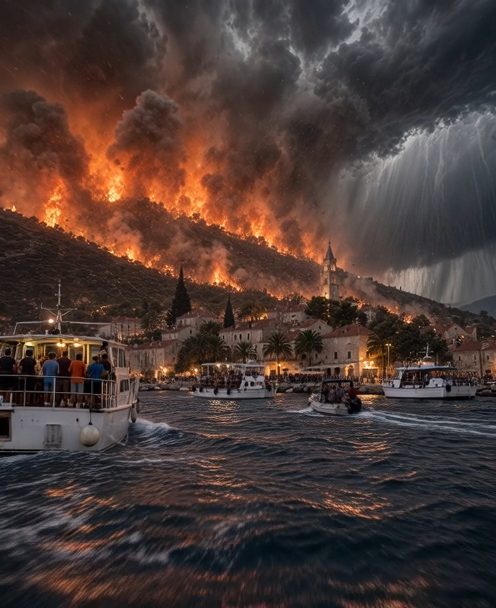
🔥🇭🇷 HUNDREDS EVACUATED BY SEA AS WILDFIRE SWEEPS CROATIAN ISLAND — FLAMES PUSH TOWARD COMMUNITIES ON BRAČ
A dangerous wildfire has erupted across Brač Island in Croatia, forcing a major emergency response as flames spread toward communities near Milna and hundreds of people were evacuated by sea.
As the fire intensified, approximately 700 people were evacuated by boat, turning what was already a frightening wildfire emergency into an extraordinary evacuation operation.
Firefighters battled the flames through the night as the blaze moved across parts of the island, with the growing threat forcing residents and others in affected areas to leave before conditions became even more dangerous.
For those watching the fire approach, there was little time to waste.
The escape route was not a highway.
It was the sea.
🔥 FLAMES PUSH TOWARD COMMUNITIES
Wildfires can become especially dangerous when strong winds and dry vegetation allow flames to spread rapidly.
On Brač, the fire moved toward populated areas near Milna, raising concerns for communities caught in the path of the advancing flames.
When a wildfire approaches a settlement, authorities have to make difficult decisions.
Waiting too long to evacuate can leave people trapped by smoke, flames or blocked roads.
But evacuating hundreds of people also requires coordination, transportation and safe routes out of the danger zone.
In this case, the geography of the island created another possibility.
People could leave by sea.
🚤 AROUND 700 PEOPLE EVACUATED BY SEA
Approximately 700 people were evacuated by sea as the wildfire threatened communities on the island.
The operation was extraordinary.
Instead of hundreds of people leaving through a single road network, boats became a crucial part of the emergency response.
For those being evacuated, the sight of flames spreading across the island while they moved toward the coastline must have been deeply unsettling.
Behind them was a landscape being consumed by wildfire.
Ahead was the open water.
The sea became the escape route.
This kind of evacuation also highlights the unique challenges faced by island communities during natural disasters.
When a wildfire affects an island, roads can quickly become congested or threatened by flames.
Smoke can reduce visibility.
Fire can cut off routes between communities.
And residents may have fewer options for leaving compared with people on the mainland.
For Brač, the surrounding Adriatic Sea provided an alternative lifeline.
🌙 FIREFIGHTERS BATTLE THROUGH THE NIGHT
While hundreds of people were being moved away from danger, firefighters continued working through the night to battle the blaze.
Nighttime firefighting can present its own challenges.
Darkness can make it more difficult to ᴀssess the full extent of a fire, while shifting winds and changing fire behavior can create unpredictable conditions.
Firefighters must constantly monitor the direction of the flames and determine where defensive efforts are most urgently needed.
Their objective is not simply to put out visible flames.
They must also work to prevent the fire from reaching homes, roads and other critical areas.
Every hour matters when a wildfire is advancing toward a community.
🔥 ONE FIRE, HUNDREDS OF PEOPLE FORCED TO FLEE
The scale of the evacuation illustrates how quickly a wildfire can disrupt an entire community.
Around 700 people were forced to leave by sea as flames pushed closer to populated areas.
For residents and visitors, the evacuation likely meant leaving behind belongings and familiar surroundings with little certainty about when they would be able to return.
Wildfires do not simply threaten forests.
They can disrupt transportation, tourism, businesses and everyday life.
For an island such as Brač, where communities and visitors depend heavily on the surrounding transportation network, the consequences can spread far beyond the immediate fire zone.
🚨 WHY ISLAND WILDFIRES ARE SO DIFFICULT TO CONTROL
Brač is one of Croatia’s well-known Adriatic islands, and like many Mediterranean locations, its landscape can become highly vulnerable to wildfire under H๏τ and dry conditions.
Dry vegetation can provide fuel for rapidly spreading flames.
Wind can carry embers ahead of the main fire, potentially creating new ignition points.
And once multiple areas begin burning, firefighters can be forced to divide resources between protecting communities and containing the wider blaze.
That creates a race against time.
The longer the fire remains active, the more opportunities it has to change direction or approach new areas.
This is why early evacuation decisions can be so important.
🌬️ WIND CAN CHANGE EVERYTHING
One of the most dangerous characteristics of wildfire is unpredictability.
A fire that appears to be moving in one direction can suddenly shift if wind conditions change.
Strong winds can push flames forward, increase the rate at which vegetation burns and carry embers into areas that were previously considered safe.
This can create spot fires far from the main fire front.
For people near an active wildfire, that means conditions can deteriorate much faster than expected.
A community that appears safe in one moment may need to evacuate shortly afterward.
🔥 THE HUMAN SIDE OF THE EMERGENCY
Behind every evacuation number are individual stories.
Families gathering essential belongings.
Visitors trying to understand where they should go.
Residents watching smoke rise over familiar landscapes.
Emergency crews working while others are trying to escape.
And hundreds of people boarding boats because the safest route away from the flames was across the water.
The number — approximately 700 people — gives an indication of the scale of the emergency.
But it does not fully capture the fear and uncertainty experienced by those forced to leave.
For many, the priority was simply getting away from the fire.
🏝️ THE SEA BECOMES AN ESCAPE ROUTE
The evacuation by sea is perhaps the most striking element of this wildfire.
In many emergencies, people instinctively think of roads as the primary escape route.
But on an island surrounded by water, the sea can become a critical evacuation corridor.
Boats can transport large numbers of people away from threatened communities when roads are congested or potentially exposed to fire.
The operation demonstrates how emergency planning must adapt to local geography.
What might be impossible in one location can become a vital solution somewhere else.
On Brač, the Adriatic provided an escape route when flames threatened communities on land.
⚠️ WILDFIRE DANGER DOESN’T END WHEN PEOPLE LEAVE
Evacuation is only the beginning of a wildfire emergency.
Even after residents reach safety, firefighters still have to battle the blaze.
Communities may remain threatened by smoke, embers and shifting fire fronts.
Roads may remain closed.
Returning home too early can be dangerous.
And authorities must continue monitoring conditions before determining when evacuated residents can safely return.
For those who have left the island or moved to safer areas, uncertainty can be difficult.
They may not know how much damage has occurred or when they will be allowed back.
🇭🇷 BRAČ NOW FACES THE AFTERMATH
The wildfire on Brač has become a powerful reminder of how quickly a natural disaster can transform a peaceful island landscape into an emergency zone.
One wildfire forced hundreds of people to flee.
Approximately 700 people were evacuated by sea.
Firefighters battled through the night.
And flames pushed dangerously close to communities near Milna.
The full impact of the fire will depend on how successfully crews can contain it and whether weather conditions allow the situation to stabilize.
For now, the priority remains protecting lives, defending communities and preventing the flames from spreading further.
🔥🌊 ONE WILDFIRE. HUNDREDS EVACUATED. AN ENTIRE COMMUNITY LOOKING TO THE SEA FOR A WAY OUT.
The dramatic evacuation from Brač shows just how quickly wildfire conditions can overwhelm an island — and how critical every available escape route can become.
As firefighters continue their work, residents and visitors should follow official instructions, avoid entering threatened areas and remain alert for changing conditions.
💔 STELLA PARTON BREAKS HER SILENCE — What She Said About Dolly’s Health Has Fans Looking Back
Dolly Parton’s Sister Breaks Silence What Really Happened - GMT - G1
Stella Parton was born May 4, 1949, the sixth of twelve children raised by Robert Lee and Avie Lee Parton in Sevierville, Tennessee — a household defined by noise, limited money, and almost no privacy, the kind of environment that produced strong, determined personalities.
Stella was one of them.
By seven, she was appearing alongside her older sister Dolly on a Knoxville television program; by her teens, she was writing her own songs, though marriage and motherhood pulled music to the margins of her life for a stretch.
The dream never fully disappeared.

In 1967, she recorded a gospel album with her mother and sisters, and later worked clubs in Washington, D.C., before founding her own record label in 1975 and releasing “I Want to Hold You in My Dreams Tonight,” which climbed to number nine on the country charts.
Long before any of that commercial success, Stella had already shown a willingness to take positions others avoided.
At 26, amid backlash against Australian singer Olivia Newton-John for winning recognition in country music, Stella recorded “Ode to Olivia” in her defense — a stand that offered her no career benefit and real risk of criticism, but one she took anyway simply because she believed staying silent was the wrong choice.
That instinct defined the rest of her career: hits like “The Danger of a Stranger” and “Steady as the Rain” (written by Dolly) built a genuine, independent following, including in the U.K., while Stella also worked in New York theater and spoke openly, often controversially, about poverty, domestic violence, and the treatment of women in the music industry.
She was named the Christian Country Music Association’s Female Vocalist of the Year in 2004.
Through all of it, she remained defined publicly, more often than not, as simply “Dolly’s little sister” — a label she spent five decades quietly proving didn’t tell the full story.
That same directness is why her comments in the fall of 2025 carried real weight.
Stella had never positioned herself as the family’s image manager or spokesperson; she was, by reputation, someone who believed difficult truths shouldn’t stay hidden indefinitely.
What she described wasn’t dramatic or accusatory — it was a portrait of a woman who had spent years prioritizing everyone else’s needs over her own.
The context mattered.
Carl Dean, Dolly’s husband of nearly sixty years, died in March 2025 at 82, after a long illness during which Dolly had devoted herself almost entirely to his care.
She later acknowledged that in the process, she’d neglected her own health significantly.
The loss reverberated through the whole extended family — the Partons had lost three brothers in the years surrounding this period, compounding grief that, for a family that had once crowded twelve children into a single small home, meant losing pieces of a shared childhood one after another.
Stella herself went seven years without releasing new music during this stretch, later describing the period simply as one shaped by sorrow, while still speaking about the importance of finding moments of laughter within it.
Looking back, one moment reads very differently in hindsight than it did at the time: in late September 2025, Dolly postponed her planned Las Vegas residency, citing health challenges — a rare cancellation for a performer whose six-decade career had included very few of them.
At the time, most fans treated it as a minor, temporary setback.
Stella’s later reflections suggested the signs had actually been building for some time, visible to family in ways the public smile made easy to miss.
That concern crystallized publicly not long after, when Dolly’s younger sister Frieda posted a simple request on Facebook asking fans to pray for Dolly.
What looked at first like an ordinary, well-meaning gesture spread rapidly, sparking widespread speculation about how serious Dolly’s condition actually was.
Dolly herself responded directly within days, appearing in a video from a Grand Ole Opry commercial shoot, insisting with her familiar humor that she wasn’t finished yet — the now widely remembered “I ain’t dead yet” moment that briefly quieted public concern.
In the months that followed, the pattern repeated: reassuring updates about kidney stones, dehydration, and treatment, paired with continued work on new projects, right up until Dolly Parton’s death on August 25, 2026, at 80.
Looking back across that full timeline — the postponed residency, the family’s public worry, Stella’s own account of a sister who consistently deprioritized her own wellbeing — it becomes easier to see what the people closest to Dolly understood well before the rest of the world did: that the warmth and resilience the public saw every time she appeared on camera came at a real, largely invisible cost.