The discovery and study of Qasr al-Farid, famously known as the “Lonely Castle,” represent a monumental milestone in the archaeological exploration of ancient Arabian civilizations. Dating back to the 1st century CE during the height of the Nabataean Kingdom, this striking monument is an exceptional example of monumental rock-cut architecture. From an archaeological perspective, the structure provides critical insights into the mortuary practices, engineering capabilities, and socioeconomic status of a once-nomadic people who grew immensely wealthy through the control of lucrative ancient trade routes, such as the Incense Road. Its impressive physical isolation and remarkably pristine state of preservation offer modern researchers an unparalleled window into the architectural traditions of antiquity.
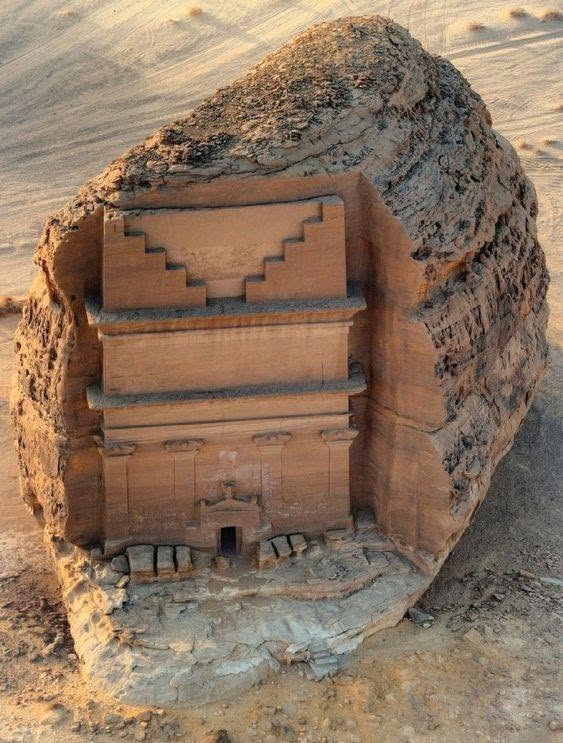
The primary site of discovery is the vast archaeological complex of Hegra, also known as Al-Hijr or Madain Saleh, situated in the arid desert expanse of the AlUla governorate in northwestern Saudi Arabia. Hegra served as the southern capital and second-largest city of the Nabataean realm, functioning as a strategic outpost for merchants traversing the Arabian Peninsula. The geological context of the region features dramatic outcrops of fine-grained, golden-brown sandstone rising directly out of the desert floor, which provided ancient artisans with a stable, workable canvas. Within this sweeping landscape, Qasr al-Farid stands completely apart from the other clustered tomb groups, occupying its own isolated sandstone mᴀssif that commands the surrounding horizon.
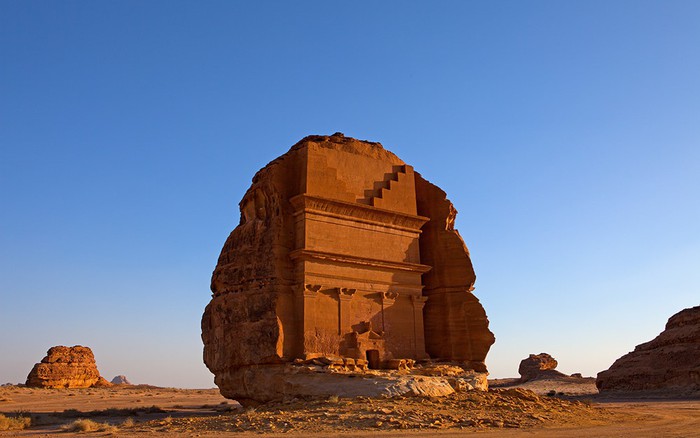
In terms of material composition and manufacturing techniques, the monument is an absolute masterpiece of subtractive sculpture executed directly on a natural monolith. Standing approximately 22 meters tall, the tomb was carved entirely from top to bottom by ancient stonemasons using chisels and mallets, featuring a sophisticated architectural facade complete with a stepped crown, four engaged pilasters, and intricate classical capitals influenced by Hellenistic and Near Eastern traditions. However, the most fascinating archaeological feature of Qasr al-Farid is that it remains famously unfinished; the lower third of the structure reveals rough, uncarved stone and exposed quarry marks. This incomplete state provides invaluable technical evidence regarding Nabataean construction methods, proving that artisans worked downward from the top to prevent falling debris from damaging lower architectural details and to eliminate the need for complex external scaffolding.

The functional utility and cultural significance of Qasr al-Farid were centered entirely on elite mortuary veneration and territorial marking, although the tomb was ultimately never occupied. Commissioned as an eternal resting place for a prominent individual—historically ᴀssociated with Lihyan, son of Kuza—the monument was designed to project power, divine status, and dynastic permanence across the desert frontier. In Nabataean cosmology, elaborate facades served as sacred thresholds and permanent homes for the spirits of the deceased, reinforcing the social hierarchy and ancestral lineage of the ruling elite. The decision to leave the tomb unfinished suggests a sudden historical disruption, such as the Roman annexation of the Nabataean Kingdom in 106 CE, which abruptly halted grand construction projects across the region.
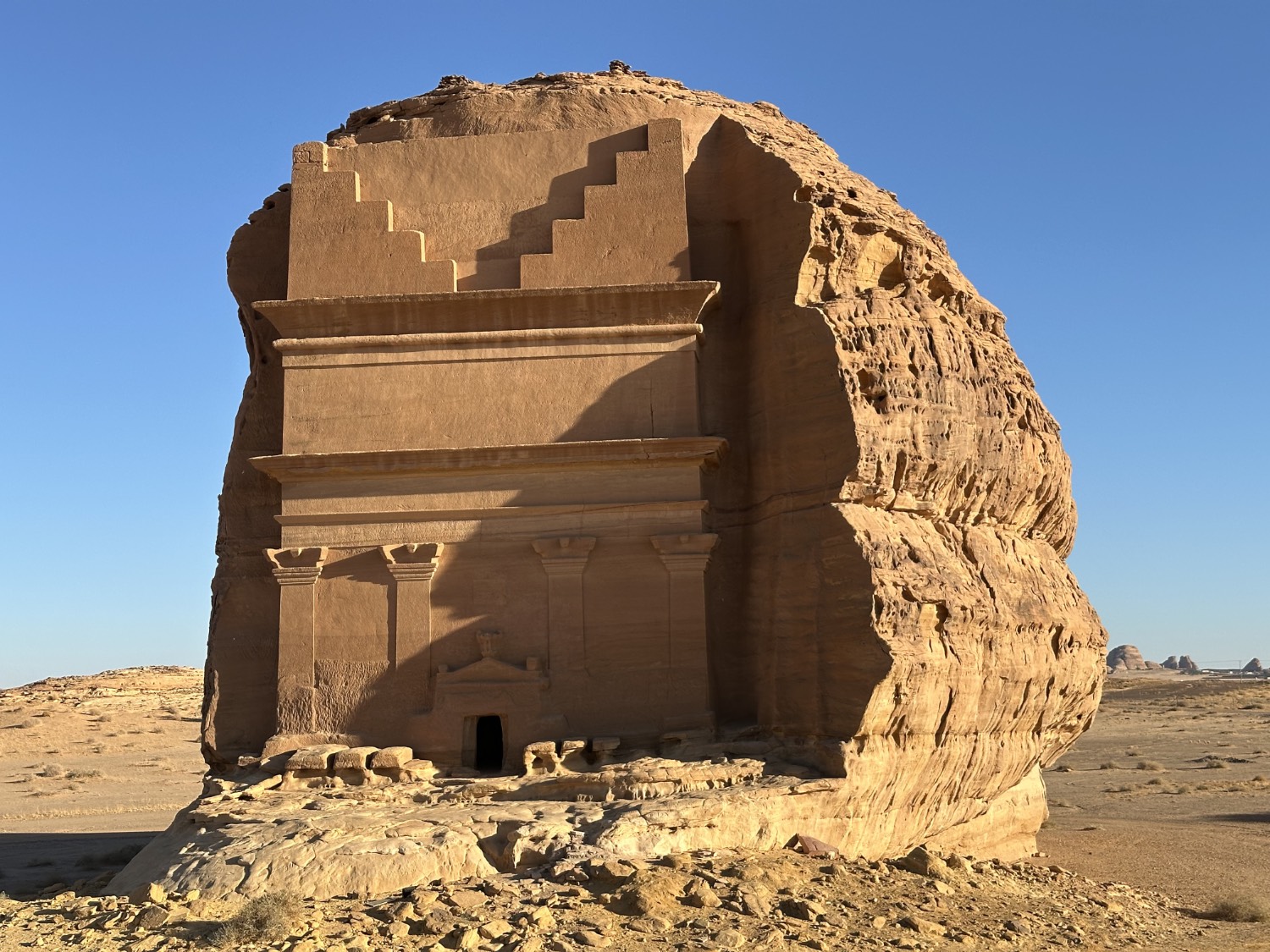
The scientific documentation, preservation, and modern exploration of Hegra and its iconic monuments have been spearheaded by international archaeological missions in collaboration with the Saudi Commission for Tourism and National Heritage and the Royal Commission for AlUla. Early western explorers, including Charles Montagu Doughty and Albert Jaussen, documented the site in the late 19th and early 20th centuries, laying the groundwork for modern stratigraphic excavation and epigraphic surveys. In recognition of its outstanding universal value, Hegra was inscribed in 2008 as Saudi Arabia’s first UNESCO World Heritage Site. Today, advanced digital conservation projects utilizing laser scanning and pH๏τogrammetry ensure that Qasr al-Farid continues to inspire awe while safeguarding its architectural secrets for future generations of scholars.
💔 STELLA PARTON BREAKS HER SILENCE — What She Said About Dolly’s Health Has Fans Looking Back
Dolly Parton’s Sister Breaks Silence What Really Happened - GMT - G1
Stella Parton was born May 4, 1949, the sixth of twelve children raised by Robert Lee and Avie Lee Parton in Sevierville, Tennessee — a household defined by noise, limited money, and almost no privacy, the kind of environment that produced strong, determined personalities.
Stella was one of them.
By seven, she was appearing alongside her older sister Dolly on a Knoxville television program; by her teens, she was writing her own songs, though marriage and motherhood pulled music to the margins of her life for a stretch.
The dream never fully disappeared.

In 1967, she recorded a gospel album with her mother and sisters, and later worked clubs in Washington, D.C., before founding her own record label in 1975 and releasing “I Want to Hold You in My Dreams Tonight,” which climbed to number nine on the country charts.
Long before any of that commercial success, Stella had already shown a willingness to take positions others avoided.
At 26, amid backlash against Australian singer Olivia Newton-John for winning recognition in country music, Stella recorded “Ode to Olivia” in her defense — a stand that offered her no career benefit and real risk of criticism, but one she took anyway simply because she believed staying silent was the wrong choice.
That instinct defined the rest of her career: hits like “The Danger of a Stranger” and “Steady as the Rain” (written by Dolly) built a genuine, independent following, including in the U.K., while Stella also worked in New York theater and spoke openly, often controversially, about poverty, domestic violence, and the treatment of women in the music industry.
She was named the Christian Country Music Association’s Female Vocalist of the Year in 2004.
Through all of it, she remained defined publicly, more often than not, as simply “Dolly’s little sister” — a label she spent five decades quietly proving didn’t tell the full story.
That same directness is why her comments in the fall of 2025 carried real weight.
Stella had never positioned herself as the family’s image manager or spokesperson; she was, by reputation, someone who believed difficult truths shouldn’t stay hidden indefinitely.
What she described wasn’t dramatic or accusatory — it was a portrait of a woman who had spent years prioritizing everyone else’s needs over her own.
The context mattered.
Carl Dean, Dolly’s husband of nearly sixty years, died in March 2025 at 82, after a long illness during which Dolly had devoted herself almost entirely to his care.
She later acknowledged that in the process, she’d neglected her own health significantly.
The loss reverberated through the whole extended family — the Partons had lost three brothers in the years surrounding this period, compounding grief that, for a family that had once crowded twelve children into a single small home, meant losing pieces of a shared childhood one after another.
Stella herself went seven years without releasing new music during this stretch, later describing the period simply as one shaped by sorrow, while still speaking about the importance of finding moments of laughter within it.
Looking back, one moment reads very differently in hindsight than it did at the time: in late September 2025, Dolly postponed her planned Las Vegas residency, citing health challenges — a rare cancellation for a performer whose six-decade career had included very few of them.
At the time, most fans treated it as a minor, temporary setback.
Stella’s later reflections suggested the signs had actually been building for some time, visible to family in ways the public smile made easy to miss.
That concern crystallized publicly not long after, when Dolly’s younger sister Frieda posted a simple request on Facebook asking fans to pray for Dolly.
What looked at first like an ordinary, well-meaning gesture spread rapidly, sparking widespread speculation about how serious Dolly’s condition actually was.
Dolly herself responded directly within days, appearing in a video from a Grand Ole Opry commercial shoot, insisting with her familiar humor that she wasn’t finished yet — the now widely remembered “I ain’t dead yet” moment that briefly quieted public concern.
In the months that followed, the pattern repeated: reassuring updates about kidney stones, dehydration, and treatment, paired with continued work on new projects, right up until Dolly Parton’s death on August 25, 2026, at 80.
Looking back across that full timeline — the postponed residency, the family’s public worry, Stella’s own account of a sister who consistently deprioritized her own wellbeing — it becomes easier to see what the people closest to Dolly understood well before the rest of the world did: that the warmth and resilience the public saw every time she appeared on camera came at a real, largely invisible cost.


