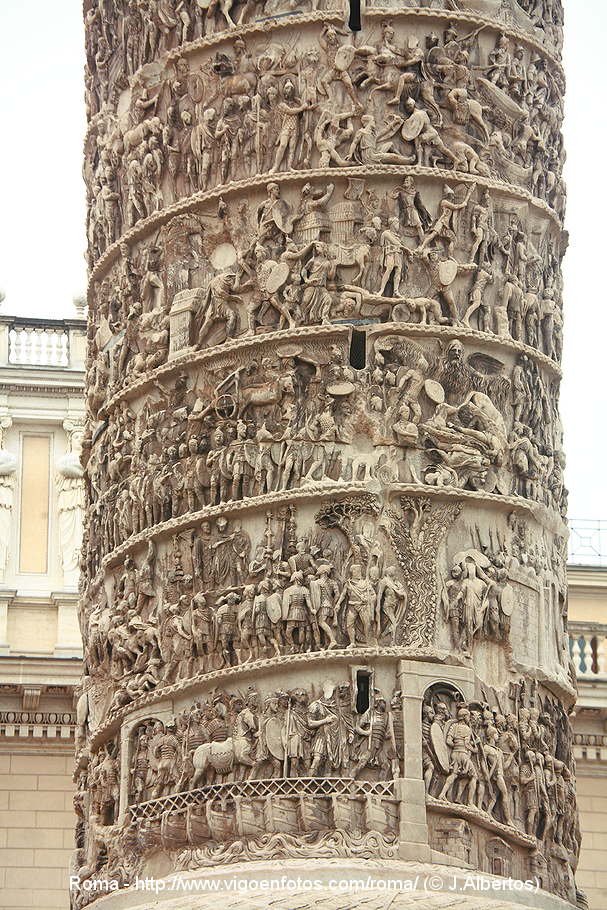
Standing proudly in the heart of Rome’s Piazza Colonna, the Column of Marcus Aurelius is a monumental masterpiece of imperial Roman art and public architecture. Erected between approximately 180 and 193 CE—following the death of the emperor and completed during the reign of his son Commodus—this soaring Doric column celebrates the military victories of Marcus Aurelius over the Germanic Marcomanni, Quadi, and Sarmatian tribes along the Danubian frontier. Rising to an original height of nearly 30 meters for the shaft alone (and over 40 meters including its pedestal), the column serves as an enduring historical narrative carved in stone. Inspired directly by the earlier Column of Trajan, it provides contemporary archaeologists and historians with an invaluable visual archive of Roman military tactics, logistics, weaponry, and imperial ideology.
Unlike buried artifacts recovered through excavation, the Column of Marcus Aurelius has remained an above-ground fixture of Rome’s urban landscape since antiquity, situated originally within the northern part of the Campus Martius. Its archaeological provenance is deeply intertwined with the civic evolution of Rome, having served continuously as a landmark despite the collapse of the surrounding imperial complexes. Historical records indicate that during the late 2nd century CE, a dedicated imperial caretaker or procurator—such as a freedman named Adrastus—managed the monument and maintained a small hut nearby. Over subsequent centuries, the column survived medieval shifts in the city’s topography, though its original base reliefs were largely altered or lost during a major architectural restoration commissioned by Pope Sixtus V in the late 16th century, when the architect Domenico Fontana repaired the structure and crowned it with a bronze statue of Saint Paul.

The structural integrity and artistic brilliance of the column rely heavily on its choice of material: fine-grained white Carrara marble (known in antiquity as luna marble). The shaft is ingeniously constructed from approximately 28 mᴀssive cylindrical marble blocks stacked horizontally, each meticulously hollowed out on the interior to house a continuous helical staircase of 190 steps leading to an upper viewing platform. Encircling the exterior of the shaft is a continuous spiral relief band measuring roughly 100 Roman feet in length when unrolled, featuring over 115 distinct narrative scenes carved in high-to-low relief. Master sculptors utilized precision chisels and drills to execute the intricate friezes, portraying detailed armor, facial expressions, and landscape elements across 21 distinct spiral turns.
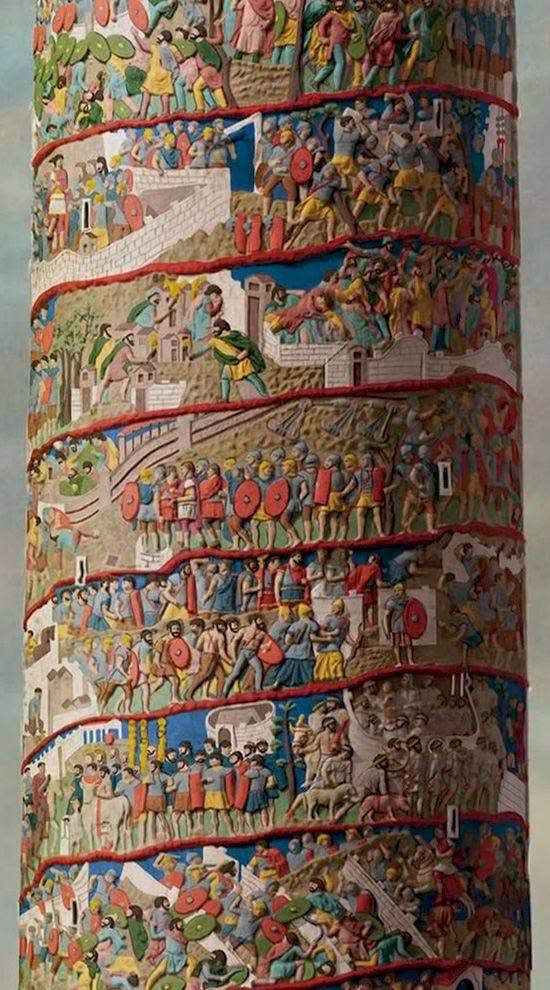
Functionally, the column served both as a grandiose royal tomb marker or memorial and as a political propaganda tool demonstrating the might and divine favor of the Roman state. The spiral frieze acts as a visual history book, beginning at the base with Roman troops crossing the Danube River on a pontoon bridge and progressing upward through military campaigns, battles, enemy submissions, and miraculous interventions—such as the famous “Rain Miracle” that saved the Roman army. Unlike the triumphant conquest themes of Trajan’s column, the reliefs on this monument emphasize intense struggle, endurance, and punitive retaliation against northern tribes, reflecting the harsher political and military realities of the late Antonine period.

Because the monument has never been lost to history, its modern study relies on architectural documentation, epigraphic analysis, and structural conservation rather than initial discovery excavations. Pioneers of classical archaeology and topography, such as Italian archaeologist Rodolfo Lanciani and subsequent scholars specializing in Antonine art, have meticulously documented its reliefs and structural phases. In modern times, insтιтutions like the Archaeological Superintendency of Rome oversee its continuous preservation. Through advanced pH๏τogrammetry, laser scanning, and conservation initiatives, contemporary researchers continue to protect this fragile marble masterpiece from urban pollution and environmental decay, ensuring its legacy endures for future archaeological inquiry.
💔 STELLA PARTON BREAKS HER SILENCE — What She Said About Dolly’s Health Has Fans Looking Back
Dolly Parton’s Sister Breaks Silence What Really Happened - GMT - G1
Stella Parton was born May 4, 1949, the sixth of twelve children raised by Robert Lee and Avie Lee Parton in Sevierville, Tennessee — a household defined by noise, limited money, and almost no privacy, the kind of environment that produced strong, determined personalities.
Stella was one of them.
By seven, she was appearing alongside her older sister Dolly on a Knoxville television program; by her teens, she was writing her own songs, though marriage and motherhood pulled music to the margins of her life for a stretch.
The dream never fully disappeared.

In 1967, she recorded a gospel album with her mother and sisters, and later worked clubs in Washington, D.C., before founding her own record label in 1975 and releasing “I Want to Hold You in My Dreams Tonight,” which climbed to number nine on the country charts.
Long before any of that commercial success, Stella had already shown a willingness to take positions others avoided.
At 26, amid backlash against Australian singer Olivia Newton-John for winning recognition in country music, Stella recorded “Ode to Olivia” in her defense — a stand that offered her no career benefit and real risk of criticism, but one she took anyway simply because she believed staying silent was the wrong choice.
That instinct defined the rest of her career: hits like “The Danger of a Stranger” and “Steady as the Rain” (written by Dolly) built a genuine, independent following, including in the U.K., while Stella also worked in New York theater and spoke openly, often controversially, about poverty, domestic violence, and the treatment of women in the music industry.
She was named the Christian Country Music Association’s Female Vocalist of the Year in 2004.
Through all of it, she remained defined publicly, more often than not, as simply “Dolly’s little sister” — a label she spent five decades quietly proving didn’t tell the full story.
That same directness is why her comments in the fall of 2025 carried real weight.
Stella had never positioned herself as the family’s image manager or spokesperson; she was, by reputation, someone who believed difficult truths shouldn’t stay hidden indefinitely.
What she described wasn’t dramatic or accusatory — it was a portrait of a woman who had spent years prioritizing everyone else’s needs over her own.
The context mattered.
Carl Dean, Dolly’s husband of nearly sixty years, died in March 2025 at 82, after a long illness during which Dolly had devoted herself almost entirely to his care.
She later acknowledged that in the process, she’d neglected her own health significantly.
The loss reverberated through the whole extended family — the Partons had lost three brothers in the years surrounding this period, compounding grief that, for a family that had once crowded twelve children into a single small home, meant losing pieces of a shared childhood one after another.
Stella herself went seven years without releasing new music during this stretch, later describing the period simply as one shaped by sorrow, while still speaking about the importance of finding moments of laughter within it.
Looking back, one moment reads very differently in hindsight than it did at the time: in late September 2025, Dolly postponed her planned Las Vegas residency, citing health challenges — a rare cancellation for a performer whose six-decade career had included very few of them.
At the time, most fans treated it as a minor, temporary setback.
Stella’s later reflections suggested the signs had actually been building for some time, visible to family in ways the public smile made easy to miss.
That concern crystallized publicly not long after, when Dolly’s younger sister Frieda posted a simple request on Facebook asking fans to pray for Dolly.
What looked at first like an ordinary, well-meaning gesture spread rapidly, sparking widespread speculation about how serious Dolly’s condition actually was.
Dolly herself responded directly within days, appearing in a video from a Grand Ole Opry commercial shoot, insisting with her familiar humor that she wasn’t finished yet — the now widely remembered “I ain’t dead yet” moment that briefly quieted public concern.
In the months that followed, the pattern repeated: reassuring updates about kidney stones, dehydration, and treatment, paired with continued work on new projects, right up until Dolly Parton’s death on August 25, 2026, at 80.
Looking back across that full timeline — the postponed residency, the family’s public worry, Stella’s own account of a sister who consistently deprioritized her own wellbeing — it becomes easier to see what the people closest to Dolly understood well before the rest of the world did: that the warmth and resilience the public saw every time she appeared on camera came at a real, largely invisible cost.