Rising dramatically from a remote and rugged mountain gorge in western Afghanistan, the Minaret of Jam stands as one of the most breathtaking architectural masterpieces of the medieval Islamic world. Dating back to the late 12th century—specifically constructed around 1190–1194 CE during the height of the Ghurid Dynasty under Sultan Ghiyath al-Din Muhammad—this soaring tower reaches a height of approximately 65 meters (213 feet). The structure serves as an exceptional testament to the engineering brilliance, artistic sophistication, and expansive political power of a civilization that once dominated regions spanning from eastern Iran to northern India. Surrounded by towering peaks at the confluence of the Hari and Jam rivers, the minaret remains a lonely yet majestic sentinel of a forgotten imperial past.
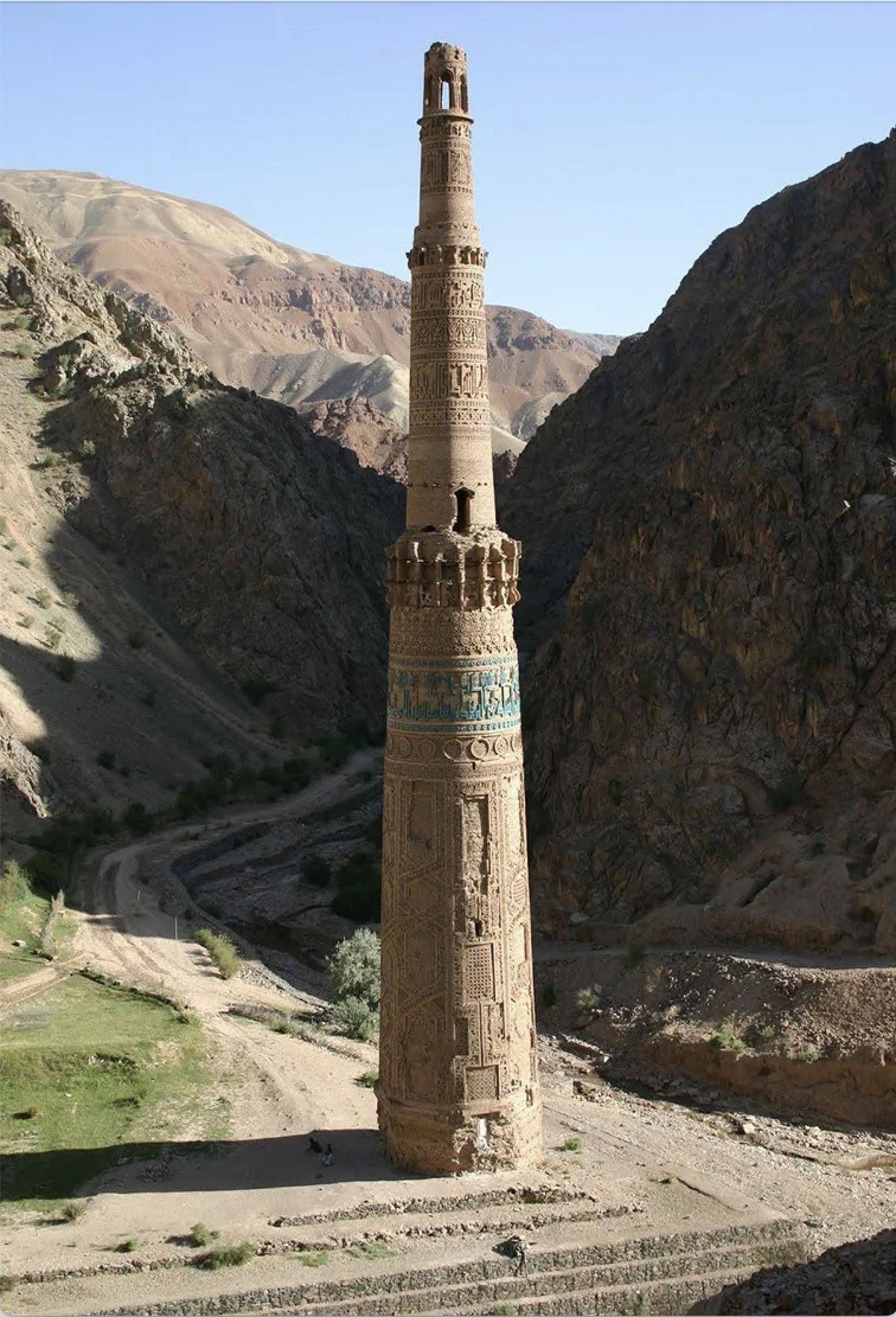
Despite its monumental scale, the Minaret of Jam remained largely unknown to the outside modern world for centuries due to its extreme geographical isolation. It was first documented in 1886 by Sir Thomas Holdich of the Afghan Boundary Commission, though it did not gain widespread international and academic attention until 1957 through the exploratory work of French archaeologists André Maricq and Gaston Wiet. Located within the Shahrak District of Ghor Province, subsequent archaeological investigations—such as those by the Minaret of Jam Archaeological Project (MJAP)—have revealed that the tower is the sole surviving major monument of Firozkoh, the legendary lost summer capital of the Ghurid Empire. The surrounding archaeological landscape contains remnants of fortifications, a Jewish cemetery, pottery kilns, and palace structures, establishing its profound historical provenance.

The construction of the Minaret of Jam showcases extraordinary mastery over masonry and material selection, utilizing baked bricks as the primary structural medium bound with high-quality lime mortar. The exterior is lavishly adorned with intricate geometric patterns, floral motifs, and bands of sophisticated Kufic and Naskhi calligraphy executed in stucco, terracotta, and striking turquoise-glazed tiles. Architecturally, the tower features a circular shaft resting upon a mᴀssive octagonal base. Internal structural integrity is maintained by a complex design incorporating a central solid pillar housing double-helix spiral staircases of 159 steps that lead up to historic wooden balconies. The careful arrangement of brick courses and interlocking structural layers allowed this slender skyscraper to withstand centuries of severe seismic activity and environmental erosion.
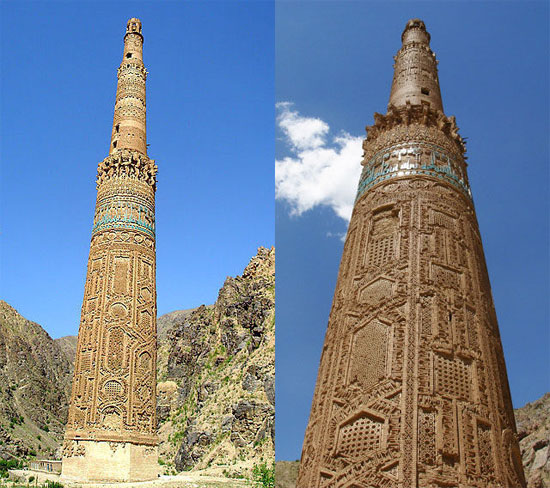
Functionally, minarets in Islamic architecture traditionally served as elevated platforms for the call to prayer (adhan) and as powerful visual symbols of Islamic sovereignty. However, scholars suggest that the Minaret of Jam also functioned as a “tower of victory” (victory tower), commemorating the Ghurid military triumphs over rival empires, such as the Ghaznavids. The decorative bands wrapping around the shaft prominently feature entire chapters and verses from the Quran, most notably Surah Maryam (Mary), intertwining religious devotion with imperial propaganda. Its strategic placement in a deep, defensible mountain valley emphasized the dominance of the Ghurid dynasty over both the landscape and local populations.
The scientific exploration and preservation of this fragile heritage site have been advanced by notable researchers and international organizations. Following its initial modern sightings by British surveyors and mid-20th-century French scholars, modern archaeological excavations were significantly expanded by researchers like David Thomas and Alison Gascoigne under the Minaret of Jam Archaeological Project in the early 2000s. Facing threats from severe river erosion, local seismic faults, and illegal artifact looting, the site was officially designated as Afghanistan’s first UNESCO World Heritage Site in 2002 and simultaneously placed on the List of World Heritage in Danger. Ongoing international efforts continue to monitor and protect this irreplaceable engineering marvel from complete environmental degradation.
💔 STELLA PARTON BREAKS HER SILENCE — What She Said About Dolly’s Health Has Fans Looking Back
Dolly Parton’s Sister Breaks Silence What Really Happened - GMT - G1
Stella Parton was born May 4, 1949, the sixth of twelve children raised by Robert Lee and Avie Lee Parton in Sevierville, Tennessee — a household defined by noise, limited money, and almost no privacy, the kind of environment that produced strong, determined personalities.
Stella was one of them.
By seven, she was appearing alongside her older sister Dolly on a Knoxville television program; by her teens, she was writing her own songs, though marriage and motherhood pulled music to the margins of her life for a stretch.
The dream never fully disappeared.

In 1967, she recorded a gospel album with her mother and sisters, and later worked clubs in Washington, D.C., before founding her own record label in 1975 and releasing “I Want to Hold You in My Dreams Tonight,” which climbed to number nine on the country charts.
Long before any of that commercial success, Stella had already shown a willingness to take positions others avoided.
At 26, amid backlash against Australian singer Olivia Newton-John for winning recognition in country music, Stella recorded “Ode to Olivia” in her defense — a stand that offered her no career benefit and real risk of criticism, but one she took anyway simply because she believed staying silent was the wrong choice.
That instinct defined the rest of her career: hits like “The Danger of a Stranger” and “Steady as the Rain” (written by Dolly) built a genuine, independent following, including in the U.K., while Stella also worked in New York theater and spoke openly, often controversially, about poverty, domestic violence, and the treatment of women in the music industry.
She was named the Christian Country Music Association’s Female Vocalist of the Year in 2004.
Through all of it, she remained defined publicly, more often than not, as simply “Dolly’s little sister” — a label she spent five decades quietly proving didn’t tell the full story.
That same directness is why her comments in the fall of 2025 carried real weight.
Stella had never positioned herself as the family’s image manager or spokesperson; she was, by reputation, someone who believed difficult truths shouldn’t stay hidden indefinitely.
What she described wasn’t dramatic or accusatory — it was a portrait of a woman who had spent years prioritizing everyone else’s needs over her own.
The context mattered.
Carl Dean, Dolly’s husband of nearly sixty years, died in March 2025 at 82, after a long illness during which Dolly had devoted herself almost entirely to his care.
She later acknowledged that in the process, she’d neglected her own health significantly.
The loss reverberated through the whole extended family — the Partons had lost three brothers in the years surrounding this period, compounding grief that, for a family that had once crowded twelve children into a single small home, meant losing pieces of a shared childhood one after another.
Stella herself went seven years without releasing new music during this stretch, later describing the period simply as one shaped by sorrow, while still speaking about the importance of finding moments of laughter within it.
Looking back, one moment reads very differently in hindsight than it did at the time: in late September 2025, Dolly postponed her planned Las Vegas residency, citing health challenges — a rare cancellation for a performer whose six-decade career had included very few of them.
At the time, most fans treated it as a minor, temporary setback.
Stella’s later reflections suggested the signs had actually been building for some time, visible to family in ways the public smile made easy to miss.
That concern crystallized publicly not long after, when Dolly’s younger sister Frieda posted a simple request on Facebook asking fans to pray for Dolly.
What looked at first like an ordinary, well-meaning gesture spread rapidly, sparking widespread speculation about how serious Dolly’s condition actually was.
Dolly herself responded directly within days, appearing in a video from a Grand Ole Opry commercial shoot, insisting with her familiar humor that she wasn’t finished yet — the now widely remembered “I ain’t dead yet” moment that briefly quieted public concern.
In the months that followed, the pattern repeated: reassuring updates about kidney stones, dehydration, and treatment, paired with continued work on new projects, right up until Dolly Parton’s death on August 25, 2026, at 80.
Looking back across that full timeline — the postponed residency, the family’s public worry, Stella’s own account of a sister who consistently deprioritized her own wellbeing — it becomes easier to see what the people closest to Dolly understood well before the rest of the world did: that the warmth and resilience the public saw every time she appeared on camera came at a real, largely invisible cost.