DOVER AIR FORCE BASE, Del. — President Donald Trump on Saturday joined grieving families at Dover Air Force Base at the dignified transfer for the six U.S. soldiers killed in the war in the Middle East.
The dignified transfer, a ritual that returns the remains of U.S. service members killed in action, is considered one of the most somber duties of any commander in chief. During his first term, Trump said bearing witness to the transfer was “the toughest thing I have to do” as president.
“It’s a very sad day,” Trump told reporters on Air Force One as he returned to Florida later Saturday afternoon, saying that he was “glad we paid our respects.” He said the relatives of the deceased are “great people, great parents, wives, family” and said that the “parents were so proud.”
Both Trump and Vice President JD Vance were present for the transfer, as were their spouses. A host of top administration officials were in attendance, including Defense Secretary Pete Hegseth, who wrote in a social media post Friday of “an unbreakable spirit to honor their memory and the resolve they embodied”; Attorney General Pam Bondi, White House chief of staff Susie Wiles, special envoy Steve Witkoff and Tulsi Gabbard, the director of national intelligence.
Also present for the solemn event were governors and senators from Iowa, Minnesota, Nebraska and Florida.
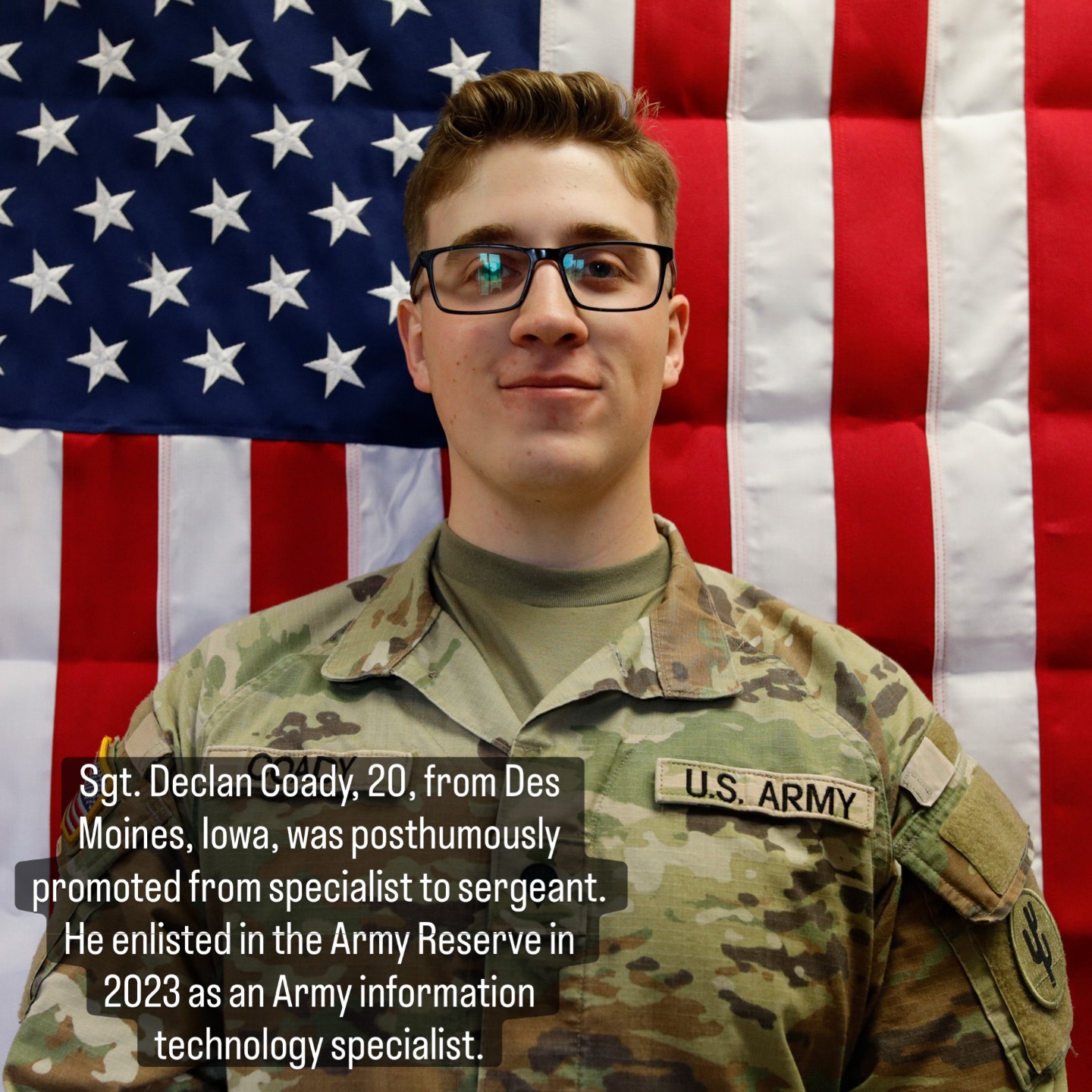
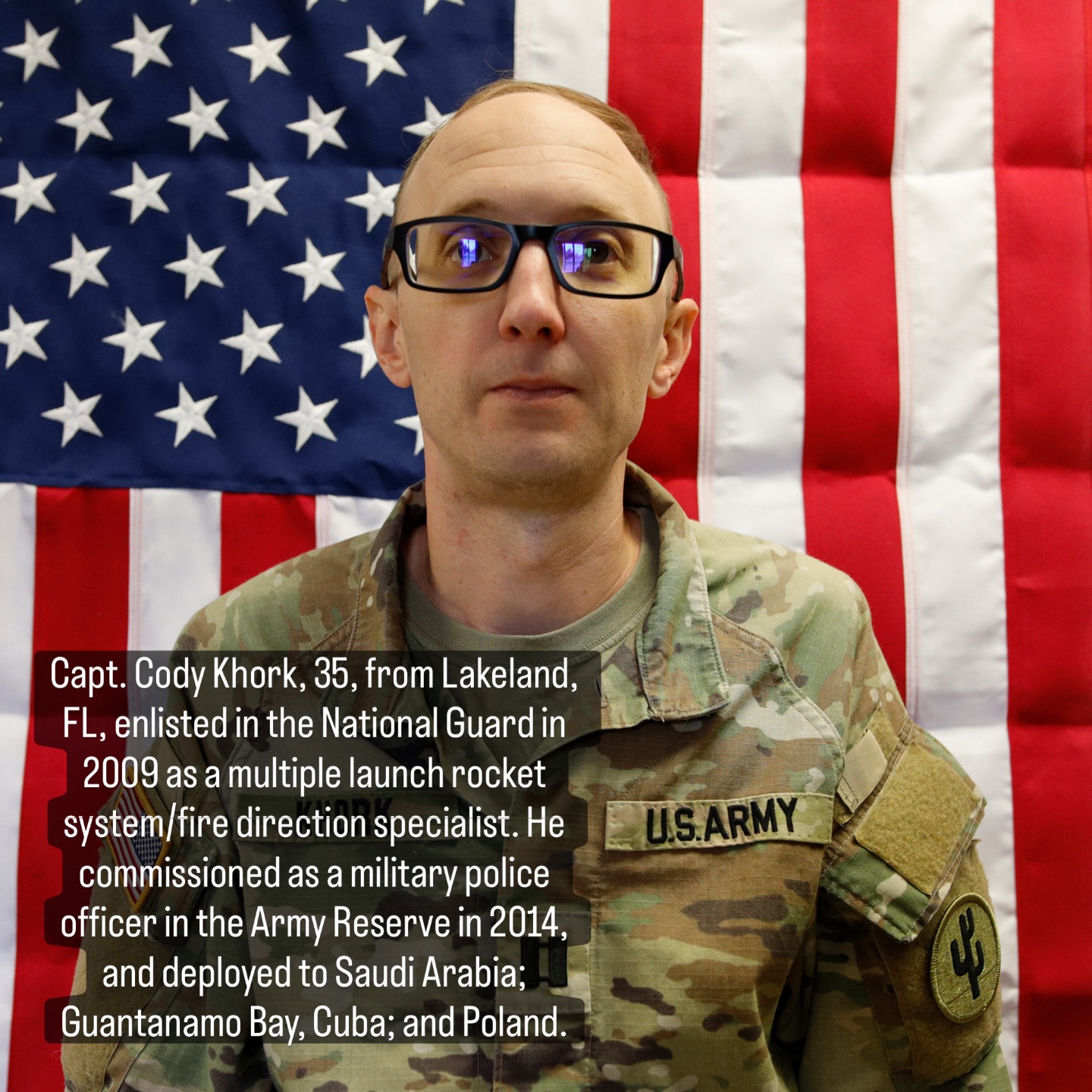
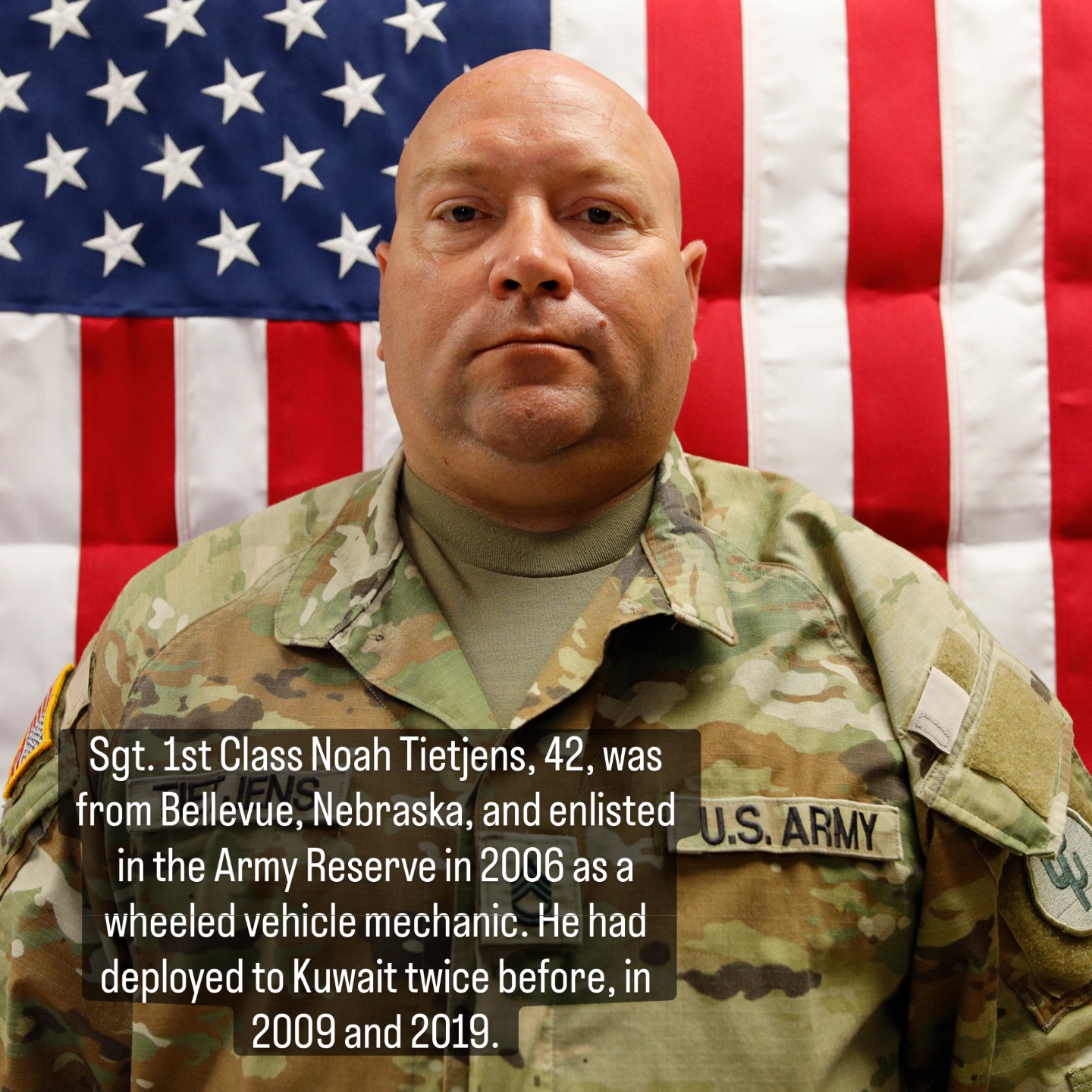
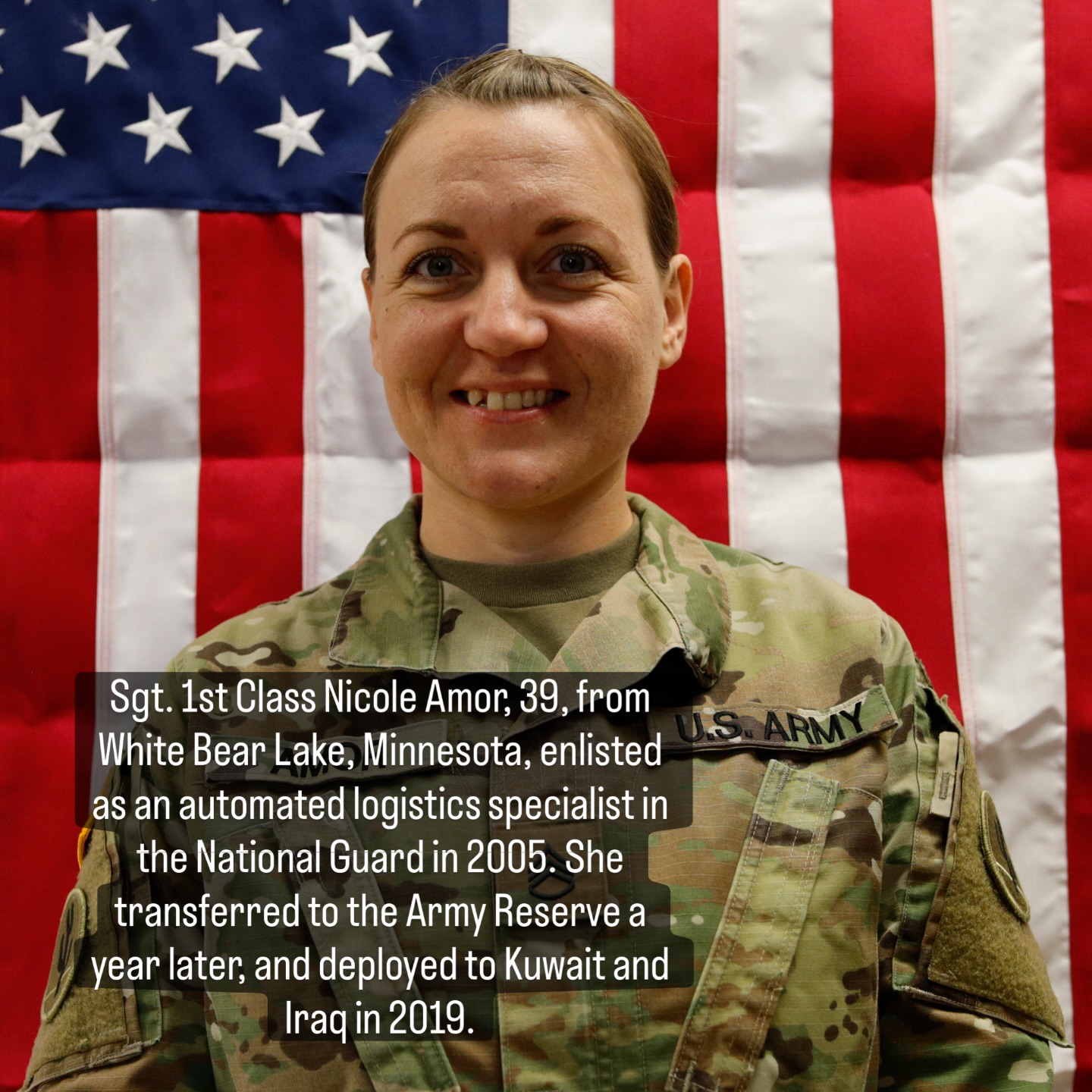
Those killed in action were Maj. Jeffrey O’Brien, 45, of Indianola, Iowa; Capt. Cody Khork, 35, of Winter Haven, Florida; Chief Warrant Officer 3 Robert Marzan, 54, of Sacramento, California; Sgt. 1st Class Nicole Amor, 39, of White Bear Lake, Minnesota; Sgt. 1st Class Noah Tietjens, 42, of Bellevue, Nebraska; and Sgt. Declan Coady, 20, of West Des Moines, lowa, who was posthumously promoted from specialist.
As is protocol, Trump — wearing a blue suit, red tie and a white USA hat — did not speak during the transfer. The president saluted as each flag-draped transfer case was carried from the military aircraft to awaiting transfer vehicles, which would take them to a mortuary facility to prepare them for their final resting place. The families were largely silent as they observed the ritual, which lasted about a half hour.
The six members of the Army Reserve, who were killed by a drone strike at a command center in Kuwait, were all from the 103rd Sustainment Command based in Des Moines, Iowa, which provides food, fuel, water and ammunition, transport equipment and supplies. They died just one day after the U.S. and Israel launched its military campaign against Iran.
“These soldiers engaged in the most noble mission: protecting their fellow Americans and keeping our homeland secure,” Republican Sen. Joni Ernst of Iowa, a combat veteran, said earlier this week after the six were identified. “Our nation owes them an incredible debt of graтιтude that can never be repaid.”
During the ritual, transfer cases draped with the American flag and holding the remains of the fallen soldiers are carried from the military aircraft that transported them to an awaiting vehicle to take them to the mortuary facility at the base. There, the service members are prepared for their final resting place.
Amor’s husband, Joey Amor, said earlier this week that she had been scheduled to return home to him and their two children within days.
“You don’t go to Kuwait thinking something’s going to happen, and for her to be one of the first – it hurts,” Joey Amor said.
O’Brien had served in the Army Reserve for nearly 15 years, according to his LinkedIn account, and his aunt said in a post on Facebook that O’Brien “was the sweetest blue-eyed, blonde farm kid you’d ever know. He is so missed already.”
Marzan’s sister described him in a Facebook post as a “strong leader” and loving husband, father and brother.
“My baby brother, you are loved and I will hold onto all our memories and cherish them always in my heart,” Elizabeth Marzan wrote.
Coady was among the youngest people in his class, trained to troubleshoot military computer systems, but he impressed his instructors, his father, Andrew Coady, told The ᴀssociated Press.
“He trained hard, he worked hard, his physical fitness was important to him. He loved being a soldier,” Coady said. “He was also one of the most kindest people you would ever meet, and he would do anything and everything for anyone.”
Khork’s family described him as “the life of the party” who was known for his “infectious spirit” and “generous heart” and who had wanted to serve in the military since childhood.
“That commitment helped shape the course of his life and reflected the deep sense of duty that was always at the core of who he was,” according to a statement from his mother, Donna Burhans, his father, James Khork, and his stepmother, Stacey Khork.
Tietjens, who came from a military family, previously served alongside his father in Kuwait. When he returned home in February 2010, he reunited with his overjoyed wife in a local church’s gym.
Tietjens’ cousin Kaylyn Golike asked for prayers, especially for Tietjens’ 12-year-old son, wife and parents, as they navigate “unimaginable loss.”
Trump most recently traveled to Dover in December to honor two Iowa National Guard members and a U.S. civilian interpreter who were killed in an ambush attack in the Syrian desert. He attended dignified transfers several times during his first term, including for a Navy SEAL killed during a raid in Yemen, for two Army officers whose helicopter crashed in Afghanistan and for two Army soldiers killed in Afghanistan when a person dressed in an Afghan army uniform opened fire.
💔 STELLA PARTON BREAKS HER SILENCE — What She Said About Dolly’s Health Has Fans Looking Back
Dolly Parton’s Sister Breaks Silence What Really Happened - GMT - G1
Stella Parton was born May 4, 1949, the sixth of twelve children raised by Robert Lee and Avie Lee Parton in Sevierville, Tennessee — a household defined by noise, limited money, and almost no privacy, the kind of environment that produced strong, determined personalities.
Stella was one of them.
By seven, she was appearing alongside her older sister Dolly on a Knoxville television program; by her teens, she was writing her own songs, though marriage and motherhood pulled music to the margins of her life for a stretch.
The dream never fully disappeared.

In 1967, she recorded a gospel album with her mother and sisters, and later worked clubs in Washington, D.C., before founding her own record label in 1975 and releasing “I Want to Hold You in My Dreams Tonight,” which climbed to number nine on the country charts.
Long before any of that commercial success, Stella had already shown a willingness to take positions others avoided.
At 26, amid backlash against Australian singer Olivia Newton-John for winning recognition in country music, Stella recorded “Ode to Olivia” in her defense — a stand that offered her no career benefit and real risk of criticism, but one she took anyway simply because she believed staying silent was the wrong choice.
That instinct defined the rest of her career: hits like “The Danger of a Stranger” and “Steady as the Rain” (written by Dolly) built a genuine, independent following, including in the U.K., while Stella also worked in New York theater and spoke openly, often controversially, about poverty, domestic violence, and the treatment of women in the music industry.
She was named the Christian Country Music Association’s Female Vocalist of the Year in 2004.
Through all of it, she remained defined publicly, more often than not, as simply “Dolly’s little sister” — a label she spent five decades quietly proving didn’t tell the full story.
That same directness is why her comments in the fall of 2025 carried real weight.
Stella had never positioned herself as the family’s image manager or spokesperson; she was, by reputation, someone who believed difficult truths shouldn’t stay hidden indefinitely.
What she described wasn’t dramatic or accusatory — it was a portrait of a woman who had spent years prioritizing everyone else’s needs over her own.
The context mattered.
Carl Dean, Dolly’s husband of nearly sixty years, died in March 2025 at 82, after a long illness during which Dolly had devoted herself almost entirely to his care.
She later acknowledged that in the process, she’d neglected her own health significantly.
The loss reverberated through the whole extended family — the Partons had lost three brothers in the years surrounding this period, compounding grief that, for a family that had once crowded twelve children into a single small home, meant losing pieces of a shared childhood one after another.
Stella herself went seven years without releasing new music during this stretch, later describing the period simply as one shaped by sorrow, while still speaking about the importance of finding moments of laughter within it.
Looking back, one moment reads very differently in hindsight than it did at the time: in late September 2025, Dolly postponed her planned Las Vegas residency, citing health challenges — a rare cancellation for a performer whose six-decade career had included very few of them.
At the time, most fans treated it as a minor, temporary setback.
Stella’s later reflections suggested the signs had actually been building for some time, visible to family in ways the public smile made easy to miss.
That concern crystallized publicly not long after, when Dolly’s younger sister Frieda posted a simple request on Facebook asking fans to pray for Dolly.
What looked at first like an ordinary, well-meaning gesture spread rapidly, sparking widespread speculation about how serious Dolly’s condition actually was.
Dolly herself responded directly within days, appearing in a video from a Grand Ole Opry commercial shoot, insisting with her familiar humor that she wasn’t finished yet — the now widely remembered “I ain’t dead yet” moment that briefly quieted public concern.
In the months that followed, the pattern repeated: reassuring updates about kidney stones, dehydration, and treatment, paired with continued work on new projects, right up until Dolly Parton’s death on August 25, 2026, at 80.
Looking back across that full timeline — the postponed residency, the family’s public worry, Stella’s own account of a sister who consistently deprioritized her own wellbeing — it becomes easier to see what the people closest to Dolly understood well before the rest of the world did: that the warmth and resilience the public saw every time she appeared on camera came at a real, largely invisible cost.