HE WAS ONLY 14 — THEN, 70 YEARS LATER, A JUDGE SAID THE TRIAL THAT SENT HIM TO THE ELECTRIC CHAIR HAD VIOLATED HIS RIGHTS 💔

HE WAS ONLY 14 — THEN, 70 YEARS LATER, A JUDGE SAID THE TRIAL THAT SENT HIM TO THE ELECTRIC CHAIR HAD VIOLATED HIS RIGHTS 💔
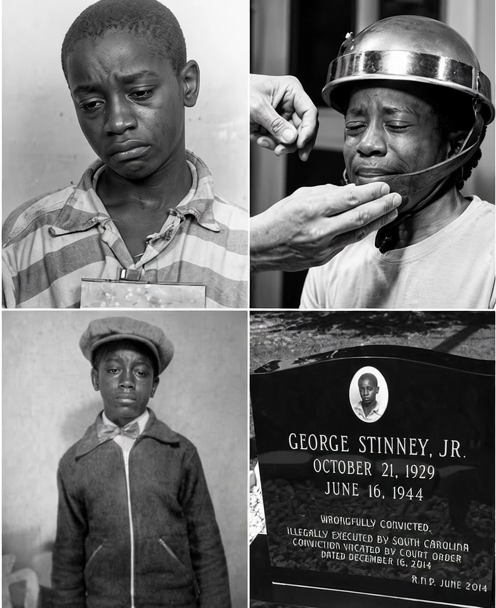
They executed a 14-year-old boy after a trial that lasted only one day. Seventy years later, a judge said the process that sent him to the electric chair had violated his consтιтutional rights.
George Stinney Jr. was fourteen years old.
He was barely five feet tall and weighed around 95 pounds.
He was still a child.
But in the Jim Crow South of 1944, being a Black child could not protect you from a justice system built around racial inequality.
In March 1944, two white girls from Alcolu, South Carolina—11-year-old Betty June Binnicker and 7-year-old Mary Emma Thames—disappeared while out looking for flowers.
The following morning, their bodies were discovered in a water-filled ditch.
The town was horrified.
And authorities quickly focused on George.
Police took him into custody while his parents were away.
His younger sister later said she remembered hiding as officers took George and his brother Johnnie away.
Johnnie was eventually released.
George wasn’t.
He was questioned without his parents present and without a lawyer beside him.
Police said he confessed.
But that alleged confession became one of the most controversial pieces of the entire case.
There was no surviving signed confession in George’s own words.
There was no recording.
And decades later, his family maintained that George was innocent.
His sister Amie said she had been with George around the time the girls disappeared and that they had been near the railroad tracks when the girls pᴀssed by on bicycles.
That account never reached the 1944 jury.
Then the case moved with astonishing speed.
George was arrested in March.
His capital trial began on April 24.
By the end of that same day, his fate had been decided.
The jury was made up entirely of white men.
George’s court-appointed attorney did not present defense witnesses.
His siblings’ account was not presented to the jury.
And no appeal was filed after the conviction.
The jury deliberated for only a few minutes.
Then came the verdict:
Guilty.
George was sentenced to death.
He was fourteen.
His mother pleaded for mercy.
His family was forced from their home after his father lost his job at the local mill.
But the execution remained scheduled.
On June 16, 1944, George was taken to the electric chair.
Only 84 days had pᴀssed since the girls disappeared.
A child had gone from being accused to being executed in less than three months.
South Carolina killed George Stinney Jr. that evening.
He was still fourteen.
For decades afterward, his family carried the memory of what had happened.
They did not simply ask the state to forgive George.
They wanted the conviction itself confronted.
Because a pardon could suggest mercy.
They wanted the court to confront whether the process that condemned him had ever been fair.
Then, seventy years after George’s execution, his case returned to court.
In 2014, surviving members of his family testified.
His sister Amie again described what she remembered.
Experts examined the alleged confession and the quality of George’s legal representation.
The question before Judge Carmen Mullen was not simply whether a modern court could determine who killed the two girls.
It was whether George Stinney had received the consтιтutional protections that should have applied to him in 1944.
The answer was devastating.
Judge Mullen concluded that George’s prosecution had been fundamentally flawed and that his consтιтutional right to due process had been violated.
His conviction was vacated.
Seventy years after South Carolina declared him guilty and executed him, the state court erased that conviction.
But the ruling did not magically reconstruct every missing piece of the 1944 investigation.
It did not identify another person as the killer.
It did not conduct a new murder trial.
It addressed something more fundamental:
The process used to condemn George Stinney was not consтιтutionally acceptable.
And that distinction matters.
Because George did not simply lose his freedom.
He lost his childhood.
He lost every birthday after fourteen.
Every Christmas.
Every graduation.
Every friendship he might have made.
Every career he might have built.
Every ordinary moment that comes with growing older.
A court could vacate a conviction seven decades later.
It could acknowledge the consтιтutional violations.
But it could not give George back a single day.
And there is another reason his story must be told carefully.
Images circulated online claiming to show George inside the electric chair have repeatedly been presented as authentic. Some widely shared images are actually ᴀssociated with the 1991 television film Carolina Skeletons, not documented pH๏τographs of George’s execution.
George’s story does not need invented pH๏τographs.
It does not need fabricated final words.
It does not need mythology.
The historical record is already powerful enough.
Two little girls lost their lives.
And a fourteen-year-old Black boy was condemned by a legal process that, seventy years later, a judge found had violated his consтιтutional rights.
That is the tragedy.
And perhaps the most painful part is the simplest.
George entered the system as a 14-year-old child.
He died before he ever had the chance to become 15.
Seventy years could change the judgment on paper.
But nothing could change the fact that George Stinney Jr. never got to grow up.
PH๏τos of Betty June Binnicker and Mary Emma Thames are in the comments below.

💔 STELLA PARTON BREAKS HER SILENCE — What She Said About Dolly’s Health Has Fans Looking Back


Dolly Parton’s Sister Breaks Silence What Really Happened - GMT - G1

Stella Parton was born May 4, 1949, the sixth of twelve children raised by Robert Lee and Avie Lee Parton in Sevierville, Tennessee — a household defined by noise, limited money, and almost no privacy, the kind of environment that produced strong, determined personalities.

Stella was one of them.

By seven, she was appearing alongside her older sister Dolly on a Knoxville television program; by her teens, she was writing her own songs, though marriage and motherhood pulled music to the margins of her life for a stretch.

The dream never fully disappeared.

Stella Parton

In 1967, she recorded a gospel album with her mother and sisters, and later worked clubs in Washington, D.C., before founding her own record label in 1975 and releasing “I Want to Hold You in My Dreams Tonight,” which climbed to number nine on the country charts.

Long before any of that commercial success, Stella had already shown a willingness to take positions others avoided.

At 26, amid backlash against Australian singer Olivia Newton-John for winning recognition in country music, Stella recorded “Ode to Olivia” in her defense — a stand that offered her no career benefit and real risk of criticism, but one she took anyway simply because she believed staying silent was the wrong choice.

That instinct defined the rest of her career: hits like “The Danger of a Stranger” and “Steady as the Rain” (written by Dolly) built a genuine, independent following, including in the U.K., while Stella also worked in New York theater and spoke openly, often controversially, about poverty, domestic violence, and the treatment of women in the music industry.

She was named the Christian Country Music Association’s Female Vocalist of the Year in 2004.

Through all of it, she remained defined publicly, more often than not, as simply “Dolly’s little sister” — a label she spent five decades quietly proving didn’t tell the full story.

That same directness is why her comments in the fall of 2025 carried real weight.

Stella had never positioned herself as the family’s image manager or spokesperson; she was, by reputation, someone who believed difficult truths shouldn’t stay hidden indefinitely.

What she described wasn’t dramatic or accusatory — it was a portrait of a woman who had spent years prioritizing everyone else’s needs over her own.

The context mattered.

Carl Dean, Dolly’s husband of nearly sixty years, died in March 2025 at 82, after a long illness during which Dolly had devoted herself almost entirely to his care.

She later acknowledged that in the process, she’d neglected her own health significantly.

The loss reverberated through the whole extended family — the Partons had lost three brothers in the years surrounding this period, compounding grief that, for a family that had once crowded twelve children into a single small home, meant losing pieces of a shared childhood one after another.

Stella herself went seven years without releasing new music during this stretch, later describing the period simply as one shaped by sorrow, while still speaking about the importance of finding moments of laughter within it.

Looking back, one moment reads very differently in hindsight than it did at the time: in late September 2025, Dolly postponed her planned Las Vegas residency, citing health challenges — a rare cancellation for a performer whose six-decade career had included very few of them.

At the time, most fans treated it as a minor, temporary setback.

Stella’s later reflections suggested the signs had actually been building for some time, visible to family in ways the public smile made easy to miss.

That concern crystallized publicly not long after, when Dolly’s younger sister Frieda posted a simple request on Facebook asking fans to pray for Dolly.

What looked at first like an ordinary, well-meaning gesture spread rapidly, sparking widespread speculation about how serious Dolly’s condition actually was.

Dolly herself responded directly within days, appearing in a video from a Grand Ole Opry commercial shoot, insisting with her familiar humor that she wasn’t finished yet — the now widely remembered “I ain’t dead yet” moment that briefly quieted public concern.

In the months that followed, the pattern repeated: reassuring updates about kidney stones, dehydration, and treatment, paired with continued work on new projects, right up until Dolly Parton’s death on August 25, 2026, at 80.

Looking back across that full timeline — the postponed residency, the family’s public worry, Stella’s own account of a sister who consistently deprioritized her own wellbeing — it becomes easier to see what the people closest to Dolly understood well before the rest of the world did: that the warmth and resilience the public saw every time she appeared on camera came at a real, largely invisible cost.


Related Posts

😱💔 WHAT DID WILLIAM CHAPMAN ASK THE SECURITY GUARD BEFORE THE TIGER TRAGEDY? An Alleged Final Conversation at Yorkshire Wildlife Park Has Raised One Heartbreaking Question!

😱💔 WHAT DID WILLIAM CHAPMAN ASK THE SECURITY GUARD BEFORE THE TIGER TRAGEDY? An Alleged Final Conversation at Yorkshire Wildlife Park Has Raised One Heartbreaking Question!

A Routine Encounter That Became an Unforgettable Memory A brief conversation at a security post inside Yorkshire Wildlife Park became the center of a deeply emotional account…

🐅😱 WHAT HAPPENED TO THE TIGER AFTER WILLIAM CHAPMAN’S REPORTED DEATH? An Alleged Emergency Meeting at Yorkshire Wildlife Park Raises Questions About the Animal’s Ultimate Fate!

🐅😱 WHAT HAPPENED TO THE TIGER AFTER WILLIAM CHAPMAN’S REPORTED DEATH? An Alleged Emergency Meeting at Yorkshire Wildlife Park Raises Questions About the Animal’s Ultimate Fate!

A Tragedy That Left Another Difficult Question Unanswered The aftermath of the tiger attack involving William Chapman at Yorkshire Wildlife Park brought an immediate focus on the…

🚨🔥 HE SUDDENLY STOPPED, TURNED HIS HEAD, AND THEN SOMETHING UNEXPECTED HAPPENED! A Chilling Account of William Chapman’s Final Moments Raises One Disturbing Question!

🚨🔥 HE SUDDENLY STOPPED, TURNED HIS HEAD, AND THEN SOMETHING UNEXPECTED HAPPENED! A Chilling Account of William Chapman’s Final Moments Raises One Disturbing Question!

The 17 Seconds That Became the Focus of the Investigation Seventeen seconds. That was the length of a security camera recording that became central to a disturbing…

💔🐅 A MYSTERIOUS NOTE FOUND INSIDE WILLIAM CHAPMAN’S JACKET? An Emotional Story From the Yorkshire Tiger Tragedy Claims His Family Discovered a Final Message — But What Did the Last Line Say?

💔🐅 A MYSTERIOUS NOTE FOUND INSIDE WILLIAM CHAPMAN’S JACKET? An Emotional Story From the Yorkshire Tiger Tragedy Claims His Family Discovered a Final Message — But What Did the Last Line Say?

 A Discovery Among the Belongings He Left Behind In the aftermath of the tragedy involving William Chapman and a tiger at Yorkshire Wildlife Park, his family faced…

🚨😱 SHOCKING TOXICOLOGY CLAIMS IN THE YORKSHIRE TIGER TRAGEDY! An Allegedly Unsealed Report Raises Disturbing Questions About William Chapman’s Final Hours — But What Does the Evidence Really Show?

🚨😱 SHOCKING TOXICOLOGY CLAIMS IN THE YORKSHIRE TIGER TRAGEDY! An Allegedly Unsealed Report Raises Disturbing Questions About William Chapman’s Final Hours — But What Does the Evidence Really Show?

“THE AUTOPSY TOXICOLOGY DOSSIER”: Unsealed Medical Examiner Extractions and Biochemical Audits Reveal Positive Illicit Substance Telemetry Prior to William Chapman Tiger Enclosure Incident DONCASTER, United Kingdom —…

😱🧪 A SHOCKING AUTOPSY TWIST IN THE YORKSHIRE TIGER TRAGEDY? Unverified Claims About William Chapman’s Last Meal and Medication Have Raised a Mysterious New Question!

😱🧪 A SHOCKING AUTOPSY TWIST IN THE YORKSHIRE TIGER TRAGEDY? Unverified Claims About William Chapman’s Last Meal and Medication Have Raised a Mysterious New Question!

A Discovery That Changed the Direction of the Investigation The circumstances surrounding William Chapman’s final hours at Yorkshire Wildlife Park have taken an unexpected turn in a…

Leave a Reply

Your email address will not be published. Required fields are marked *