Pamela Cisneros’s bag may have obstructed one of the probes. A layer of body fat might have diminished the effectiveness of the other.
These were among the explanations offered by a Taser expert analyzing why the device failed to subdue Pamela.
A Taser does not simply touch the body and instantly immobilize a person.
Both probes must make proper contact for the electrical current to affect the neuromuscular system.
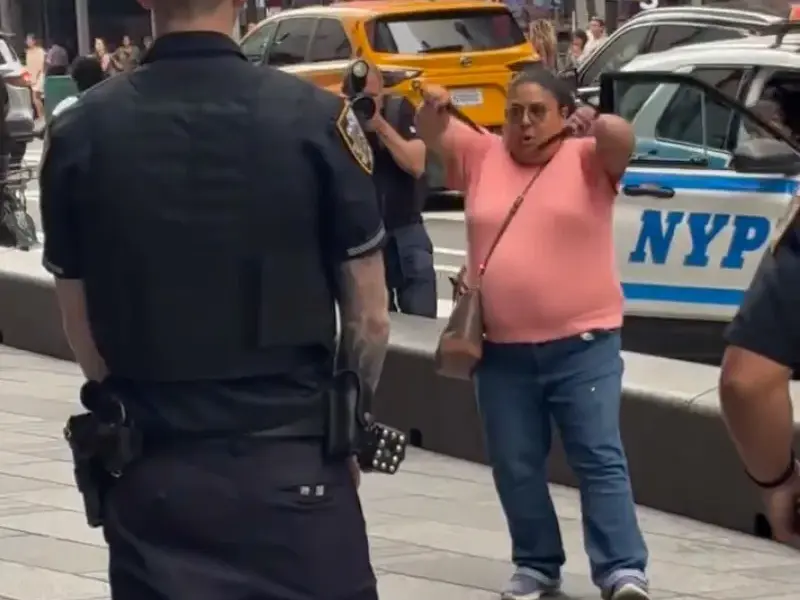
However, Pamela was constantly moving; one probe reportedly snagged on her bag, and the layer of tissue overlying the muscle may have reduced the device’s efficacy.
A combination of minor factors came into play simultaneously.
And now, upon reviewing the body-worn camera footage, the moment at the ten-second mark is truly chilling.
The Combination of Small Factors That Kept the Taser from Working

Pamela Cisneros’s bag may have obstructed one of the Taser probes. A layer of subcutaneous fat may have reduced the effectiveness of another. Those were among the explanations offered by a Taser expert examining why the device failed to stop her in Times Square on the afternoon of August 31, 2026.
A Taser does not simply touch the body and instantly immobilize a person. Both probes must make solid contact so that electrical current can complete a circuit and disrupt the neuromuscular system. When that circuit is incomplete or the current cannot reach the muscle effectively, the intended effect—temporary loss of voluntary muscle control—does not occur. Cisneros was moving constantly. One probe reportedly snagged on the bag or purse wrapped around her torso. The layer of tissue overlying the muscle in the area where another probe struck may have further limited the device’s reach. A combination of relatively minor factors arrived at the same moment.

### What the Expert Observed
Artur Sadowski, a retired NYPD detective and former Axon master instructor who helped write the department’s Taser training curriculum, reviewed available video of the confrontation. He noted that conducted-energy weapons require both probes to land with sufficient separation and to maintain contact long enough for the current to lock the muscles. Distance between the officers and Cisneros, combined with her erratic motion, made a reliable circuit difficult. Video suggested at least one strike near the midsection, an area where subcutaneous fat is typically thicker. “The thicker the padding in front of the muscles, the more difficult it is for the taser to get to the muscles and be effective,” Sadowski said. Even when probes make contact, he added, a narrow spread, intervening clothing or objects, or body fat can blunt the electrical effect.
One probe striking the bag would have broken the circuit entirely for that deployment. The result, according to the expert, could have been localized pain or muscle cramping without the full neuromuscular incapacitation officers expect. Cisneros continued to advance while holding a knife in each hand. Police Commissioner Jessica Tisch confirmed that multiple officers discharged Tasers and that the shocks proved ineffective before two officers fired their service weapons.
### The Limits of the Tool
Tasers are designed as a less-lethal option precisely because they are not guaranteed. Training materials emphasize probe placement, probe separation, and the need for both probes to complete the circuit. Real-world variables—subject movement, clothing, carried objects, body composition, and distance—routinely reduce success rates. In this instance several of those variables aligned. The bag, the midsection targeting, the movement, and the tissue layer did not each have to be decisive on its own. Together they were enough to keep the device from producing the intended effect.
Official accounts state that officers spent roughly four minutes attempting to persuade Cisneros to drop the knives before resorting to Tasers. When those deployments failed and she closed the distance, the officers used ᴅᴇᴀᴅly force. The New York attorney general’s office is reviewing the incident, including available body-worn camera footage, as required in any civilian death involving law enforcement. Publicly released material so far has consisted primarily of bystander video; detailed frame-by-frame analysis of official body-worn camera recordings has not been released.
The Moment That Remains Difficult to Watch

The technical explanation for the Taser failure supplies one clear piece of the final sequence. It does not erase the human stakes of those seconds. Cisneros had already stabbed two people. She refused repeated commands. The less-lethal option did not work. She continued forward. The combination of small mechanical factors that prevented the Taser from stopping her is now part of the public record. The larger questions—about prior mental-health interventions, the limits of police tools in chaotic public spaces, and the speed with which a confrontation can escalate—remain larger still. The footage, whether bystander or body-worn, continues to show a sequence that is difficult to look away from once it begins.
The Ten-Second Stretch That Changed Everything
When both Taser probes fail to complete an effective circuit, the confrontation does not pause for analysis. It simply continues. In the final seconds on Seventh Avenue, that is exactly what happened.
Pamela Cisneros kept moving. The knives remained in her hands. Officers who had already spent minutes giving verbal commands and then deployed less-lethal tools were left with a rapidly closing distance and an armed subject who had already stabbed two people. The combination of factors that prevented the Tasers from working—erratic movement, a bag that may have blocked one probe, and the tissue layer that may have limited the effect of another—did not create a new option. It removed one.
Body-worn camera footage from the officers involved is now part of the official review being conducted by the New York attorney general’s Office of Special Investigation. Publicly available material so far has come largely from bystander recordings. Those recordings, slowed and rewatched, show a compressed sequence in which the failure of the conducted-energy weapons and the decision to fire occur almost on top of each other. Viewers who have examined the clips closely often point to a roughly ten-second window in which the situation visibly tips from attempted control to the use of ᴅᴇᴀᴅly force. In that short span, the technical limitations of the Taser become irreversible.
From Ineffective Shock to Lethal Force
Police accounts and video evidence establish a clear order of events. Officers formed a semicircle. They issued repeated commands to drop the knives. Cisneros refused and made threats. Multiple officers discharged Tasers. The devices produced no visible incapacitation. Cisneros then advanced while still holding the knives. Two officers fired their service weapons. She was struck, fell, and was later pronounced ᴅᴇᴀᴅ at Bellevue Hospital.
The Taser expert’s analysis does not rewrite that sequence. It explains why the middle step—the less-lethal option—did not interrupt it. A Taser is not a guarantee. It is a tool that requires specific physical conditions to work. When those conditions are not met, officers are left with the remaining options on the force continuum. In a crowded public space, with an armed subject already responsible for two stabbings and closing distance, the remaining option was lethal force.
Policing experts who reviewed the available video have generally described the shooting itself as justified under the circumstances that existed once Cisneros advanced. Some have questioned earlier tactical decisions—the positioning of officers relative to traffic and pedestrians, the time spent in verbal commands, and the geometry of the semicircle—but the moment the Tasers failed and the subject continued forward is widely viewed as the point at which ᴅᴇᴀᴅly force became the only remaining immediate response.
What the Footage Shows and What It Cannot Resolve
Body-worn cameras capture what the officers saw and heard from their own perspectives. They do not capture every variable that affected the Taser deployments. Probe placement, the exact angle of the bag, the depth of subcutaneous tissue, and the precise timing of Cisneros’s movements are details that require forensic examination of the equipment and the physical evidence. The cameras do, however, show the human reality of those seconds: a woman who would not drop the knives, officers who had already tried the less-lethal option, and a distance that was shrinking.
The ten-second stretch that many viewers find most difficult is not cinematic. It is ordinary in its compression. Commands continue. The Taser cycles are visible or audible. Cisneros does not stop. The decision to fire follows. There is no extended negotiation left in the frame. The technical explanation for the Taser failure sits inside that short window and helps account for why it ended the way it did. It does not make the images easier to watch.
The Larger Arc Still Visible

The final confrontation cannot be separated from everything that preceded it. The long history of mental-health crises, the six-year divorce process, the growing distance from her children, the intermittent employment, the April conversation in which she told her father she was fine, and the quiet months of living alone in Queens all form the background against which those ten seconds occurred. The Taser failure is a mechanical detail inside a much longer human trajectory.
Investigators will continue to examine the body-worn camera recordings, the Taser data downloads, the autopsy findings, and the sequence of decisions made by the officers on the scene. The public record already contains enough to understand why the less-lethal tools did not work and why the situation escalated so quickly afterward. What remains is the weight of the images themselves—the moment when a combination of small physical factors removed the last non-lethal option, and the ten seconds that followed.
💔 STELLA PARTON BREAKS HER SILENCE — What She Said About Dolly’s Health Has Fans Looking Back
Dolly Parton’s Sister Breaks Silence What Really Happened - GMT - G1
Stella Parton was born May 4, 1949, the sixth of twelve children raised by Robert Lee and Avie Lee Parton in Sevierville, Tennessee — a household defined by noise, limited money, and almost no privacy, the kind of environment that produced strong, determined personalities.
Stella was one of them.
By seven, she was appearing alongside her older sister Dolly on a Knoxville television program; by her teens, she was writing her own songs, though marriage and motherhood pulled music to the margins of her life for a stretch.
The dream never fully disappeared.

In 1967, she recorded a gospel album with her mother and sisters, and later worked clubs in Washington, D.C., before founding her own record label in 1975 and releasing “I Want to Hold You in My Dreams Tonight,” which climbed to number nine on the country charts.
Long before any of that commercial success, Stella had already shown a willingness to take positions others avoided.
At 26, amid backlash against Australian singer Olivia Newton-John for winning recognition in country music, Stella recorded “Ode to Olivia” in her defense — a stand that offered her no career benefit and real risk of criticism, but one she took anyway simply because she believed staying silent was the wrong choice.
That instinct defined the rest of her career: hits like “The Danger of a Stranger” and “Steady as the Rain” (written by Dolly) built a genuine, independent following, including in the U.K., while Stella also worked in New York theater and spoke openly, often controversially, about poverty, domestic violence, and the treatment of women in the music industry.
She was named the Christian Country Music Association’s Female Vocalist of the Year in 2004.
Through all of it, she remained defined publicly, more often than not, as simply “Dolly’s little sister” — a label she spent five decades quietly proving didn’t tell the full story.
That same directness is why her comments in the fall of 2025 carried real weight.
Stella had never positioned herself as the family’s image manager or spokesperson; she was, by reputation, someone who believed difficult truths shouldn’t stay hidden indefinitely.
What she described wasn’t dramatic or accusatory — it was a portrait of a woman who had spent years prioritizing everyone else’s needs over her own.
The context mattered.
Carl Dean, Dolly’s husband of nearly sixty years, died in March 2025 at 82, after a long illness during which Dolly had devoted herself almost entirely to his care.
She later acknowledged that in the process, she’d neglected her own health significantly.
The loss reverberated through the whole extended family — the Partons had lost three brothers in the years surrounding this period, compounding grief that, for a family that had once crowded twelve children into a single small home, meant losing pieces of a shared childhood one after another.
Stella herself went seven years without releasing new music during this stretch, later describing the period simply as one shaped by sorrow, while still speaking about the importance of finding moments of laughter within it.
Looking back, one moment reads very differently in hindsight than it did at the time: in late September 2025, Dolly postponed her planned Las Vegas residency, citing health challenges — a rare cancellation for a performer whose six-decade career had included very few of them.
At the time, most fans treated it as a minor, temporary setback.
Stella’s later reflections suggested the signs had actually been building for some time, visible to family in ways the public smile made easy to miss.
That concern crystallized publicly not long after, when Dolly’s younger sister Frieda posted a simple request on Facebook asking fans to pray for Dolly.
What looked at first like an ordinary, well-meaning gesture spread rapidly, sparking widespread speculation about how serious Dolly’s condition actually was.
Dolly herself responded directly within days, appearing in a video from a Grand Ole Opry commercial shoot, insisting with her familiar humor that she wasn’t finished yet — the now widely remembered “I ain’t dead yet” moment that briefly quieted public concern.
In the months that followed, the pattern repeated: reassuring updates about kidney stones, dehydration, and treatment, paired with continued work on new projects, right up until Dolly Parton’s death on August 25, 2026, at 80.
Looking back across that full timeline — the postponed residency, the family’s public worry, Stella’s own account of a sister who consistently deprioritized her own wellbeing — it becomes easier to see what the people closest to Dolly understood well before the rest of the world did: that the warmth and resilience the public saw every time she appeared on camera came at a real, largely invisible cost.