TRUE CRIME | FLORIDA DEATH ROW | FAMILY AND JUSTICE
Editor’s note: The quotation attributed to Wade Wilson’s father has not been independently authenticated. This article explores its emotional meaning in the context of the documented murder case. It does not present the quoted words as a verified recording or transcript.


7
FLORIDA — Sometimes the most devastating words a father could speak to his son are not expressions of anger. They are words of recognition — an acknowledgment that the person he once knew has become someone whose actions he can no longer understand.
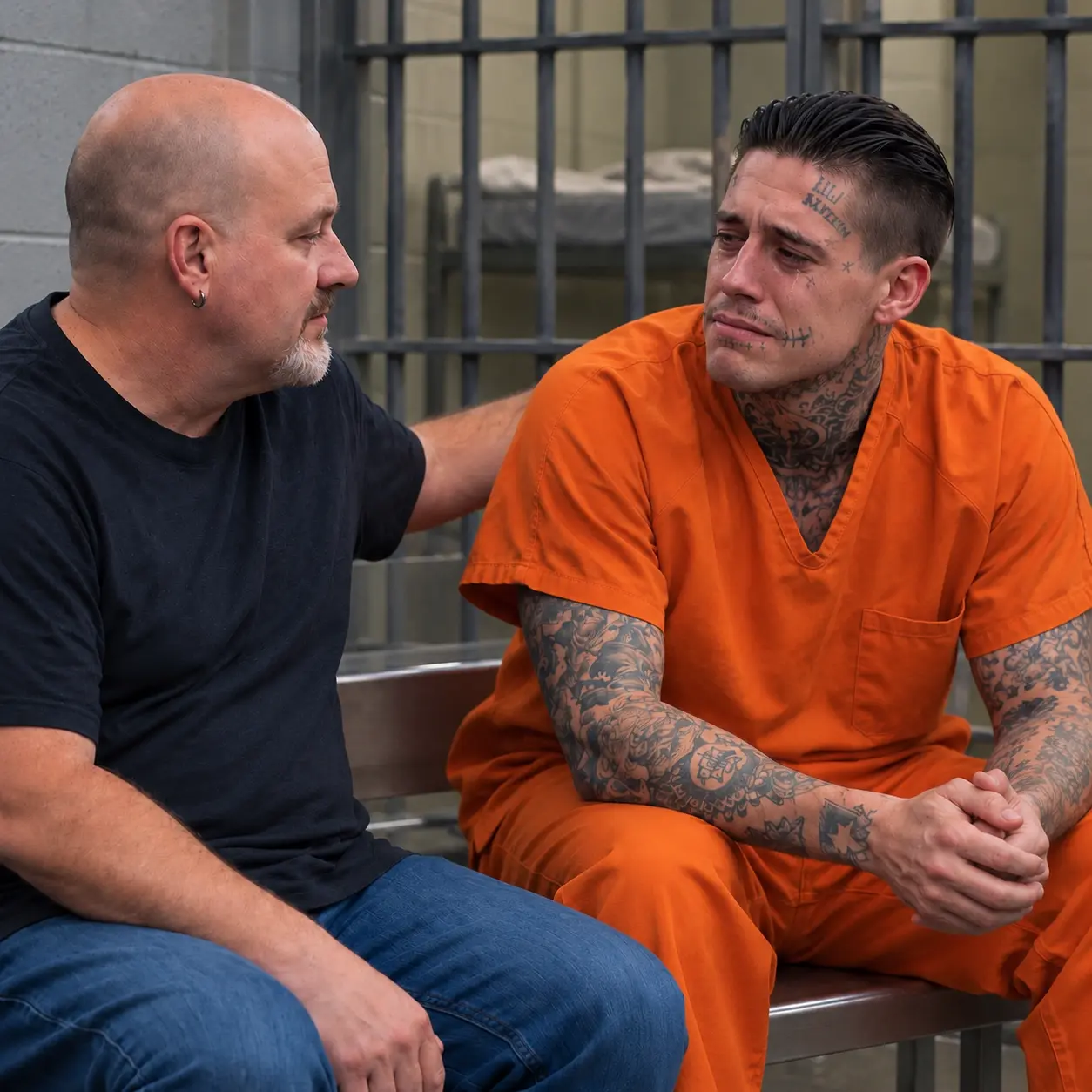
A statement circulating online, attributed to the father of convicted murderer Wade Wilson, captures that painful contradiction:
“Son, I know you’ve lost your way. Right now, much of America sees you as a monster.”
Whether those exact words were ever spoken remains unconfirmed. Yet the sentiment reflects one of the most troubling dimensions of the Wade Wilson case: the collision between a parent’s relationship with a child and the terrible reality of that child’s crimes.
Wilson became nationally notorious after being convicted of murdering Kristine Melton and Diane Ruiz in Cape Coral, Florida, in October 2019.
His trial attracted widespread attention, not only because of the brutality of the killings but also because of the unusual public fascination surrounding his appearance, courtroom behavior, and personal history.
Behind those headlines, however, was another story — that of a father who became involved in the investigation into his own son’s actions.
The Phone Call That Changed Everything
One of the most disturbing aspects of the case concerns Wilson’s communications with his biological father, Steve Testasecca.
According to accounts presented during the investigation and subsequent reporting, Wilson made incriminating statements to his father about the killings.
Testasecca ultimately contacted law enforcement.
That decision placed him in an extraordinary position.
A father is ordinarily expected to protect his child. But what happens when protecting others means telling authorities about something his own son has confessed?
The emotional conflict is difficult to imagine.
On one side stands the bond between parent and child — a relationship shaped by family history, personal memories, and responsibilities that often continue throughout adulthood.
On the other stands the obligation to confront serious violence and ensure that investigators receive information relevant to the deaths of two women.
Testasecca’s involvement became a significant element of the case.
His decision to communicate with authorities also illustrated a difficult principle: family loyalty cannot erase responsibility for violent crimes.
A Father’s Words and the Meaning Behind Them
The circulating quotation is striking because it does not attempt to excuse Wilson’s actions.
Instead, it acknowledges the gulf between the image a father might retain of his son and the way the public views a convicted murderer.
The phrase “lost your way” suggests personal tragedy.
The reference to being seen as a monster reflects public outrage.
Together, the two ideas capture a painful contradiction.
A parent may continue to recognize the humanity of an adult child while rejecting the crimes that person committed.
That distinction is important.
Acknowledging a family member’s humanity does not mean minimizing violence, disputing a conviction, or suggesting that victims’ families should offer forgiveness.
It simply recognizes that serious crimes can leave devastation extending beyond the immediate victims.
Families of offenders may experience shame, grief, anger, confusion, and profound emotional conflict.
But those experiences must never overshadow the suffering of the people whose lives were taken.
The Two Women at the Center of the Case


7
Before Wade Wilson became the subject of viral headlines, Kristine Melton and Diane Ruiz were living their own lives.
Melton was 35 years old.
Ruiz was 43 and a mother of two.
Both were murdered in separate incidents in October 2019.
Their deaths left families and loved ones facing permanent loss.
During Wilson’s trial, prosecutors presented evidence describing the circumstances of the killings and the sequence of events that connected him to both crimes.
In June 2024, a jury found Wilson guilty of the murders.
In August 2024, he received two death sentences.
The legal proceedings established his criminal responsibility, but no courtroom verdict could restore what the victims’ families had lost.
For those families, the story is not primarily about Wilson’s appearance, his relationship with his father, or the attention he has attracted online.
It is about two women who should still be alive.
When a Criminal Case Becomes an Internet Obsession
The Wade Wilson case attracted an unusual level of attention on social media.
His facial tattoos, physical appearance, and courtroom demeanor became frequent subjects of online discussion.
Some users expressed fascination with him despite the seriousness of his convictions.
That response generated considerable controversy.
Why would someone convicted of two murders attract admiration from strangers?

For most people, a prison sentence means losing freedom. For someone sentenced to death, it also means confronting a future shaped by confinement, legal uncertainty, and the knowledge that the state intends to end their life. The punishment extends beyond a courtroom announcement into the ordinary hours that follow: waking, waiting, eating, and trying to give structure to another day.
Wade Wilson received two death sentences in August 2024 for the murders of Kristine Melton and Diane Ruiz. His convictions placed him at the center of a widely followed criminal case, but the attention surrounding his appearance and courtroom behavior has sometimes overshadowed both the victims and the realities of capital punishment. Those realities deserve examination without inventing scenes from inside his cell.
The central question is compelling: what happens when a person’s world becomes тιԍнтly restricted and the future offers little certainty? Answering it requires distinguishing what Florida publicly documents about death row from what outsiders can actually know about Wilson’s personal experience.
One important correction concerns isolation. Descriptions of death row often portray every prisoner as spending virtually every hour alone, without recreation, conversation, or meaningful contact. Florida’s published information presents a more complicated picture. It permits social interaction during dayroom and recreation activities, alongside access to correspondence and certain entertainment. Death row status alone therefore does not establish that an individual lives in uninterrupted, near-total isolatio.
That distinction does not make confinement ordinary. It changes how the experience should be described. A тιԍнтly controlled prison environment can severely limit autonomy even when opportunities for contact exist. But a general account of restrictive imprisonment cannot subsтιтute for verified information about one prisoner’s daily schedule, privileges, disciplinary classification, or medical care.
For Wilson specifically, the sources reviewed for this article do not provide a complete, independently verified account of his current daily routine. Claims that he spends precisely 23 hours alone each day, has no distractions, or experiences a particular psychological condition would require additional evidence.
What can be explored responsibly is the relationship between restricted choice, repeтιтive surroundings, and the pᴀssage of time.
Outside prison, people organize their lives around decisions both large and small. They choose when to leave home, whom to meet, what to eat, and how to respond when plans change. These choices create variety. They also help distinguish one day from another.
Under confinement, many of those decisions belong to the insтιтution. Even when an activity is available, its timing and conditions may be controlled. The loss is therefore broader than physical movement. It includes the ability to shape an ordinary day according to personal priorities.
Repeтιтion can become one of the defining features of that loss. The same setting, limited activities, and recurring procedures may leave fewer memorable events separating one week from the next. This is a useful way to understand the potential burden of prison routine, rather than a claim about how Wilson personally perceives time.
A person may count days through letters, visits, legal correspondence, exercise, or reading. These activities can provide structure and anticipation. Yet describing them as coping strategies does not establish that Wilson follows any particular practice. Without reliable testimony or records, his private habits remain unknown.
The psychological risks ᴀssociated with severe isolation are nevertheless well documented. The American Psychological ᴀssociation has described research and expert testimony linking solitary confinement with anxiety, depression, panic, paranoia, and other serious difficulties. These findings explain why prolonged isolation attracts scrutiny from psychologists and prison reform advocates. They do not amount to a diagnosis of every person held in restrictive housing.That limitation matters. People respond differently to confinement, and their circumstances differ as well. The amount and quality of social contact, access to meaningful activities, previous mental health difficulties, and the duration of restrictions all matter when evaluating an individual experience. A dramatic pH๏τograph or a brief courtroom appearance cannot reveal those factors.
Nor should adaptation be confused with an absence of suffering. In general terms, someone may develop a routine that helps them function while still finding their environment distressing. Conversely, an observer should not ᴀssume psychological collapse simply because conditions appear harsh. Both conclusions require evidence beyond the fact of imprisonment.
This is where responsible reporting must resist an easy narrative. Stories about death row frequently rely on imagined silence, sleepless nights, regret, or fear. Such details can make an article vivid, but they also invite readers to mistake speculation for access. No reporter can reliably describe Wilson’s thoughts merely by describing the walls around him.
Legal uncertainty adds another dimension to the discussion. A death sentence and the subsequent review process are distinct stages. In Wilson’s case, his attorney’s February 2026 public statement explained that consтιтutional arguments had been preserved and discussed the intended route toward possible U.S. Supreme Court review. That statement described the defense’s legal position; it did not guarantee that further review would occur or succeed.
For readers, the distinction between an intended challenge and an actual court ruling is essential. Announcements about strategy should never be presented as decisions by judges. Likewise, a hearing, filing, or procedural order should not automatically be described as bringing either release or execution closer.
At a broader level, capital proceedings create a difficult relationship with the future. The sentence points toward a final outcome, while legal review concerns whether the conviction and punishment can lawfully stand. Explaining that tension does not require guessing whether a particular prisoner feels hopeful, resigned, frightened, or indifferent.
There is also a responsibility to keep the victims visible. Wilson’s punishment arose from the murders of Kristine Melton and Diane Ruiz. Their names should remain central to the story, rather than appearing only as background to public fascination with the man convicted of killing them. The prosecution’s sentencing announcement identifies their deaths as the basis for his two death sentences.
Examining prison conditions does not diminish those losses. It asks a separate public question: how should the state administer punishment after a conviction? Accountability for violent crime and scrutiny of confinement can exist within the same discussion.
That discussion becomes less useful when it turns into spectacle. An offender’s notoriety can encourage exaggerated accounts of both suffering and privilege. Readers may encounter claims that death row is either an existence without any human contact or a comfortable life with few consequences. Neither sweeping portrayal can replace evidence about actual conditions.
The more difficult task is to acknowledge the limits of what is known. Florida’s published policies describe authorized activities, but policy is not an individual activity log. Psychological research identifies risks, but research is not Wilson’s medical record. Legal statements explain arguments, but arguments are not final judgments.
What happens to a person after years of restrictive confinement therefore has no single, automatic answer. The question involves environment, health, contact, routine, and individual circumstances. In Wilson’s case, the available evidence supports a careful examination of those issues—not a confident account of an unseen inner life.
Behind the public attention remains a case involving two murdered women, two death sentences, and serious questions about punishment. Understanding it requires more than imagining an identical day repeated forever. It requires accuracy about what confinement permits, honesty about what remains unknown, and attention to the lives that made the case a matter of justice in the first place.
💔 STELLA PARTON BREAKS HER SILENCE — What She Said About Dolly’s Health Has Fans Looking Back
Dolly Parton’s Sister Breaks Silence What Really Happened - GMT - G1
Stella Parton was born May 4, 1949, the sixth of twelve children raised by Robert Lee and Avie Lee Parton in Sevierville, Tennessee — a household defined by noise, limited money, and almost no privacy, the kind of environment that produced strong, determined personalities.
Stella was one of them.
By seven, she was appearing alongside her older sister Dolly on a Knoxville television program; by her teens, she was writing her own songs, though marriage and motherhood pulled music to the margins of her life for a stretch.
The dream never fully disappeared.

In 1967, she recorded a gospel album with her mother and sisters, and later worked clubs in Washington, D.C., before founding her own record label in 1975 and releasing “I Want to Hold You in My Dreams Tonight,” which climbed to number nine on the country charts.
Long before any of that commercial success, Stella had already shown a willingness to take positions others avoided.
At 26, amid backlash against Australian singer Olivia Newton-John for winning recognition in country music, Stella recorded “Ode to Olivia” in her defense — a stand that offered her no career benefit and real risk of criticism, but one she took anyway simply because she believed staying silent was the wrong choice.
That instinct defined the rest of her career: hits like “The Danger of a Stranger” and “Steady as the Rain” (written by Dolly) built a genuine, independent following, including in the U.K., while Stella also worked in New York theater and spoke openly, often controversially, about poverty, domestic violence, and the treatment of women in the music industry.
She was named the Christian Country Music Association’s Female Vocalist of the Year in 2004.
Through all of it, she remained defined publicly, more often than not, as simply “Dolly’s little sister” — a label she spent five decades quietly proving didn’t tell the full story.
That same directness is why her comments in the fall of 2025 carried real weight.
Stella had never positioned herself as the family’s image manager or spokesperson; she was, by reputation, someone who believed difficult truths shouldn’t stay hidden indefinitely.
What she described wasn’t dramatic or accusatory — it was a portrait of a woman who had spent years prioritizing everyone else’s needs over her own.
The context mattered.
Carl Dean, Dolly’s husband of nearly sixty years, died in March 2025 at 82, after a long illness during which Dolly had devoted herself almost entirely to his care.
She later acknowledged that in the process, she’d neglected her own health significantly.
The loss reverberated through the whole extended family — the Partons had lost three brothers in the years surrounding this period, compounding grief that, for a family that had once crowded twelve children into a single small home, meant losing pieces of a shared childhood one after another.
Stella herself went seven years without releasing new music during this stretch, later describing the period simply as one shaped by sorrow, while still speaking about the importance of finding moments of laughter within it.
Looking back, one moment reads very differently in hindsight than it did at the time: in late September 2025, Dolly postponed her planned Las Vegas residency, citing health challenges — a rare cancellation for a performer whose six-decade career had included very few of them.
At the time, most fans treated it as a minor, temporary setback.
Stella’s later reflections suggested the signs had actually been building for some time, visible to family in ways the public smile made easy to miss.
That concern crystallized publicly not long after, when Dolly’s younger sister Frieda posted a simple request on Facebook asking fans to pray for Dolly.
What looked at first like an ordinary, well-meaning gesture spread rapidly, sparking widespread speculation about how serious Dolly’s condition actually was.
Dolly herself responded directly within days, appearing in a video from a Grand Ole Opry commercial shoot, insisting with her familiar humor that she wasn’t finished yet — the now widely remembered “I ain’t dead yet” moment that briefly quieted public concern.
In the months that followed, the pattern repeated: reassuring updates about kidney stones, dehydration, and treatment, paired with continued work on new projects, right up until Dolly Parton’s death on August 25, 2026, at 80.
Looking back across that full timeline — the postponed residency, the family’s public worry, Stella’s own account of a sister who consistently deprioritized her own wellbeing — it becomes easier to see what the people closest to Dolly understood well before the rest of the world did: that the warmth and resilience the public saw every time she appeared on camera came at a real, largely invisible cost.