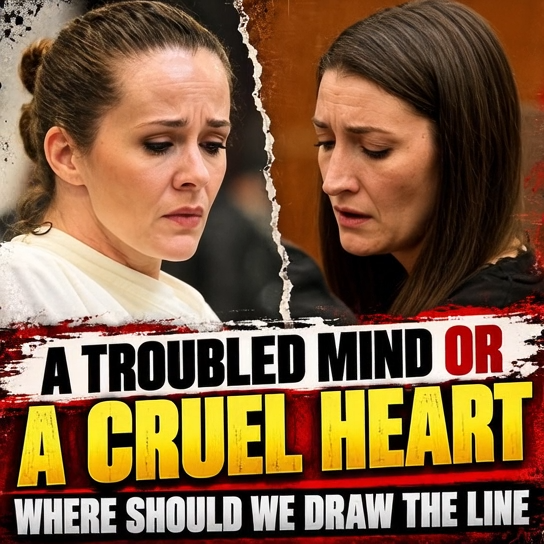
💔 A TROUBLED MIND OR A CRUEL HEART? THE HAUNTING QUESTION BEHIND CHRISTa PIKE’S CASE
When someone commits an act of shocking violence, people often search for an explanation.
Was the person struggling with serious psychological problems? Did childhood trauma shape their behavior? Did they understand the consequences of their actions? Or did they knowingly choose to inflict suffering on another human being?
And what if the answer is more complicated than choosing one side?
These questions become especially painful when a case involves a young offender, a brutal murder, and arguments about mental health and punishment. They force society to confront a difficult truth: Understanding why someone committed a crime is not the same as excusing what they did.
The case of Christa Pike and the murder of 19-year-old Colleen Slemmer illustrates why that distinction matters—and why the victim must never disappear behind the debate about the person convicted of killing her.
⚖️ A YOUNG LIFE TAKEN IN JANUARY 1995
In January 1995, Colleen Slemmer, just 19 years old, was murdered in Knoxville, Tennessee.
Christa Pike, who was 18 at the time, was later convicted of first-degree murder and sentenced to death in 1996.
The crime shocked the community because of the violence involved and the youth of those connected to the case. According to the court record, Colleen was lured to an isolated location and subjected to a violent attack that ended her life.
For Colleen’s loved ones, the consequences were permanent.
A young woman who should have had decades ahead of her was gone. The experiences she might have had, the relationships she might have built, and the future she might have created were taken away.
There would be no opportunity for Colleen to grow older, pursue new dreams, or discover what the next chapter of her life might have held.
Her family was left to live with a loss that no court ruling could reverse.
And as the legal consequences of the crime continued to draw attention, another question emerged: How should the justice system consider the psychological history of someone convicted of such a serious offense?
🧠 CAN A PERSON STRUGGLE MENTALLY AND STILL BE RESPONSIBLE?
Over the years, questions about Christa Pike’s psychological history, childhood experiences, and mental health have formed part of the broader discussion surrounding her punishment.
Such questions deserve careful consideration. But they also require a distinction that is often lost in emotionally charged debates.
Mental illness does not automatically mean a person cannot understand right from wrong.
Likewise, a history of childhood trauma does not automatically eliminate responsibility for decisions made in adulthood.
Millions of people experience depression, anxiety, trauma, or other mental health challenges without committing violent crimes. Many survive extremely difficult childhoods and work hard to build safe, meaningful lives.
It would be both inaccurate and harmful to suggest that mental illness makes someone inherently cruel or dangerous.
At the same time, psychological conditions can sometimes affect a person’s judgment, emotional regulation, perception, impulse control, or ability to understand a situation. Depending on the circumstances, those effects may be relevant when evaluating criminal responsibility or determining an appropriate sentence.
The challenge is to examine the individual evidence rather than make ᴀssumptions based on a diagnosis—or the brutality of the crime itself.
A psychiatric condition may provide context for someone’s behavior. It does not, by itself, establish that the person was legally incapable of understanding their actions.
🔎 EXPLANATION IS NOT THE SAME AS EXCUSE
One of the most important distinctions in criminal justice is the difference between explaining behavior and excusing it.
A person’s upbringing may help explain how they developed certain emotional responses. Experiences of abuse, neglect, instability, or prolonged psychological distress can influence how someone learns to manage conflict and relationships.
But explaining those influences does not mean every later action becomes unavoidable.
Two people can experience similar trauma and respond in very different ways. One may seek treatment, develop coping strategies, and avoid harming others. Another may engage in destructive behavior.
Human development is complicated, and no single experience determines a person’s future.
That is why a responsible discussion must avoid two extremes.
The first is dismissing mental health evidence entirely, as though psychological suffering can never matter when a crime is especially disturbing.
The second is treating trauma or a psychiatric diagnosis as an automatic excuse for violence.
Neither approach adequately addresses the complexity of human behavior or the demands of justice.
A fair legal process must ask what the evidence actually establishes, how it relates to the defendant’s actions, and whether it meets the relevant legal standards.
⚖️ THREE QUESTIONS THAT MUST NOT BE CONFUSED
In serious criminal cases, mental health can become relevant to several distinct legal issues. These questions are related, but they are not interchangeable.
1. Was the defendant competent to stand trial?
Competency generally concerns whether a defendant can understand the legal proceedings and ᴀssist their attorney. It is not the same as determining whether the defendant was legally responsible for the crime when it occurred.
2. Was the defendant criminally responsible at the time of the offense?
This question concerns the defendant’s mental state when the crime happened and whether the applicable legal standard for a mental-health-based defense has been met. The rules vary by jurisdiction, and a diagnosis alone does not settle the issue.
3. What punishment is appropriate?
Even when a defendant is found legally responsible, evidence about age, psychological condition, personal history, and other circumstances may be relevant to sentencing.
In a capital case, this evidence may be presented as mitigation.
Mitigation does not necessarily mean innocence. Instead, it asks whether circumstances surrounding the defendant’s life and mental state should affect the punishment imposed.
The prosecution may emphasize the evidence of planning, intent, and the harm caused. The defense may present evidence about the defendant’s background and psychological functioning.
The court must consider the applicable law and the evidence presented—not simply decide which emotional description sounds more convincing.
💔 BUT WHAT ABOUT THE VICTIM?
In discussions about an offender’s mental health, childhood, and possible rehabilitation, there is a danger that the person who suffered the harm becomes little more than a name in a legal argument.
That must not happen to Colleen Slemmer.
Colleen was 19 years old. She had her own personality, relationships, hopes, and plans. She was not merely a detail in a criminal case, nor should her life be remembered only as the reason another person received a death sentence.
She was a human being whose life was taken.
She was not responsible for Christa Pike’s childhood experiences. She was not responsible for any psychological difficulties Pike may have experienced. And whatever factors may have contributed to the crime, Colleen did not deserve to be killed.
Her death left consequences that extended far beyond the moment of the attack. Loved ones had to face birthdays, anniversaries, and ordinary days without someone who should still have been part of their lives.
No psychological explanation can undo that loss.
No sentencing argument can restore the future Colleen never had.
Remembering the victim does not require rejecting legitimate mental health evidence. It requires refusing to let the discussion of the defendant completely overshadow the person who was harmed.
Compᴀssion for one person does not require forgetting another.
⚖️ MERCY, ACCOUNTABILITY, AND THE DEATH PENALTY
The question becomes even more difficult when the punishment is death.
Some people believe that a person convicted of an exceptionally brutal murder should receive the harshest punishment permitted by law, particularly when the evidence demonstrates deliberate conduct and devastating harm.
Others believe that youth, psychological development, traumatic experiences, and the possibility of rehabilitation should carry significant weight—even when the crime is horrific.
These disagreements reflect deeper questions about the purpose of punishment.
Is the primary goal retribution? Public safety? Deterrence? Rehabilitation? Or a combination of these principles?
There is no universal agreement, and debates over capital punishment often reveal profound differences in how people understand justice, responsibility, and mercy.
But whatever position someone takes, the discussion should rest on reliable evidence.
Calling a person inherently evil does not establish their psychiatric condition. Calling someone mentally ill does not prove that they lacked criminal responsibility. And the severity of a crime, while central to understanding the harm, cannot by itself answer every question about the defendant’s mental state.
The law must distinguish what is emotionally compelling from what can actually be established.
In death-penalty cases, that responsibility is especially serious because the consequences are irreversible.
🕊️ WHY THE LINE MATTERS
There is no simple psychiatric test that can determine whether someone has a “cruel heart.” Human behavior cannot be reduced to a single diagnosis, a painful childhood, or one disturbing act.
A person’s conduct may reflect deliberate decisions, emotional difficulties, environmental pressures, personal history, and individual responsibility. These factors can interact in complicated ways.
Recognizing that complexity does not mean abandoning accountability.
It means insisting on a justice system capable of examining the facts without relying on stereotypes or speculation.
The important questions remain:
- What did the evidence establish about the crime?
- What was the defendant’s mental state at the time?
- Does credible psychological evidence affect criminal responsibility or sentencing?
- What mitigating circumstances are legally relevant?
- What punishment is lawful and appropriate under the circumstances?
- How can the justice system acknowledge the victim’s suffering while evaluating the defendant fairly?
These questions demand careful answers, not easy labels.
💬 THE BOTTOM LINE: JUSTICE MUST HOLD MORE THAN ONE TRUTH
My view is that the line between psychological suffering and criminal responsibility should be drawn through credible evidence, sound legal principles, and careful judgment—not stereotypes or ᴀssumptions.
Mental illness should not automatically excuse violence. Trauma should not automatically erase accountability. And the brutality of a crime should not be treated as proof of a psychiatric diagnosis.
A just system must be able to examine a defendant’s psychological history while taking the victim’s suffering seriously. It must recognize relevant mitigating evidence without pretending that the harm never happened.
In Christa Pike’s case, that means any discussion of mental health and punishment must remain grounded in evidence and must never push Colleen Slemmer into the background.
Colleen was 19. She had a life that should have continued. Her story deserves to be remembered for more than the circumstances of her death or the legal debate that followed.
Understanding why a crime happened can be important. Determining responsibility is essential. Deciding punishment demands careful consideration.
But none of those tasks should erase the person whose life was lost.
A troubled mind and a cruel act are not mutually exclusive concepts—but neither should be ᴀssumed without evidence. Justice requires us to confront the facts, recognize human complexity, and remember the victim.
🕊️ Remember Colleen Slemmer. Seek truth without speculation. And never let the debate over the accused become the reason the victim is forgotten.
💔 STELLA PARTON BREAKS HER SILENCE — What She Said About Dolly’s Health Has Fans Looking Back
Dolly Parton’s Sister Breaks Silence What Really Happened - GMT - G1
Stella Parton was born May 4, 1949, the sixth of twelve children raised by Robert Lee and Avie Lee Parton in Sevierville, Tennessee — a household defined by noise, limited money, and almost no privacy, the kind of environment that produced strong, determined personalities.
Stella was one of them.
By seven, she was appearing alongside her older sister Dolly on a Knoxville television program; by her teens, she was writing her own songs, though marriage and motherhood pulled music to the margins of her life for a stretch.
The dream never fully disappeared.

In 1967, she recorded a gospel album with her mother and sisters, and later worked clubs in Washington, D.C., before founding her own record label in 1975 and releasing “I Want to Hold You in My Dreams Tonight,” which climbed to number nine on the country charts.
Long before any of that commercial success, Stella had already shown a willingness to take positions others avoided.
At 26, amid backlash against Australian singer Olivia Newton-John for winning recognition in country music, Stella recorded “Ode to Olivia” in her defense — a stand that offered her no career benefit and real risk of criticism, but one she took anyway simply because she believed staying silent was the wrong choice.
That instinct defined the rest of her career: hits like “The Danger of a Stranger” and “Steady as the Rain” (written by Dolly) built a genuine, independent following, including in the U.K., while Stella also worked in New York theater and spoke openly, often controversially, about poverty, domestic violence, and the treatment of women in the music industry.
She was named the Christian Country Music Association’s Female Vocalist of the Year in 2004.
Through all of it, she remained defined publicly, more often than not, as simply “Dolly’s little sister” — a label she spent five decades quietly proving didn’t tell the full story.
That same directness is why her comments in the fall of 2025 carried real weight.
Stella had never positioned herself as the family’s image manager or spokesperson; she was, by reputation, someone who believed difficult truths shouldn’t stay hidden indefinitely.
What she described wasn’t dramatic or accusatory — it was a portrait of a woman who had spent years prioritizing everyone else’s needs over her own.
The context mattered.
Carl Dean, Dolly’s husband of nearly sixty years, died in March 2025 at 82, after a long illness during which Dolly had devoted herself almost entirely to his care.
She later acknowledged that in the process, she’d neglected her own health significantly.
The loss reverberated through the whole extended family — the Partons had lost three brothers in the years surrounding this period, compounding grief that, for a family that had once crowded twelve children into a single small home, meant losing pieces of a shared childhood one after another.
Stella herself went seven years without releasing new music during this stretch, later describing the period simply as one shaped by sorrow, while still speaking about the importance of finding moments of laughter within it.
Looking back, one moment reads very differently in hindsight than it did at the time: in late September 2025, Dolly postponed her planned Las Vegas residency, citing health challenges — a rare cancellation for a performer whose six-decade career had included very few of them.
At the time, most fans treated it as a minor, temporary setback.
Stella’s later reflections suggested the signs had actually been building for some time, visible to family in ways the public smile made easy to miss.
That concern crystallized publicly not long after, when Dolly’s younger sister Frieda posted a simple request on Facebook asking fans to pray for Dolly.
What looked at first like an ordinary, well-meaning gesture spread rapidly, sparking widespread speculation about how serious Dolly’s condition actually was.
Dolly herself responded directly within days, appearing in a video from a Grand Ole Opry commercial shoot, insisting with her familiar humor that she wasn’t finished yet — the now widely remembered “I ain’t dead yet” moment that briefly quieted public concern.
In the months that followed, the pattern repeated: reassuring updates about kidney stones, dehydration, and treatment, paired with continued work on new projects, right up until Dolly Parton’s death on August 25, 2026, at 80.
Looking back across that full timeline — the postponed residency, the family’s public worry, Stella’s own account of a sister who consistently deprioritized her own wellbeing — it becomes easier to see what the people closest to Dolly understood well before the rest of the world did: that the warmth and resilience the public saw every time she appeared on camera came at a real, largely invisible cost.